

Time to Read:
|
The old adage “putting is an art” may be slowly dying. Of course, most of the art of the golf swing is disappearing from the game – being pushed out by the science of launch monitors, AI powered swing analysis, stats-driven course management strategies, and the like. The Putting Board is another installment in the science series, but unlike some other training aids I have tried, uses science to explain the art of putting in a simpler way than words can describe.
For so long, we have heard the debates between a straight back, straight through putting stroke, and were told this was the way mallet putters were intended to be swung. Conversely, some players argue that an arcing putting stroke is the proper way to putt, and typically choose a blade or “Anser” styled putter to achieve their aims.
The Putting Board (along with the revolution of zero-torque putters) puts this debate to bed. Both camps are fundamentally wrong (or right?), and The Putting Board can illustrate the proper marriage of these concepts to the player immediately.

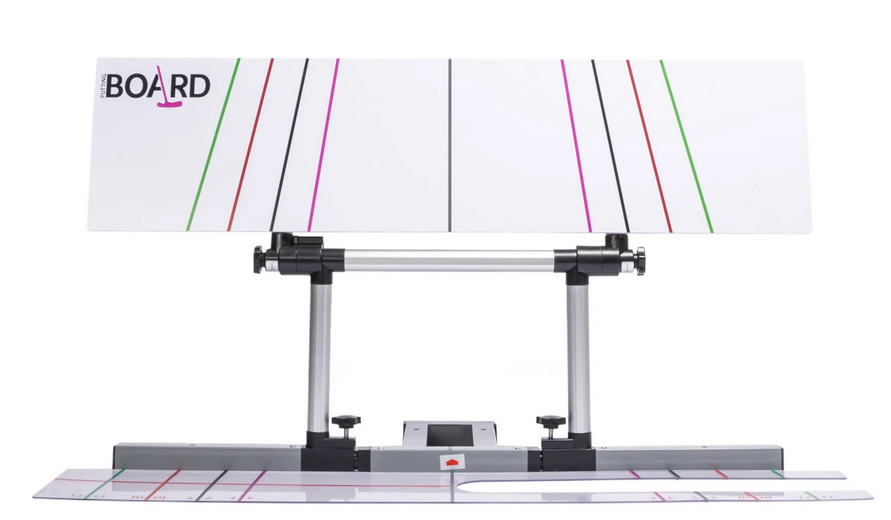
As you can see, The Putting Board is a straight line, with the ability to be set up at multiple lie angles to properly accommodate your putter. Through the four touch-point attachment, the idea is to move the putter back and forth on The Putting Board’s surface, keeping your putter “on-plane.” The club moves straight back and straight forward on the straight plane of The Putting Board.
The straight back, straight through folks may be prematurely celebrating, because the second piece of The Putting Board shows the corresponding face angle of the club as it moves straight back on the Board’s plane.

Note in the picture, the putter head, despite maintaining all four touch points on a dead straight plane, actually arcs – moving more inward as it moves backwards. The face also slightly opens as the club moves backwards on this straight line. Rather than an intentional turning of the face (which is impossible due to the four touch-points, the face is naturally opening due to the physics of swinging on plane.
Both camps are correct and The Putting Board teaches a player through muscle memory and repetition something that is very hard to explain in words: the putter should move straight back and straight through WHILE ALSO moving on an arc with the putter face opening and closing, simultaneously.
While that is hard to explain, it is incredibly easy to put into action with The Putting Board, and within a couple of swings, The Putting Board immediately reconciled the physical difference between these two schools of thought. I thought I knew how to putt before using this device; but now I actually know how to putt. Without words, I now understand the theory in a way that would have been impossible for me to feel without The Putting Board.
I have long been an advocate in my personal game for a slight amount of opening and closing of the face with the putter, as well as a bit of arc. I swear by Phil Kenyon’s Visio Golf Putting Template, which has become a mainstay on the practice greens on TOUR. I was happy to see that The Putting Board’s arc matched up perfectly with my Visio Golf Putting Template.
The Putting Board is now a mainstay in my arsenal of training aids. I envision it being my main indoor training aid for the foreseeable future. I am also not one that changes my training aids often. As a competitive golfer, I typically only make changes if I believe in long-term use of the training aid. I have for many, many years now used Dave Pelz’ Putting Tutor Triangle, Dave Pelz’ Putting Clips, as well as the Visio Golf Putting Template. The Putting Board will be a mainstay in my practice routine for years to come.
Although I have been glowing about it, I actually see The Putting Board less as something I’d use to grind out countless putts and more as a tool for building awareness and feel. It’s great for establishing a consistent stroke, with 20 to 30 putts a day hitting the ideal range. However, using The Putting Board requires you to apply an unusual pressure on the putter, as you need to push backward to keep it on the Board. The Board provides resistance to keep the putter on plane. However, when I switch back to putting without the Board, I find myself wanting to pull the putter too far inside and strike the ball on the toe due to that backwards pressure habit. It’s a bit like leaning back in an unlocked office chair after you’ve gotten used to it being locked—the support is suddenly gone. Because of this, I don’t think it’s ideal for building muscle memory through mindless repetition. Instead, it’s a valuable teaching tool to use intermittently in practice to help develop and maintain a consistent feel and as a checkpoint for any new feel.
I have some general musings about The Putting Board that I think are important to cover, both good and bad:
- The Putting Board can be used with other training aids. I have used it with all three of my mainstays and it works just fine, if I am trying to work on more than one thing.
- The Putting Board has a lie-angle dial on the back of the board which I found pretty tricky to use and inaccurate. I have a digital level (for aim-point green reading purposes) and the lie-angle listed on my Putting Board was not accurate – it is around 2 or 3 degrees off. I currently have a 70-degree lie angle putter and have to use the board on its 67-degree setting for it to be correct. This would have been a touch difficult to accurately compensate for if I did not have my digital level that can calculate angle.
- The Putting Board advertises itself being a tool to also use wedges with. I’m not sure I see the value in this, unless you have a golf simulator in your home. The Putting Board is kind of large, and not something I would feel comfortable using out on a public practice putting green. I view it as something to be used indoor with a putting mat rather than outside. However, if you have a Hummer or Cybertruck and aren’t easily embarrassed by looking a bit strange, perhaps The Putting Board may work for you in an outdoor environment. I view my Visio Putting Template as something for the practice green, and my Putting Board as something for the putting mat in my garage.
- The Putting Board was easy to put together, but I am not in love with the fastening mechanism, which consists of tightening multiple knobs to set it up. I’d imagine whenever The Putting Board v2 is developed, these knobs may be the first thing to go.
Overall, The Putting Board will make a fantastic addition to your ever growing arsenal of training aids, and may become a foundational tool for your progress. For the price, I’d recommend it for serious golfers. I would also thoroughly recommend it for any teacher who teaches students of any skill level.
Note: This is not a paid advertisement and no links to The Putting Board are affiliate links.

Author: Kyle Taylor
Kyle is the lead course reviewer at The Course Review & Journal. Kyle has been playing golf for over twenty years, is a plus handicap, and actively competes in USGA and State Golf Association events. By trade, Kyle is an attorney.
Kyle Taylor is a pseudonym used by CR&J’s lead course reviewer to protect personal relationships. The reviews and opinions remain entirely the writer’s own.
Leave a Reply
You must be logged in to post a comment.