
Time to Read:
|
This Gamble Sands review is based on a round played in 2026.
Gamble Sands is a public course in Brewster, WA.
CR&J’s Final Rating: 64/80 (Best in State)
Golf course architecture reviews have always had an uncomfortable relationship with the natural features that surround a golf course. Reviewers, panelists, resort guests, and new golfers alike – we all have to admit that it is quite difficult for us to separate our opinions of a golf course and its natural setting. The strongest example of this is oceanside courses. What would be thought of Cypress Point, Pebble Beach, or Fishers Island if they were set on uninteresting, flat land? What would my personal opinion of some of my favorite courses, like Cabot St. Lucia’s Point Hardy, be without the ocean cliffs on seemingly every shot?
The relationship is uncomfortable because it forces us to admit that something beyond the design of the golf course is moving us to enjoy a course. For regular golfers, that admission comes easy. Who doesn’t want to be by the ocean? But for those interested in golf architecture? That’s much more difficult to admit; that setting matters, perhaps even disproportionately.
Not all inland courses are at a disadvantage to seaside courses, because there are plenty of different natural settings of which to take advantage. Perhaps in the mountains (like Diamond Creek) or near a major river or lake (like our recently reviewed Turtle Point). One course we reviewed last year (and raved about) was the Course at Wente Vineyards, which was as much about the backdrop of the course as it was the actual golf.
It would be foolish to say that we golf architecture nerds are somehow so enlightened as to be able to ignore the crashing waves of the Pacific and focus on a particular bunker’s placement in relation to a fairway. Setting matters, probably more than it should. More importantly, on courses that do have a landscape advantage, how an architect features the natural surroundings is paramount. Quite honestly, from a business perspective, designing interesting holes that take maximum advantage of the natural flashpoints to provide picture-worthy moments is a chief objective of the architect. Investors in these properties need those flashpoints to sell rounds, properties, memberships, and the like.
The David McLay Kidd-designed Gamble Sands is another exercise in attempting to separate, or at least accurately attribute, setting from design. The Sands course opened to rave reviews in 2014, earning Golf Digest’s best new course of 2014. Golf Digest, in that article, largely described Gamble Sands as not being a championship test of golf, but rather, a user-friendly course that was heralded as a “celebration of fun.”
Yet, that celebration of fun finished on a list not normally known for its celebration of fun: the Top-200 golf courses in America. Rather, that list is typically reserved for what panelists view as the best in golf architecture, and most all the courses in the Top 200 are legitimate championship tests. Gamble Sands currently sits at its all-time high on Golf Digest’s Top-200 list at #178, in the Top-30 of public courses, and as third best in Washington. Top100GolfCourses.com goes even further, ranking Gamble Sands as the best course in Washington; number one.
So, what gives? I’ll tell you what gives: setting.
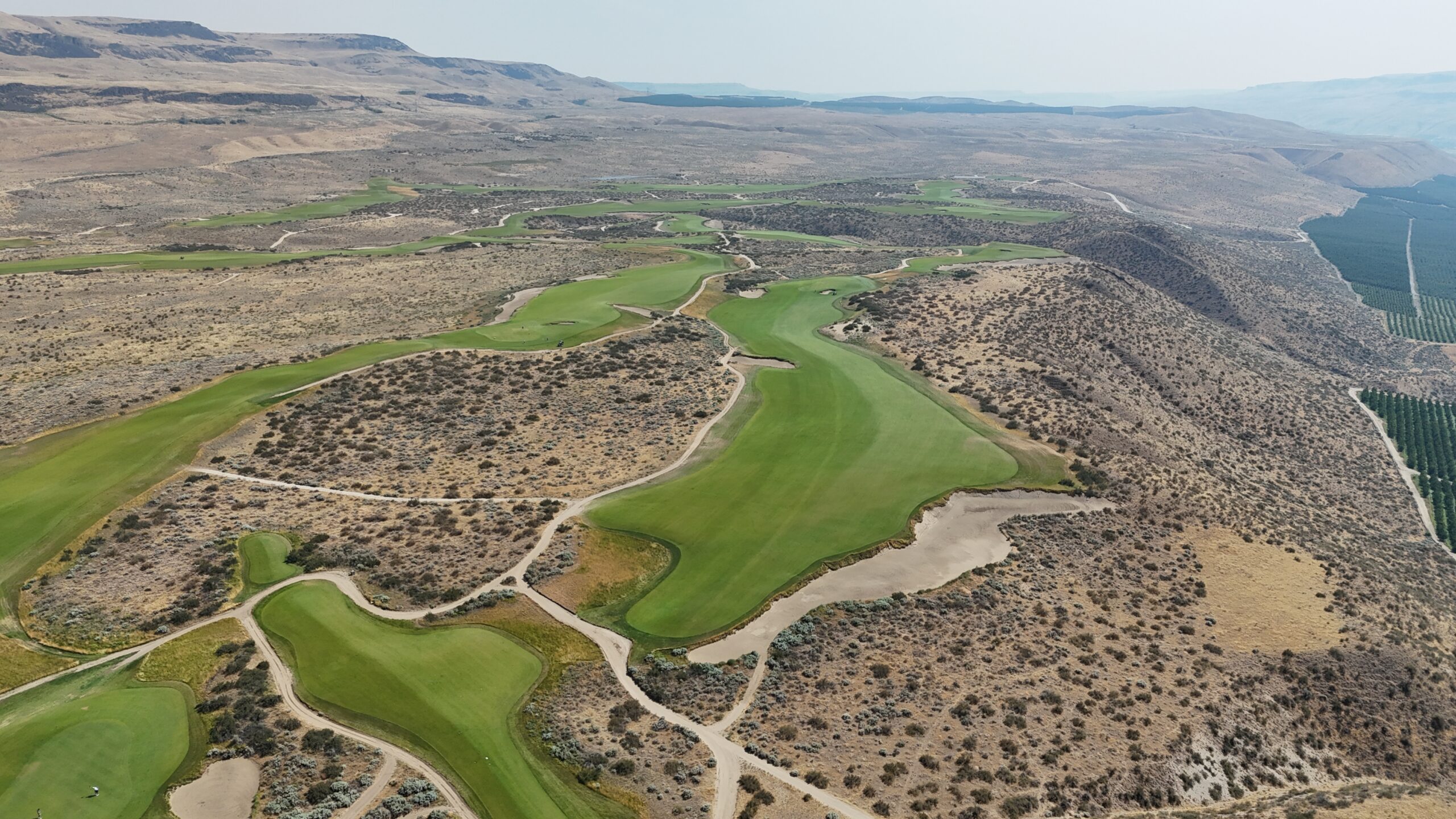
Unless you’re from eastern Washington or northern California wine country, the backdrop at Gamble Sands is incredibly unique and beautiful. From a place of ignorance, I think myself, and many others, perceive Washington state as being rainy and cloudy, but that is not the climate at all in central and eastern Washington. This part of Washington isn’t the rainy Pacific Northwest most people imagine; it’s shrub-steppe, closer to desert.
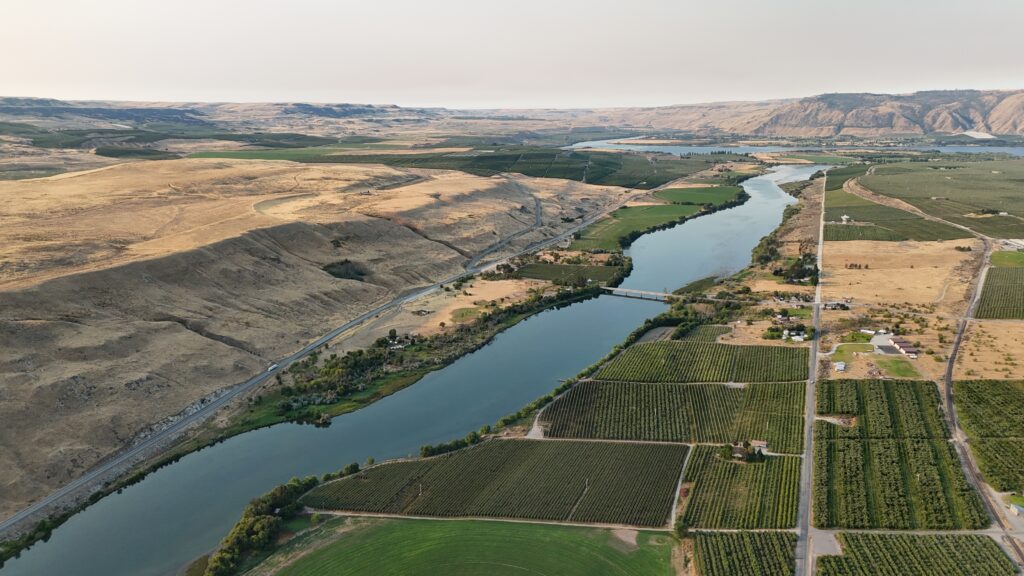
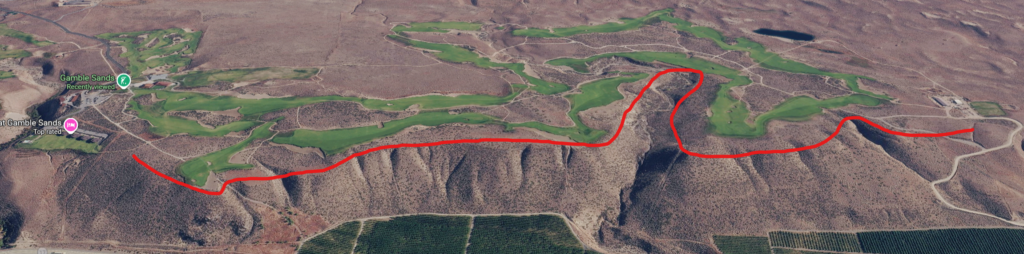
The area that Gamble Sands inhabits is on Gebbers’ fruit farms, at the intersection of the Columbia River basin, Lake Pateros, and the mountainous regions surrounding the river. Somehow, the course was also blessed with an additional ridgeline that lifts the property a few hundred feet above the basin, providing panoramic views for the first five holes. From there, the mountains and canyons take over as the visual anchors.
There are a two specific features convinced me that David McLay Kidd was more concerned with featuring the views rather than designing the most challenging or strategically sophisticated golf course the land could provide. First is the repeated use of blindness, which is a personal distaste of mine, particularly on a resort course. Many guests will not know the holes or be playing with a member or anyone with local knowledge. Complete blindness makes a shot tougher to play under these circumstances than at a club, where a guest will be hosted by a member, or at a cheap public course. Second, much of the online commentary about the best holes at Gamble Sands frames them primarily by their external views rather than by internal strategy or architectural quality.
That’s an interesting way to discuss a Top-200 course: easy, user-friendly, scenic, setting-forward, and a lot of blindness. But every discussion of Gamble Sands has to start there and then work back toward what is good.
The First Tee
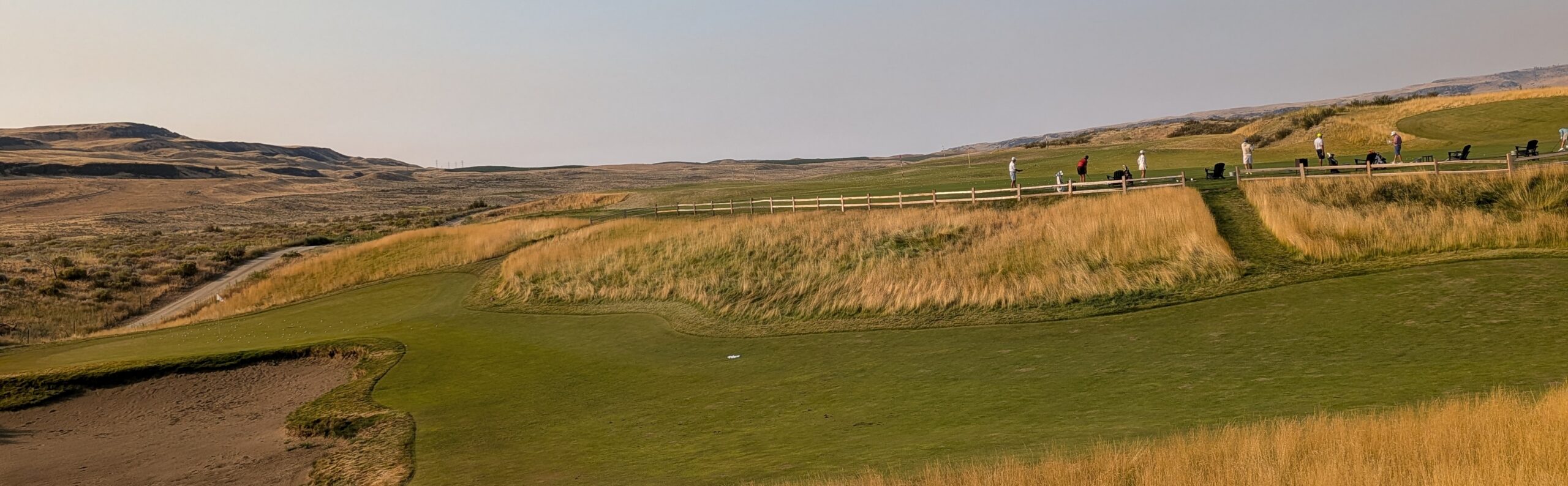
Before we get to the first tee, I have to do some light complaining. Gamble Sands is a Top-200 course that has a public green fee of well over $300. Yet, here I was hitting range balls from a mat in the middle of the summer. That is particularly unacceptable for this caliber of course. The course is also fescue, which is uncommon in the U.S. It would have been nice to hit a few shots off of the tight fescue. The practice area at Gamble Sands was fine, but the range is extremely substandard for this caliber of resort. Gamble Sands, please ditch the range mats. If y’all need to raise the greens fee from $330 to $345 to cover a range renovation, so be it, but hitting off a mat in July is unacceptable.
The first hole is a dogleg left par-4 that features blindness on both shots, particularly from the back tee box, which is more-or-less positioned on the practice putting green. This hole has some interesting strategy that pretty quickly introduces you to all of the design concepts quickly here at Gamble Sands.
First, as mentioned, the tee-shot is partially obscured. The fairway is very wide, but from the back tee, most of what you can see of the landing area consists of the bunker on the right. But in reality, the first fairway, like all the fairways here at Gamble Sands, is very wide. Laying up behind the bunkers means the fairway is around 80-yards wide. Beware, because the bunker on the left of the fairway is pitched upwards on the interior of the dogleg, which leaves a player two options from the tee.
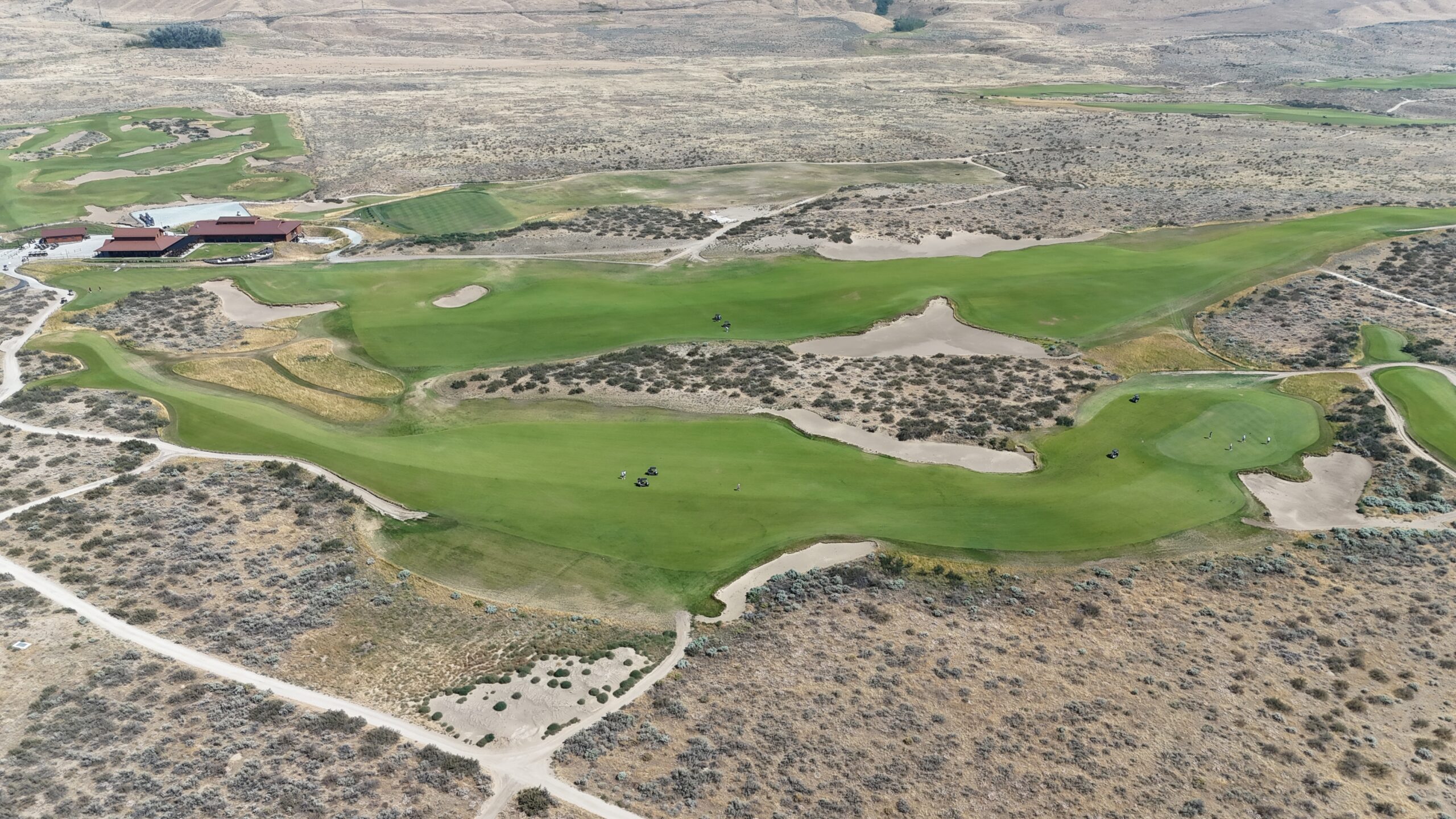
Going to the right side of the fairway will leave a much longer approach, playing the long way around the dogleg left. However, playing up the left side will leave a completely blind, but shorter approach. What neither side can see is that the large green has a huge amount of bailout room left. There is also an encroaching waste bunker on the right, hugging up tight to the front right of the green.
I didn’t particularly care for the first hole because of this blindness issue. Again – it is a resort course, with no caddie. I had a very difficult time figuring out where to aim on both shots. Perhaps the second time through, it would be easy. But the first time through, I found it a bit frustrating.
The second is arguably the signature hole at Gamble Sands; a short, downhill par-4. The fairway here is again very wide, and the long, angular green is tucked on the left side of the hole surrounded by waste bunker.
Reading Billy Satterfield’s review on GolfCourseGuru’s, Satterfield commented that the signature hole was great because “anyone with a camera is going to bust it out” and “boasts the best vistas on the property with the Columbia River acting as an inspiring backdrop.” Yet architecturally, the hole is a remarkably simple, short par-4. Satterfield’s review is a representative example of the setting-forward evaluation that Gamble Sands receives. The setting is what makes it a signature hole, not the design.
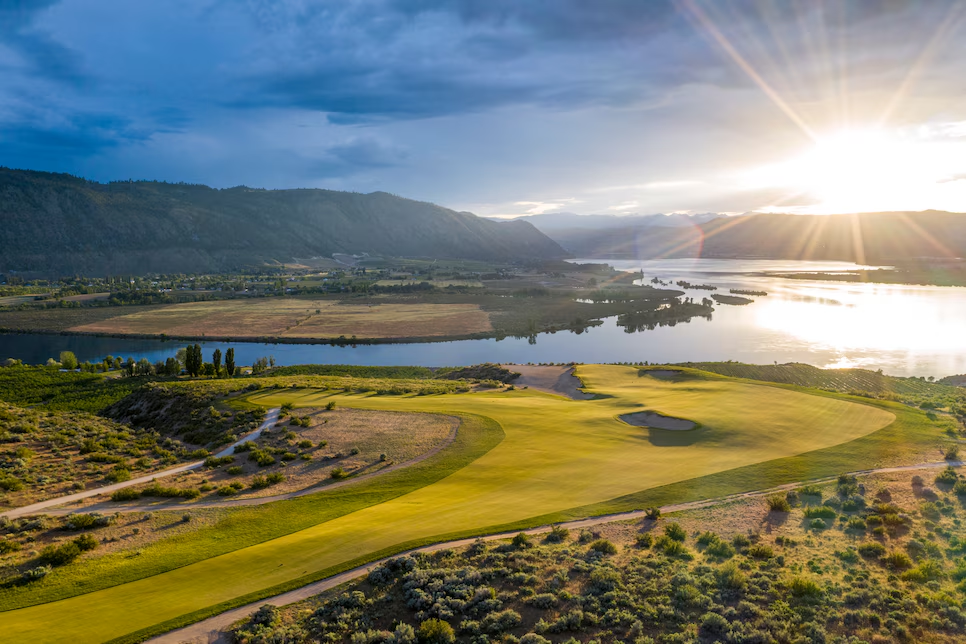
Players face two options: layup in front of the cross bunker that sits around 255 yards from the back tee. Or, drive the ball into the very wide area right of the green over the cross bunker, which is around 275 yards to carry. While the second provides an incredible view of the Columbia River basin, sitting atop the aforementioned ridgeline, the hole is just architecturally sufficient and simple.
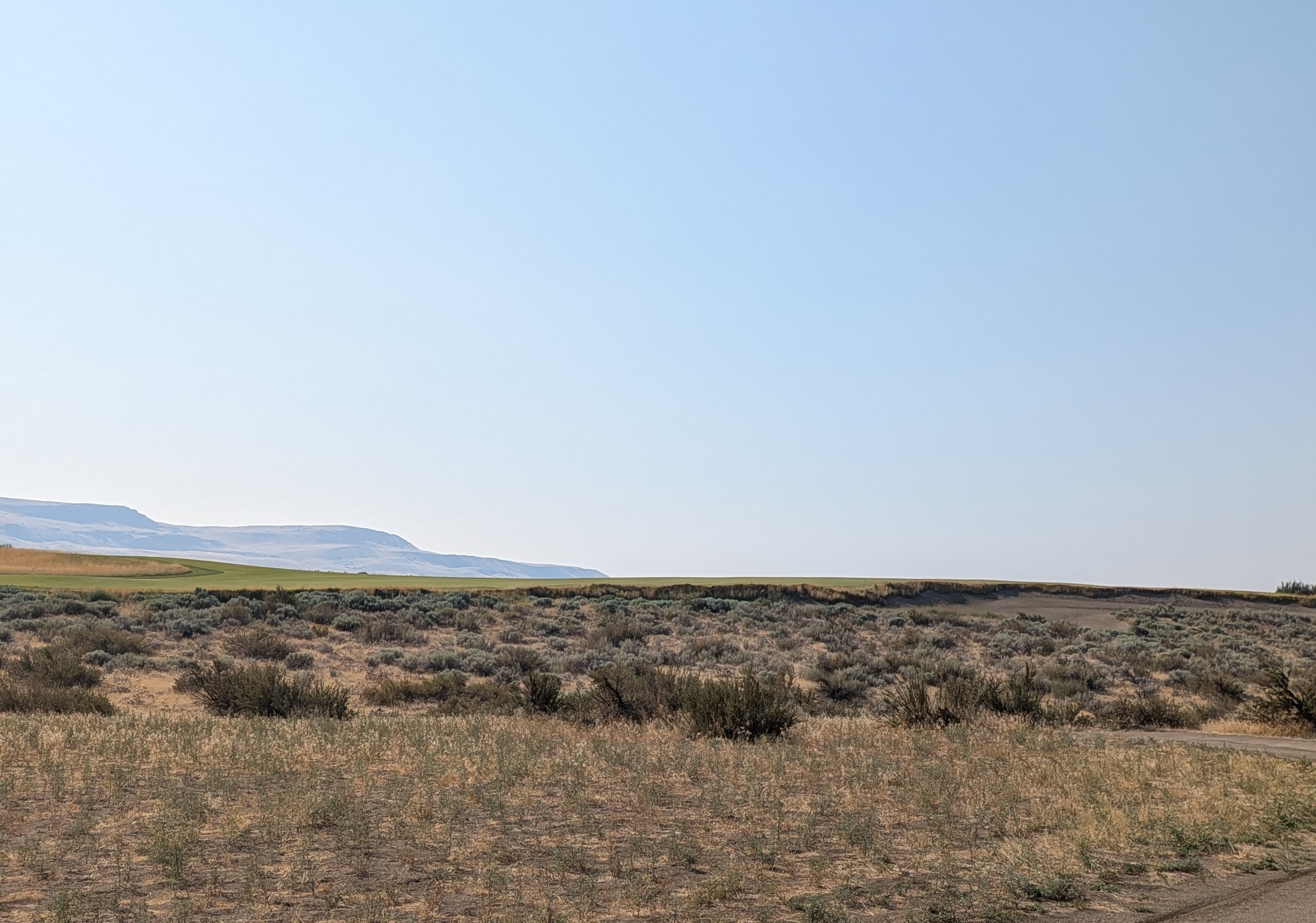
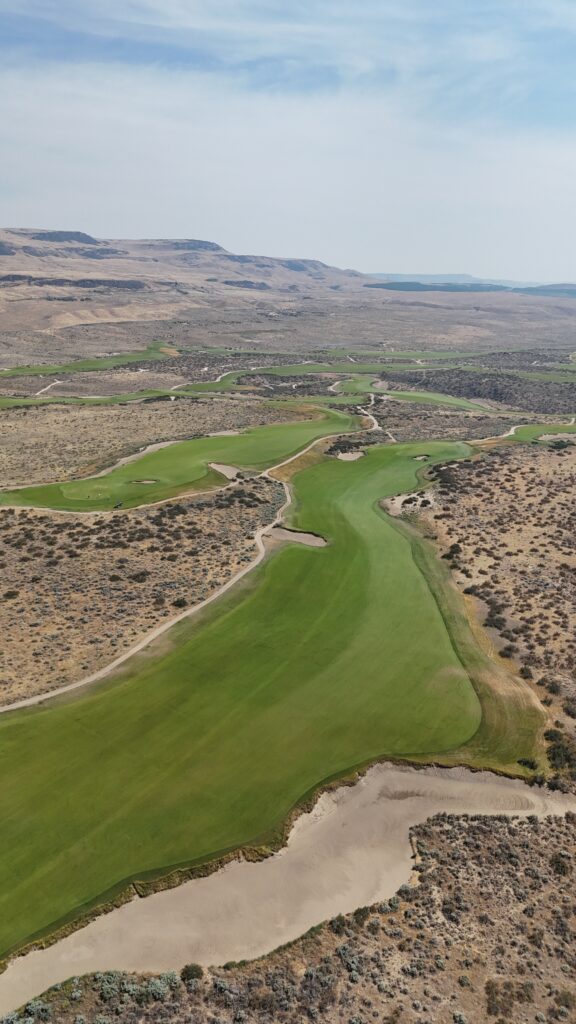
The third hole was likely my least favorite hole on the course, this time a par-5 playing over an inlet in the ridgeline. Significantly uphill on the tee shot and over a waste bunker built into the ridgeline, the tee shot is completely blind. We simply had no clue where to aim. There is a post in the ground on the ridgeline, but it was a bit left of the ideal line from the back tee we would find. Fortunately the fairway is quite wide, but picking a target here without a caddy is a pure shot in the dark.
The blindness is not over. Once the fairway is found on the long par-5, the green cannot accurately be located either, as the hole bends a bit to the right in the last 100-yards, and the green is tucked behind some mounding on the right. That mounding obscures the view from the right side of the fairway, while the close left bunker obscures the view from the left.
Basically, you’ll hit two shots here with no idea where to aim. Not my idea of celebrating fun, considering my first two shots of the day were also blind or partially obscured. For those that are keeping count, I had four blind shots in my first seven full swings.
Other than the blindness, the hole is simple; just wide and long. However, a sneaky, deep, very thin bunker sits right of the green, and should be avoided at all costs. The first three holes were not my favorite. At this point, the chatter in our cart turned to whether Gamble Sands was overrated. We simply weren’t seeing it yet. Because it was beautiful, but the golf so far had been mediocre.
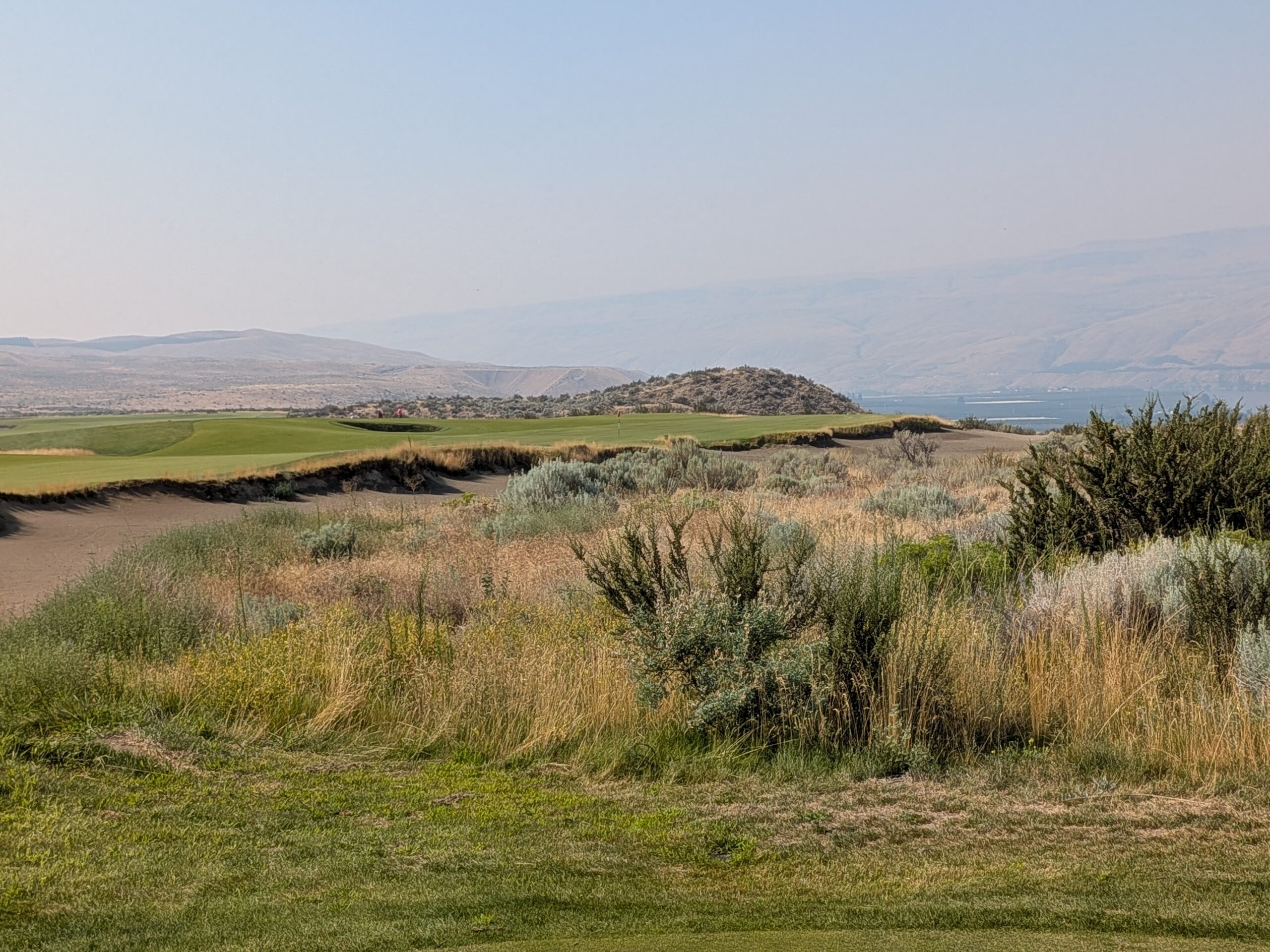
The fourth hole, however, is a legitimately great par-3. The shorter par-3 presents multiple ways to play, and hangs just above the ridgeline. Left of the green, a few knobs and ridges exist that will kick the ball down towards the green, and the green is heavily sloped from back to front. This gives the hole a mini-redan function, with the ability to bounce the ball in from the left. The green is slightly boomerang shaped from left to right.
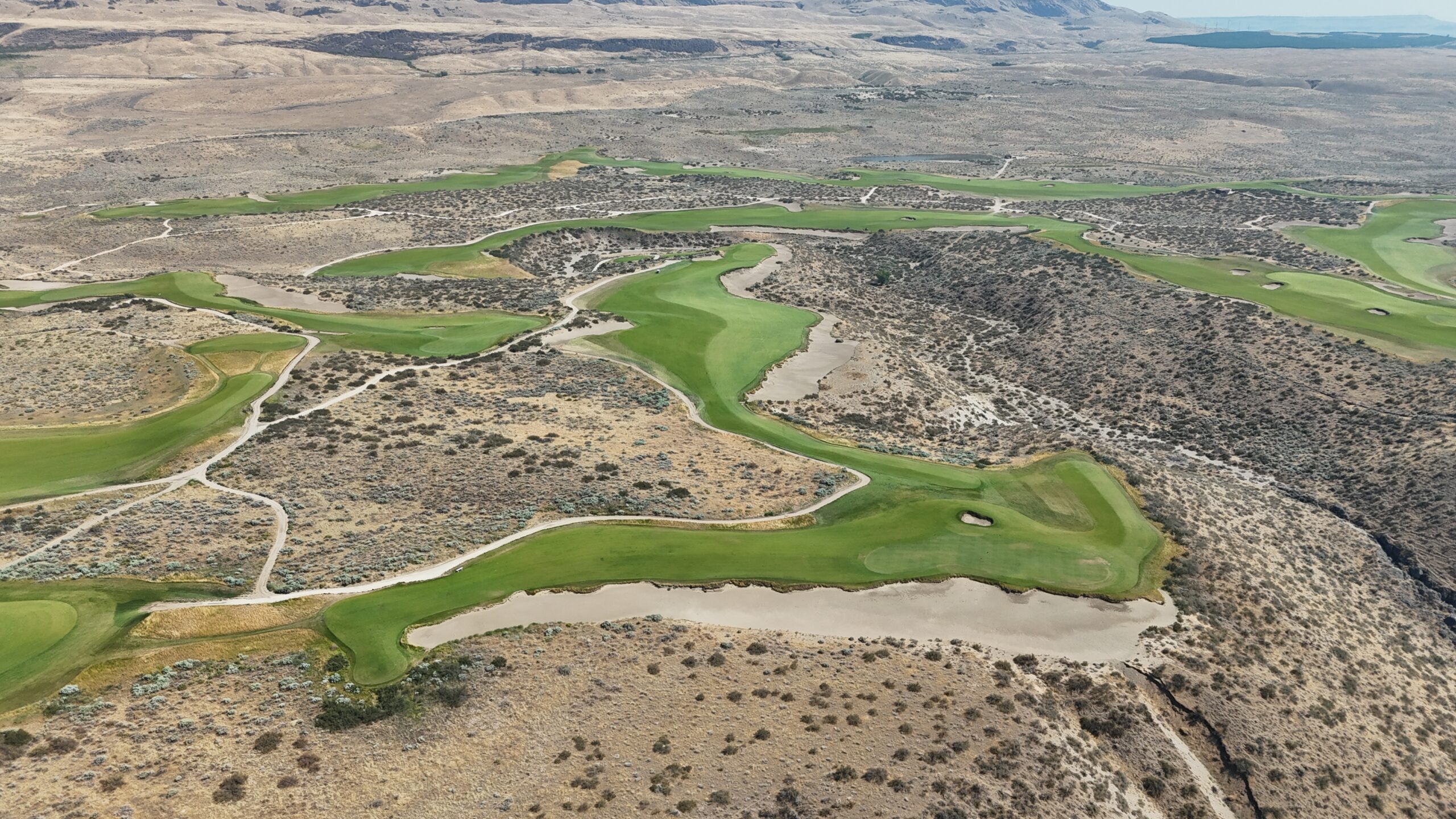
That mini-redan is a bit interrupted however, due to a deep bunker bored into a slope behind the green to the left that is to be avoided. The fourth is a well designed and fun par-3 with plenty of shot options and a great view to complement.
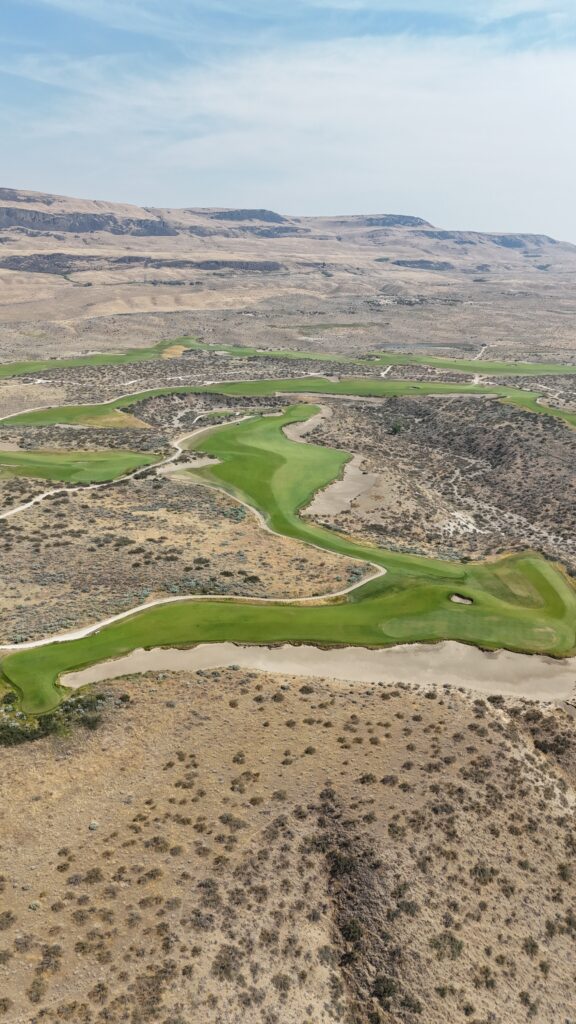
The fifth hole is a bit more of the first and third. The par-4 on paper is very long, but plays directly downhill into one of the widest fairways on the property. The view from the tee back towards the mountains is incredible.
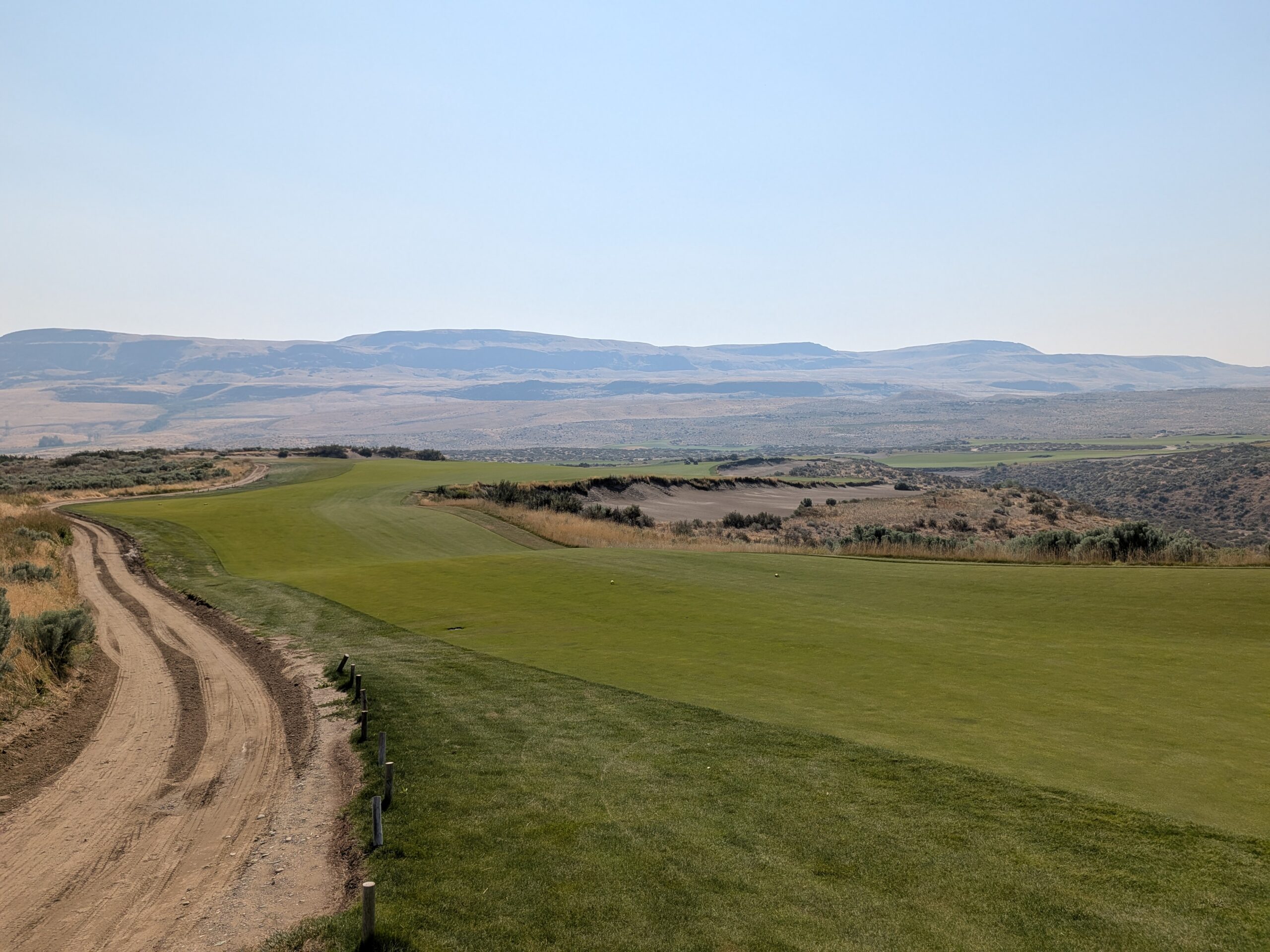
But the view of the golf hole is limited, as the fairway waterfalls down the ridge before coming back up to the green, leaving the drive completely blind to the landing area. The fairway is massively bifurcated by a ridge that runs directly through the fairway, and most balls will kick extremely hard to the right; down to the end of the fairway or first cut of rough.
From down there, the green is back up on top of the ridge, and again, completely and totally blind, further obscured by the large, encroaching fairway waste bunker; so blind we had to drive up to find the green. Perhaps from the left side it is not blind, but I’d struggle to imagine that many balls stay on the left side of this fairway on the high side of the ridge, especially when considering that all of this is completely invisible from the tee.
At what point is complete blindness too much? Because here, if you are keeping count, we’ve hit ten full shots, of which six were completely or mostly blind to the landing area.
Fortunately, again, the green is very large which means that the blindness isn’t disproportionately difficult. One of my main criticisms of the thirteenth hole at Streamsong Red is how penal the hazards surround the green were, considering that all of them were blind hazards.
“As you can see here, the green is heavily fortified. What you can’t see, is the depth of the fortification. Normally, I am perfectly fine with a deep bunker surrounding a green, but here, the entire back of the green is protected by a cavernous bunker – I’d estimate 12-15 feet deep in spots. And its completely blind to the approach. The water? Blind to the approach. The landing area right? Blind to the approach. I am fine with all of these elements in solitude. But a deep bunker or water protecting a blind green feels purposefully tricky, and a test not of the player’s skill, but of the caddie’s ability to convey danger.” – Regarding the thirteenth green at Streamsong Red.
The situation here at the fifth at Gamble Sands is better. The green is large, there is no water, and the ribbon shaped waste bunker surrounding the green is not impossibly deep.
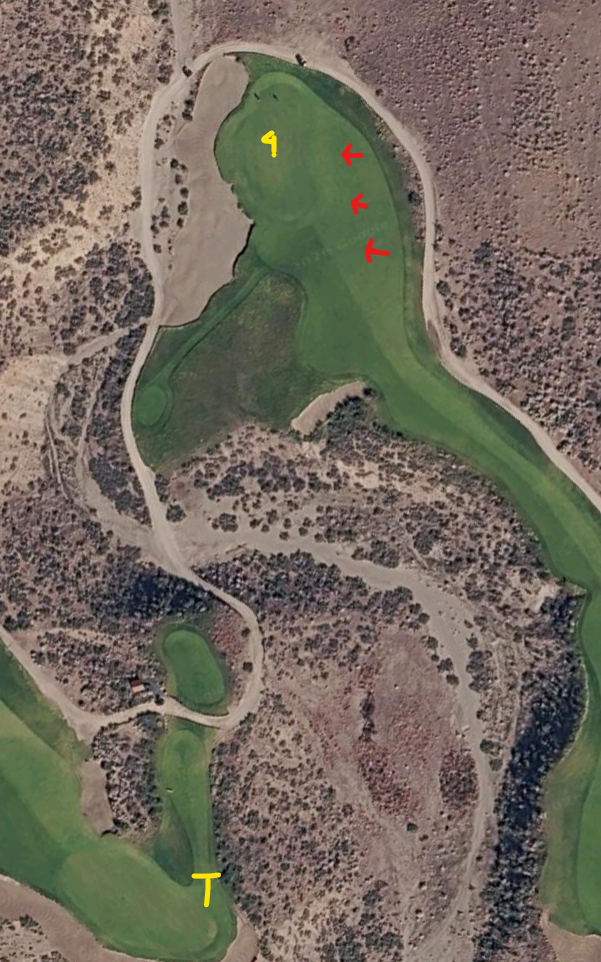
The sixth hole is a very long, downhill par-3 that is a bit hard to decipher from the tee. The green on the sixth is huge, and from the right, the adjoining seventh tee box ribbon is severely sloped right to left. Any tee shot wiped right has a decent chance of finding the putting surface, creating another redan-effect, this time from right-to-left. However, this isn’t a traditional redan because there is no frontal hazard; only a waste bunker that wraps around the left side of the green.
As an aside, and I realize this affects few people, but the furthest back tees are basically on the fifth putting green – a genuine hazard. The pin on the day we played was back left on the fifth, and we teed off on the sixth (from 250+ yards) about 7 yards away from the pin on five. Remember, this shot is completely blind to the fifth fairway. They should probably not use the furthest back tee on the sixth when the pin is back-left on the fifth.
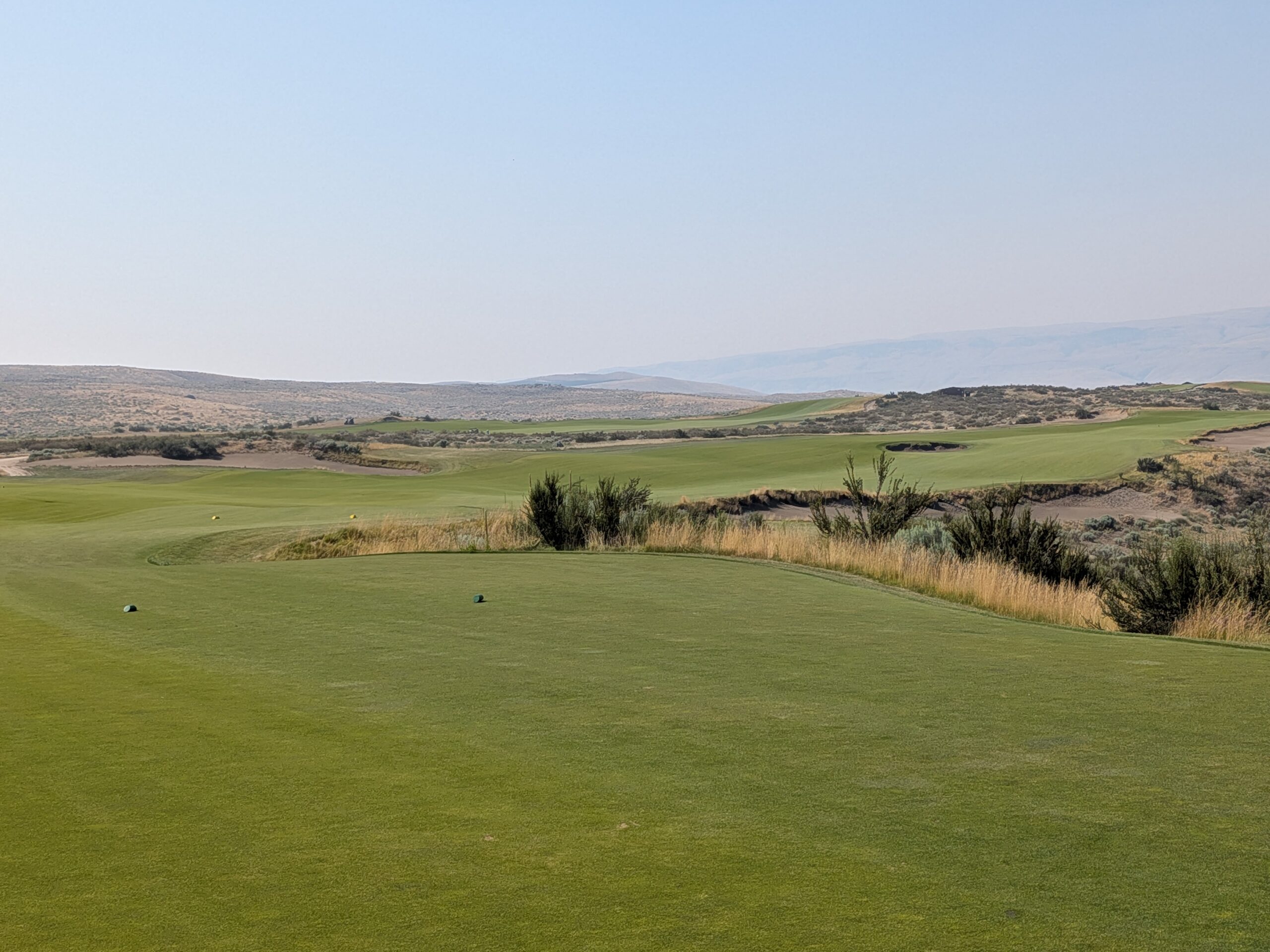
Then we move to the last three holes of the front, which is a real scorable stretch on this nine. The seventh is a reachable, risk-reward par-5, but that reachability depends on how much risk a player decides to take off the tee.
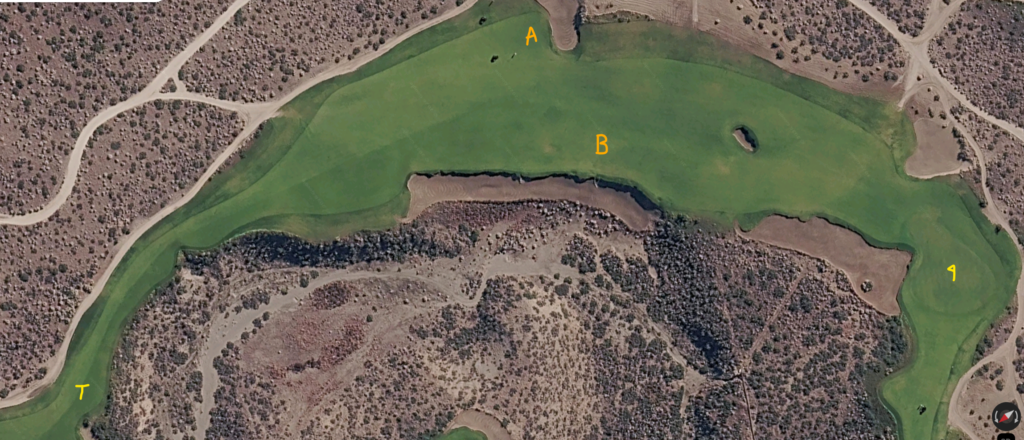
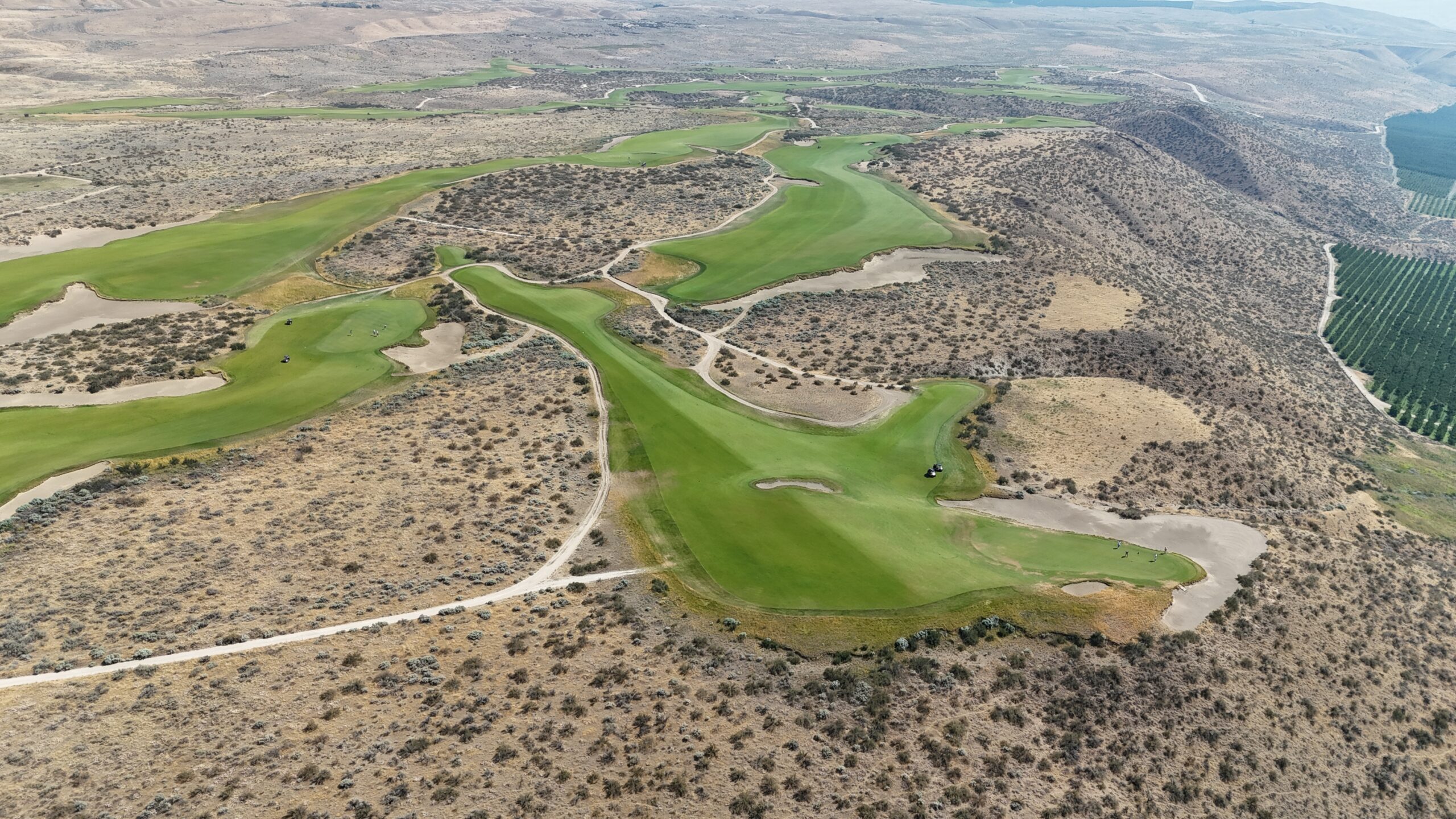
Both of these spots (marked A and B) are around 300 yards from the furthest back tee, but spot A will make this hole effectively a three-shot hole, leaving around 250-yards uphill to the green. But option A is very low risk; nothing needs to be carried and the fairway is preposterously wide. Option B is only around 190 yards from the green, but requires a perfectly struck shot to carry as much of the waste bunker as possible. Drives in the waste bunker will be found, but anything short of the waste bunker will likely never be seen again by anything other than a rattlesnake or coyote. This makes Option B risky off the tee, and the boom-or-bust route, whereas Option A is almost an assured par or birdie with a good putt.
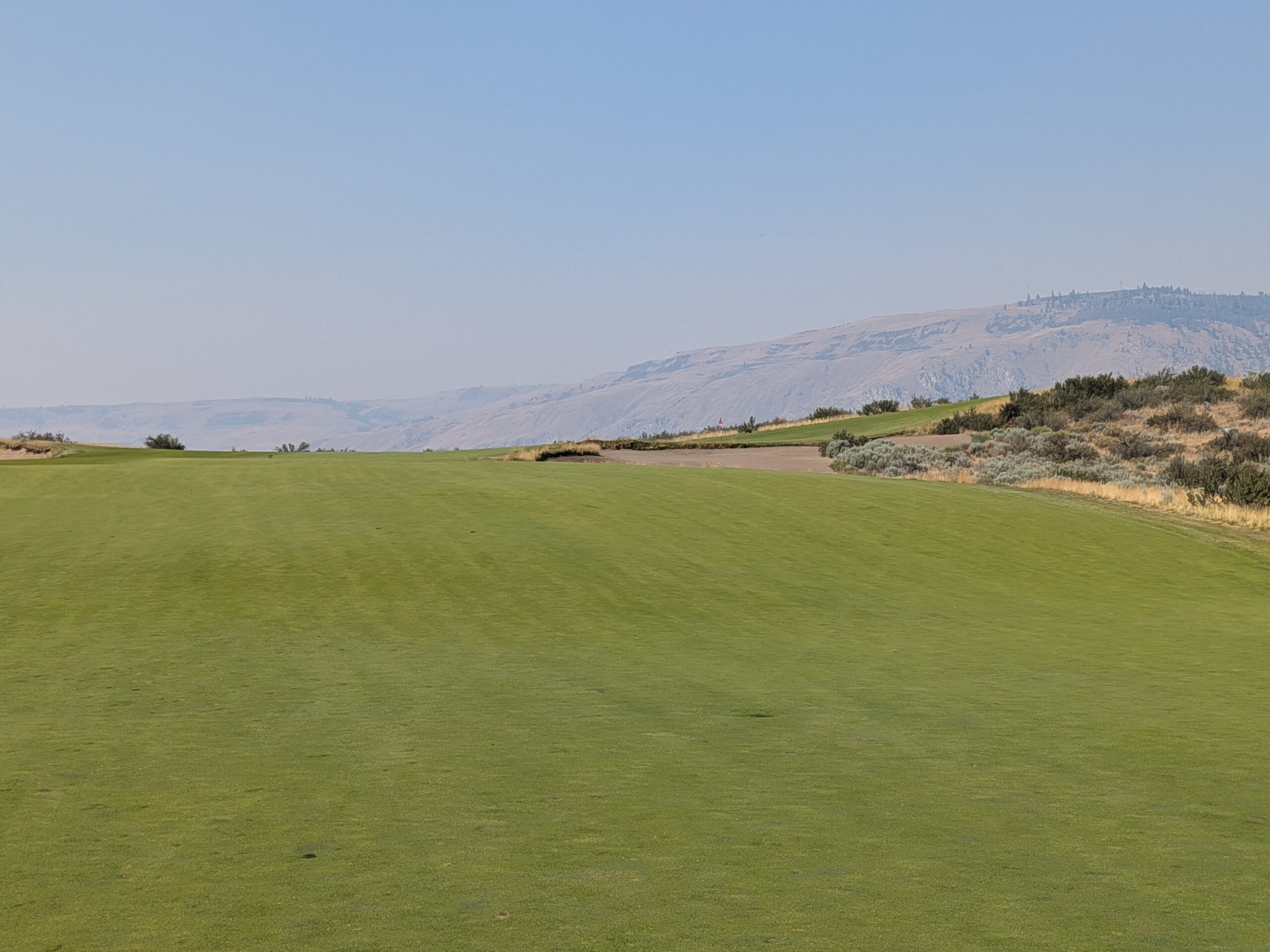
The trick here is that the “centerline” bunker, which is well out of reach, creates an illusion that the centerline bunker might be the aiming point. But, for safe players, that centerline bunker is some 80-yards right of the safe line. The green here is very, very large, particularly on the back section, and has another slope up to the next tee box ribbon that could be useful if you had a few extra shag balls and some time to kill.
David McLay Kidd must have decided that one hole in a row without complete and total blindness was enough for this front nine, and designed the eighth as a drivable par-4 with more blindness from the tee.
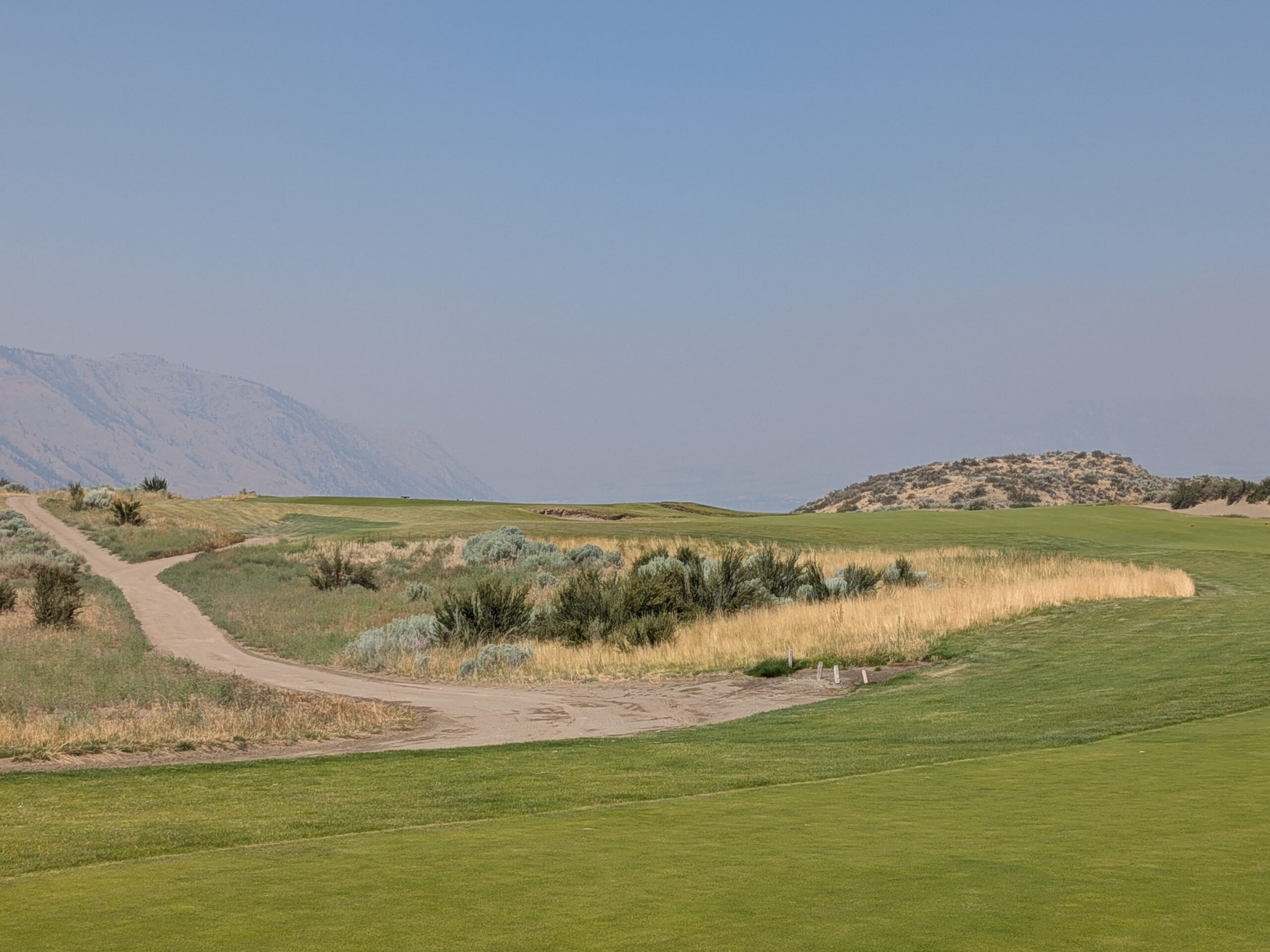
The eighth is a fun double fairway hole, with three centerline bunkers dividing the fairway into reasonably sized left and right halves. The green may be the simplest at Gamble Sands, just a long oval in otherwise fairway height fescue with no greenside bunkers. Every player should give this green a rip from the tee, as there is no legitimate hazard from which to shy away. The scorecard yardage from the very back is 313, meaning less than 300 to the front edge for all golfers.
The double fairway aspect is cool here, but the problem is, once again, you cannot see it! You’d better have known before you arrived, because the double fairway divided by the three bunkers is only a feature a player could ascertain from the aerial imagery. This is the seventh blind full shot on the front side.
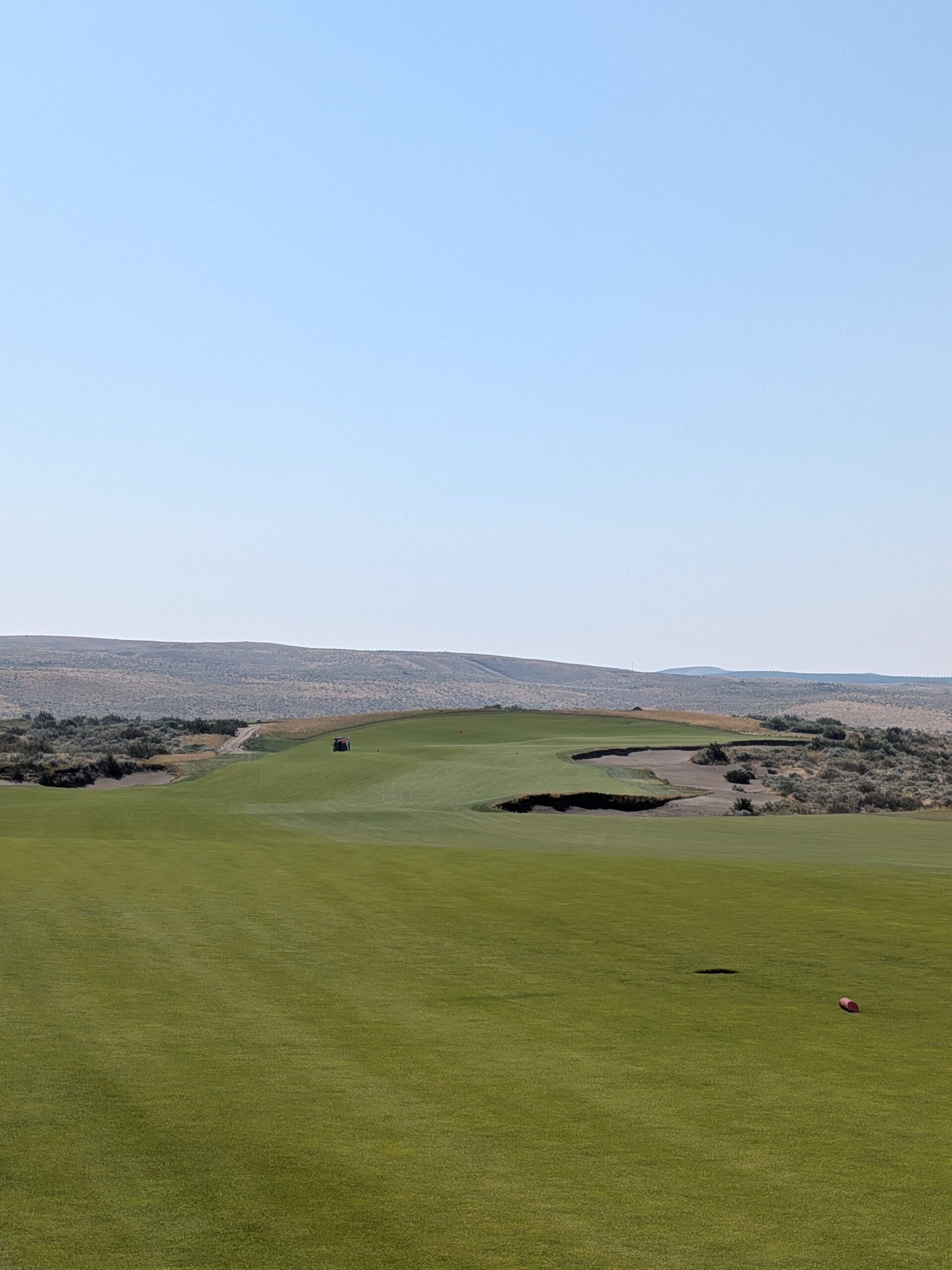
The ninth is very much like the fifth in that the mid-length par-4 goes downhill to the fairway, pitches right, and goes back uphill to the green surface. The fairway landing area is only partially obscured here; you can almost see the ball land. The otherwise wide fairway is pinched to be Gamble Sands’ most narrow landing area, around 40-yards wide. From there, the approach plays partially blind uphill, with the flagstick visible, but the green obscured by the uphill nature of the hole. The view behind the ninth of the steppe hillscape is very pretty, and as the ninth green and tenth tees are the furthest point of the property, no further development is visible for miles.
Making The Turn
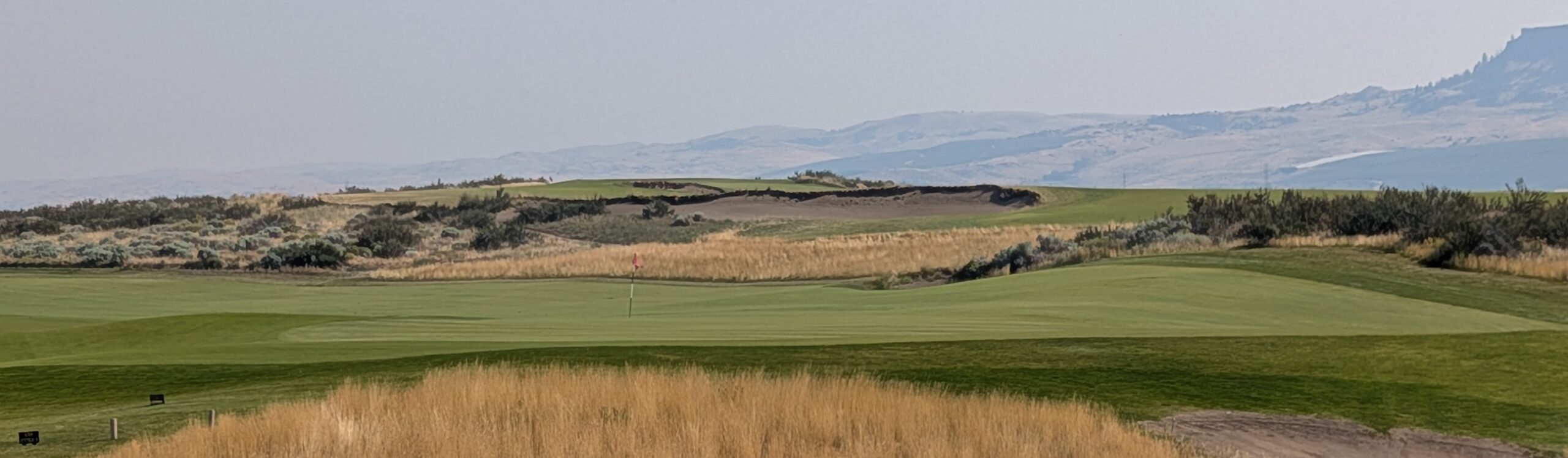
The tenth hole begins a stretch of holes that turn the tide a bit, and overall, the back nine is stronger than the front. The tenth is a short par-3 with a large green containing three distinct tongues sandwiched between bunkers left and right. On our date of play, we got the pin on the far right tongue, which appeared to be the best of the three with a slope behind the green that could be used to feed the ball back.
Also between the tenth and eleventh holes is Gamble Sands’ refreshment station, where I parted with $20 for two canned seltzers, as if the Super Bowl was being played on the eleventh tee box.
After a long walk back to the eleventh tee box, one of the best holes on the course is revealed: a mid-length par-4 with a small centerline bunker complicating the tee shot. The fairway here is sloped right-to-left, and there is more room left than right of the bunker. But on the firm and fast fescue, those choosing to take the route left of the bunker may want to hit less than driver to control the roll out. However, on the high side of the bunker, it is significantly flatter, and more narrow. Those choosing this route will get a forward kick, rather than a left one, meaning a much shorter approach.
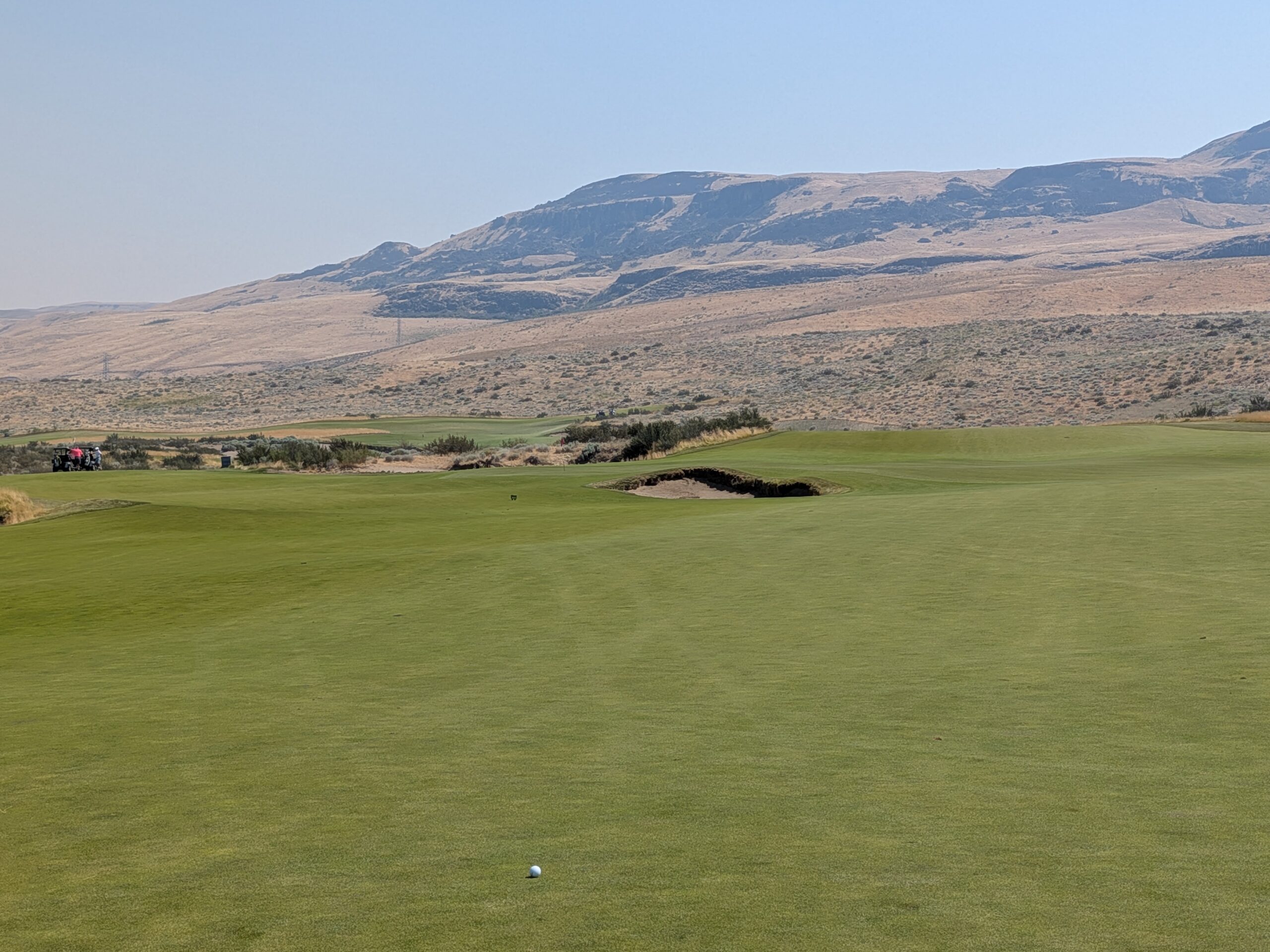
The approach has similar concepts. A centerline, lion’s mouth bunker protects the short middle of the otherwise large green, shaped like a goldfish swimming to the right, and surrounded by closely mown fescue. The greens at Gamble Sands thus far had been tame, but the next few had some significant undulation that gave them teeth. The goldfish’s tail, on the left side of the green, was significantly pitched from right to left, making recoveries difficult.
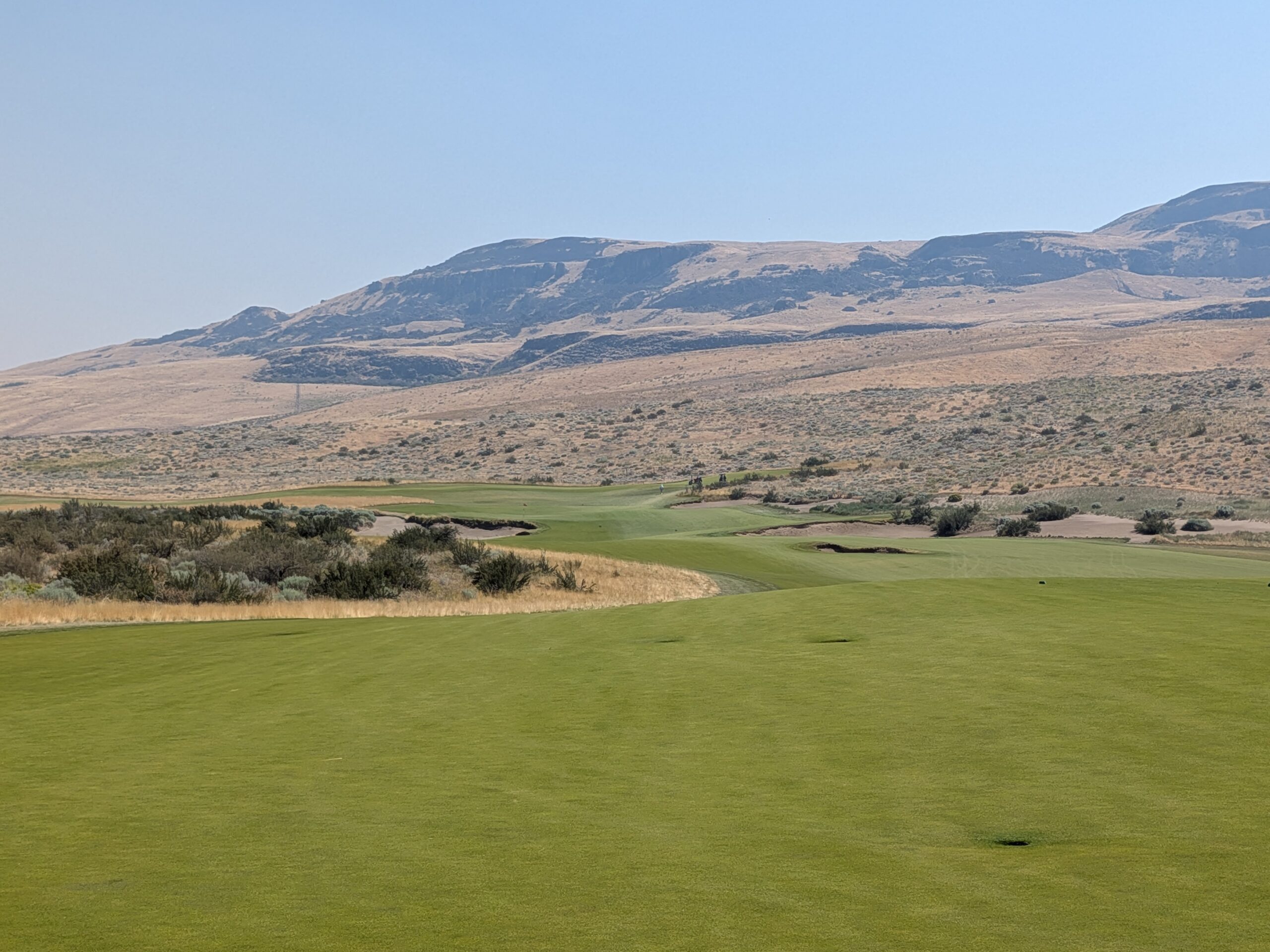
The twelfth is the third installment of the reachable par-4. This time, the hole gently works downhill, and then back uphill to the putting surface. The landing area for driver is signficantly pinched here by a bunker right and the greenside bunker left, both of which are encroaching waste bunkers. However, laying up doesn’t make much sense either, as a small centerline bunker is placed around 150-yards from the very long but narrow green, which complicates the layup from the tee, and adds a bit too much risk for me.
When choosing between being in a greenside bunker in one shot, or a pot bunker 150-yards out in one shot, I’m taking the greenside bunker every time. As mentioned, the putting green here is extremely large (62 yards long to be exact) and therefore has a bit of internal undulation, just due to the size. The view of the mountains on this hole might be the best view on the course.
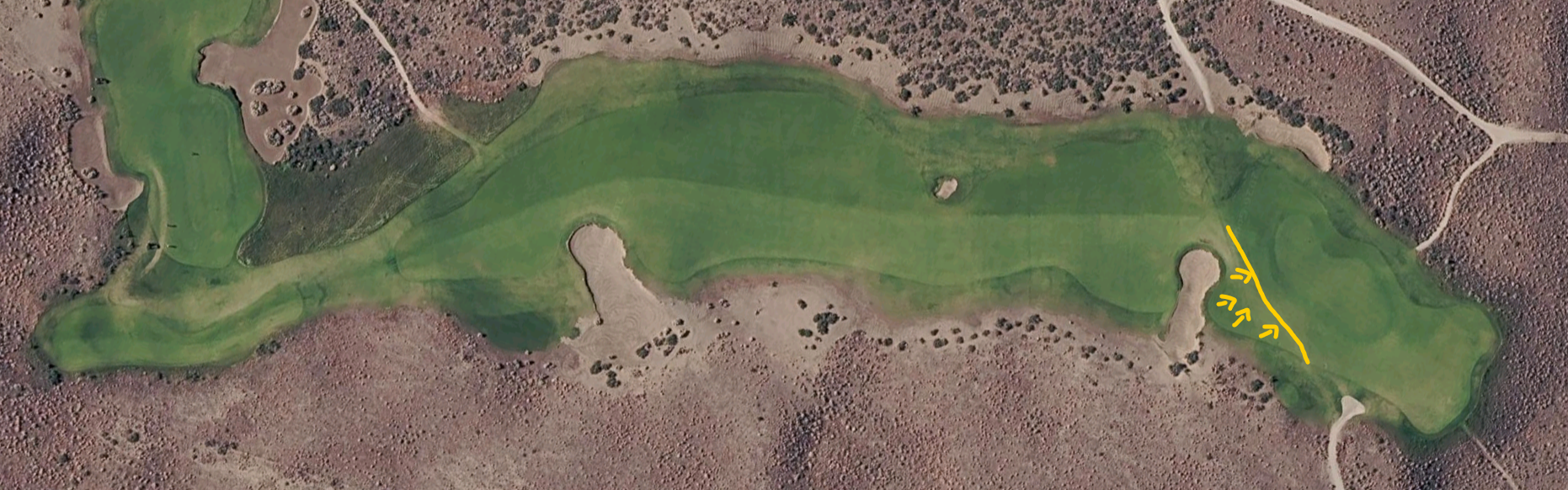
The thirteenth is the most interesting of the par-5 holes at Gamble Sands. From the tee, the hole is wide and gently doglegs around the encroaching circular waste bunker. Once in the fairway, a player has a choice to either go for the green or layup. But, I think in the celebration of fun, you have to go for it. The hole isn’t that long, and this green is a major funnel green, with all of the fairway right of the green working to kick the ball down on the large putting surface.
I like the fourteenth hole in theory, a mid-length par-4 with a double fairway. It is actually remarkably similar to the fourth hole at the Gil Hanse designed Streamsong Black, but this hole preceded that one. However, preceding them both is the similar eighth hole at the Riviera Country Club.
Basically the hole asks you to primarily play down one fairway, jump a hazard on the approach to the other side, where the fairway runs up to the green. It is almost a modern template hole, and I have played a variation at Mayacama, among other places.
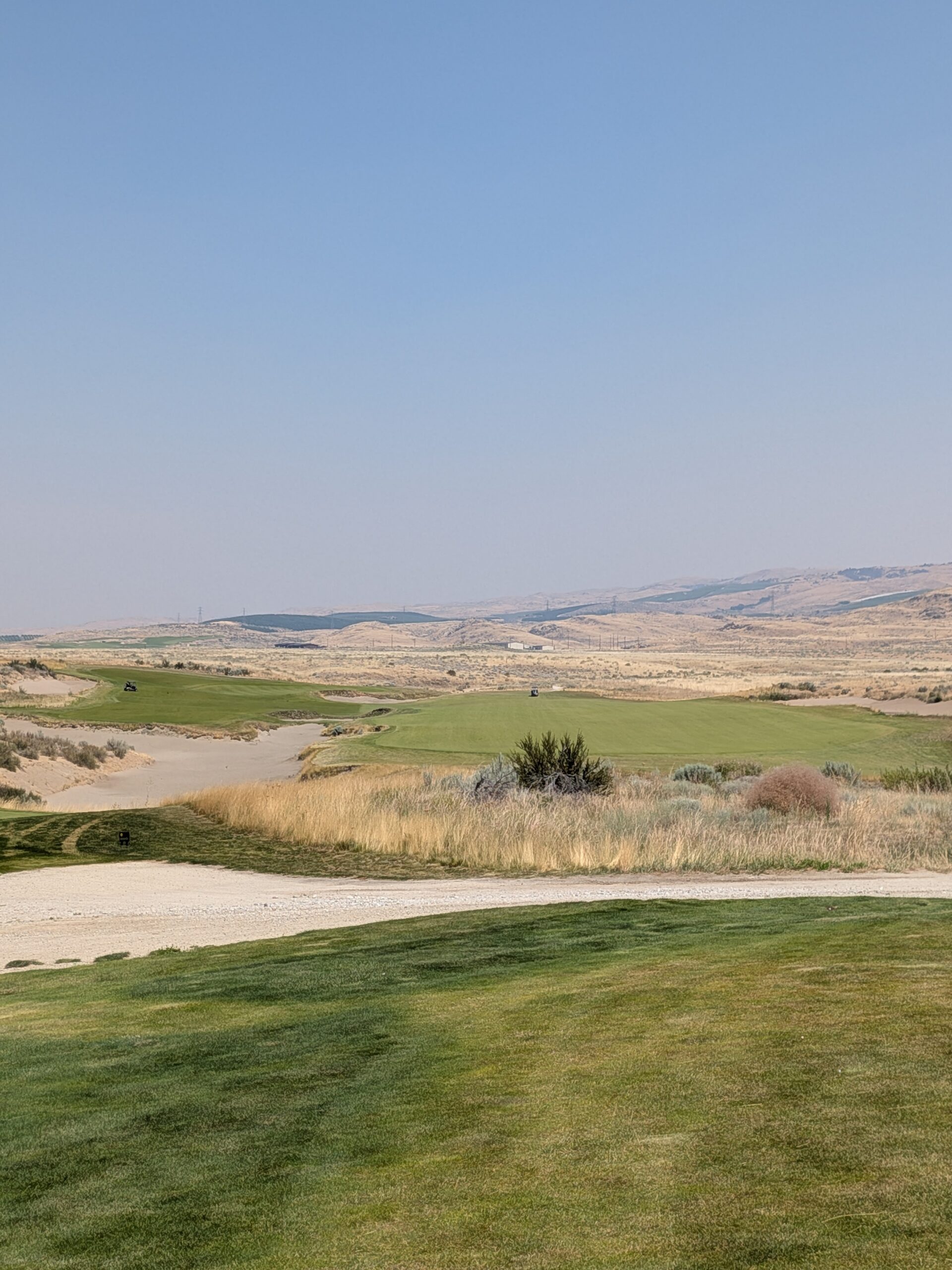
But, this feels like the worst version, mostly because unlike the eighth at Riviera, the left fairway is practically unusable. From the back tee, its actually a bit too long to even reach reliably, requiring around a 295 yard carry. From the forward tees, it may make more logistical sense, but I’m not sure why anyone would take the risk. The fairway is only around 27 yards wide on the left side, compared to 57 on the right. While the left fairway would provide a lower risk approach from a better angle, the increased risk on the tee shot would certainly not outweigh the reward of having a long, forced carry tee shot into a narrow fairway surrounded by waste.
Part of me thinks this is where designers, who are not all great golfers (DMK has said in previous interviews that he is between an 8 and14 handicap), may lose the plot a bit. It would be an interesting hole, but that left fairway would have to be 35-40 yards wide, and probably 20 yards closer, for the risk calculus to make sense for the better player. Right now, the only people going for the left fairway are the players who aren’t the greatest strategists.
Nonetheless, the hole is very aesthetic and is a cool concept, and likely plays better from the forward tees than the back tee. But, the fourteenth would easily be the best hole on the course with a few different design decisions.
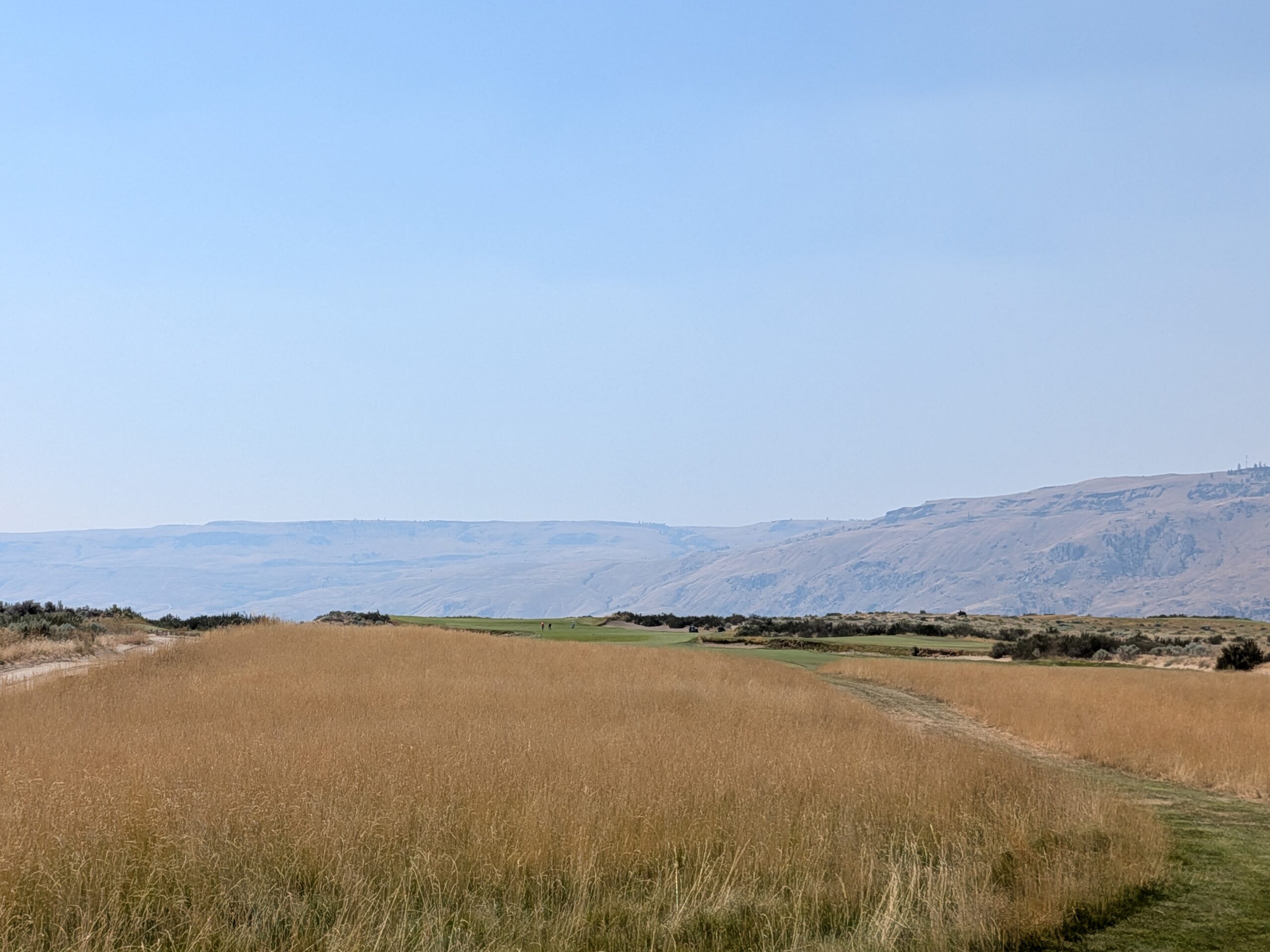
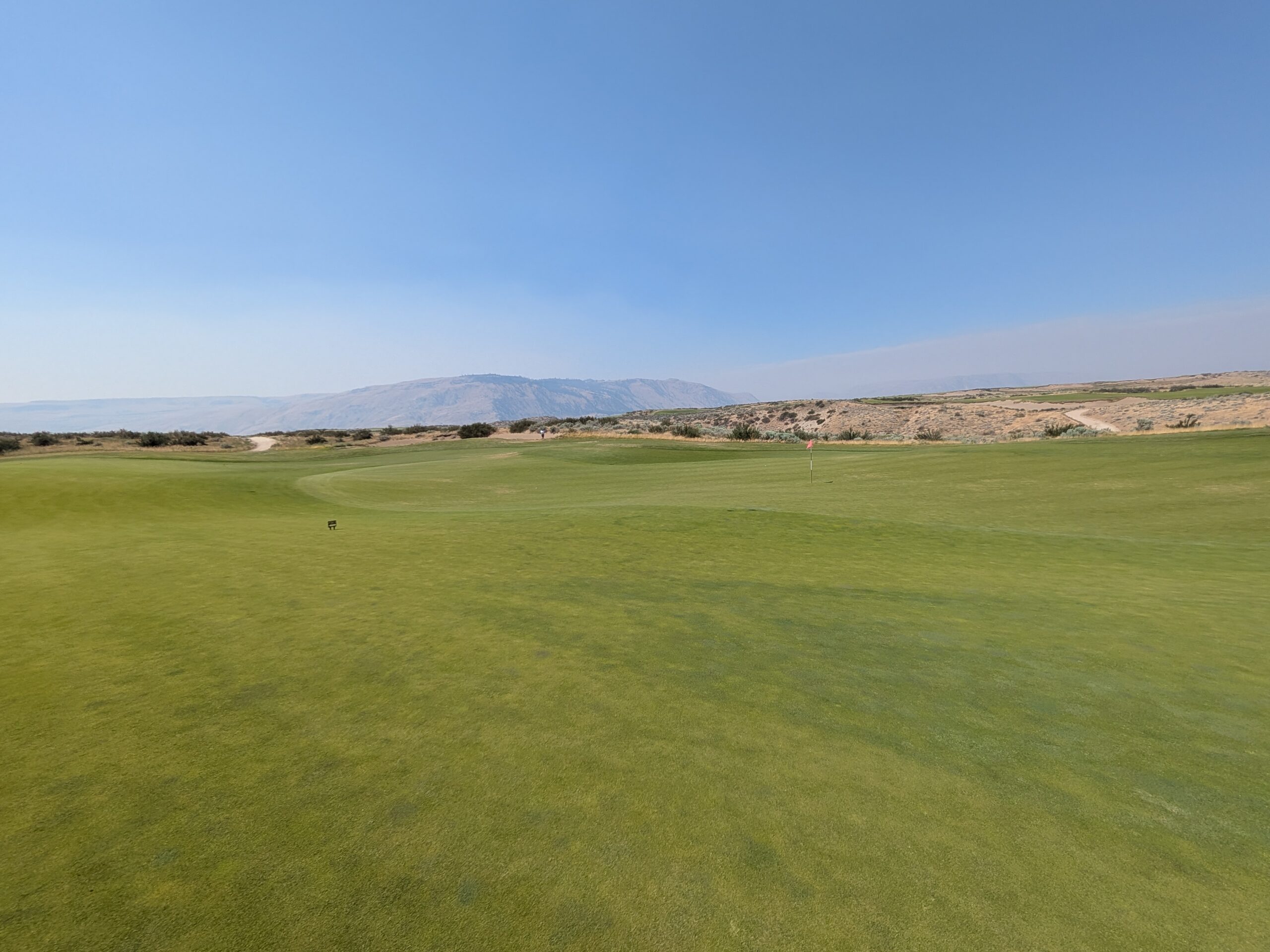
Unfortunately, while the fifteenth hole has an incredible view as well, McLay Kidd returns to blindness. Note how little of the view in the picture above is actually golf course. I’d estimate that less than 5% of that image depicts mowed grass. Therefore, the drive here is basically completely blind on this mid-length par-4. To make matters worse, the left side of the fairway slopes hard from right-to-left, bounding left of center balls into the left rough easily, all of which is completely invisible from the tee. But, the fairway is very wide, and there is a football field of fairway right of what feels like the correct aiming point, that also cannot reasonably be located from the tee. The second shot is a bit simpler, visible and to a large green that also has a bit of internal undulation, mostly pitched back-to-front.
The sixteenth is a long par-3 with a bit of fanfare and fun factor, because while a long club will be required to reach the large, tabletop green, a slope behind the green simplifies things. This large slope will repel balls over the green back towards the green, and sometimes even off the front.
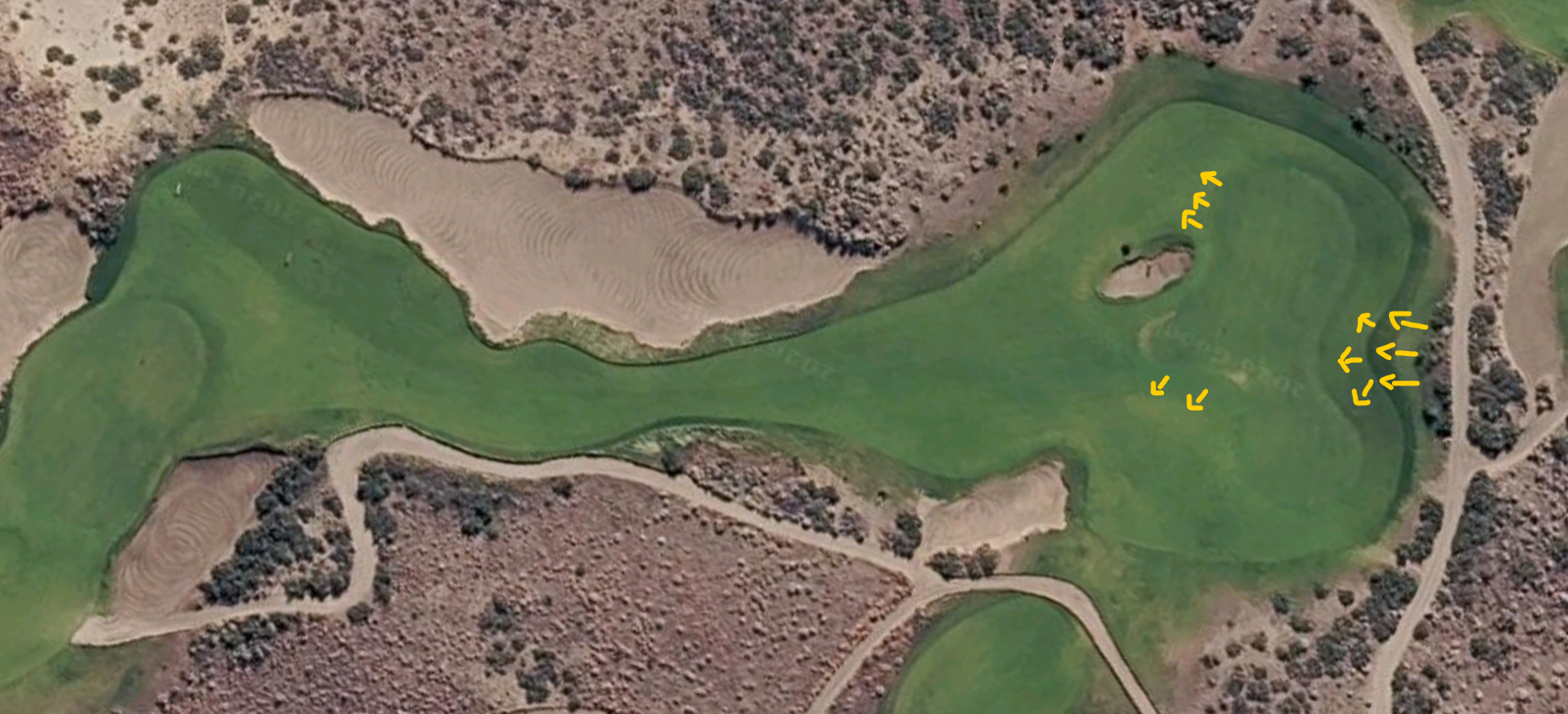
In-between clubs? No problem, just use the longer one to land up on the slope and run it back on the green. This is the kind of gimmick hole that is rather enjoyable. If the round is going poorly, take a few balls to the tee and see what trick shots you can come up with. But beware, balls landing too high on the slope will come back with such velocity as to fly off the front of the green and down the slope.
The seventeenth turns back towards the clubhouse for a two-hole march back home.
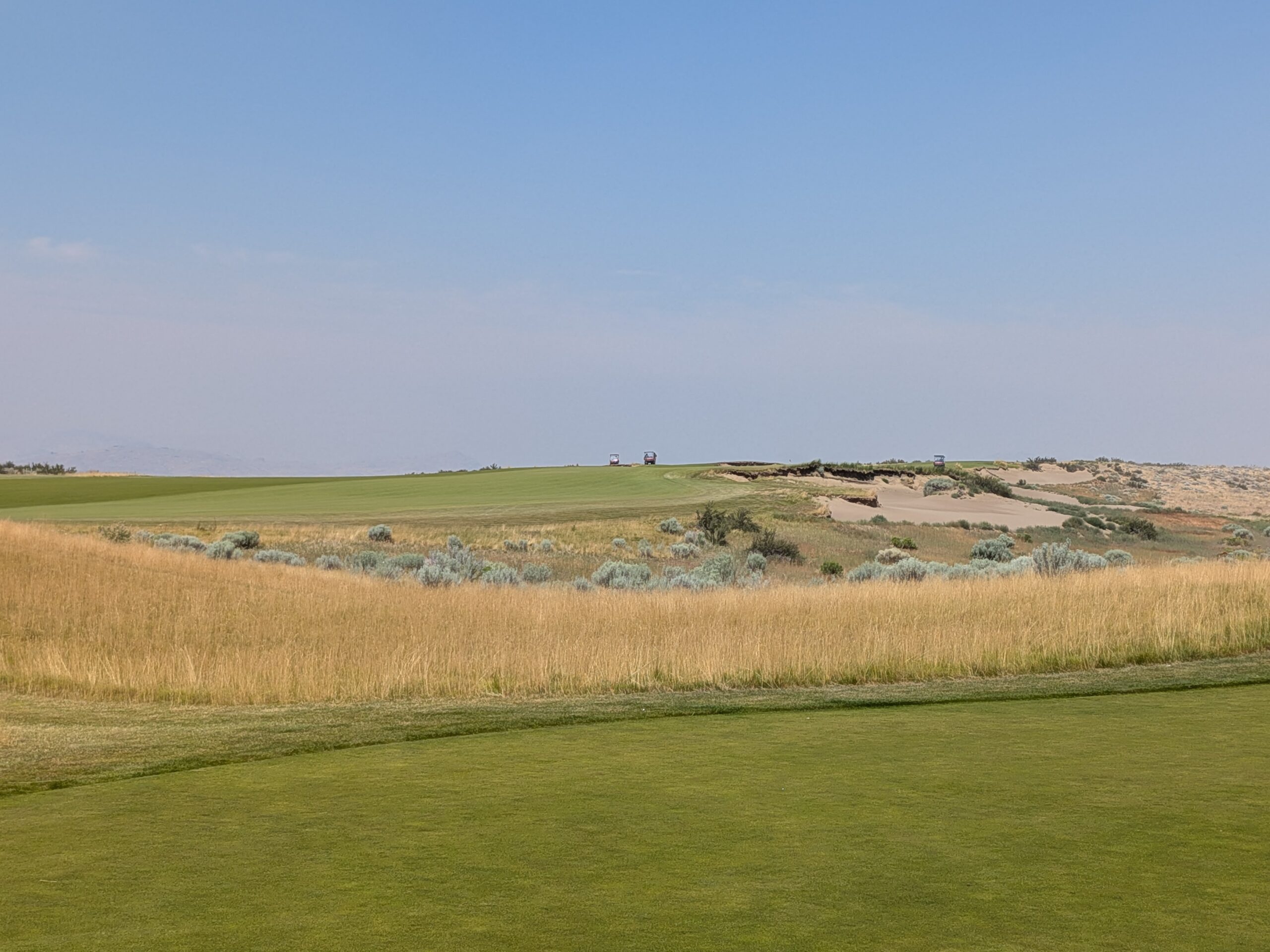
From the tee the landing area over the ridge is, you guessed it, blind. But only partially so this time, so credit where credit is due. The fairway here is wide, but an encroaching, blind fairway waste bunker is worth being concerned about from the tee for the absolute longest hitters. The green here is somewhat interesting, being protected by a large, deep bunker on the right. That bunker obscures the left side of the green from the fairway.
The eighteenth is a mid-length par-5 with likely the widest fairway on the course. This time, a more significant fairway bunker squeezes the landing area for the longest hitters, and the fairway on the left half will bounce balls further left.
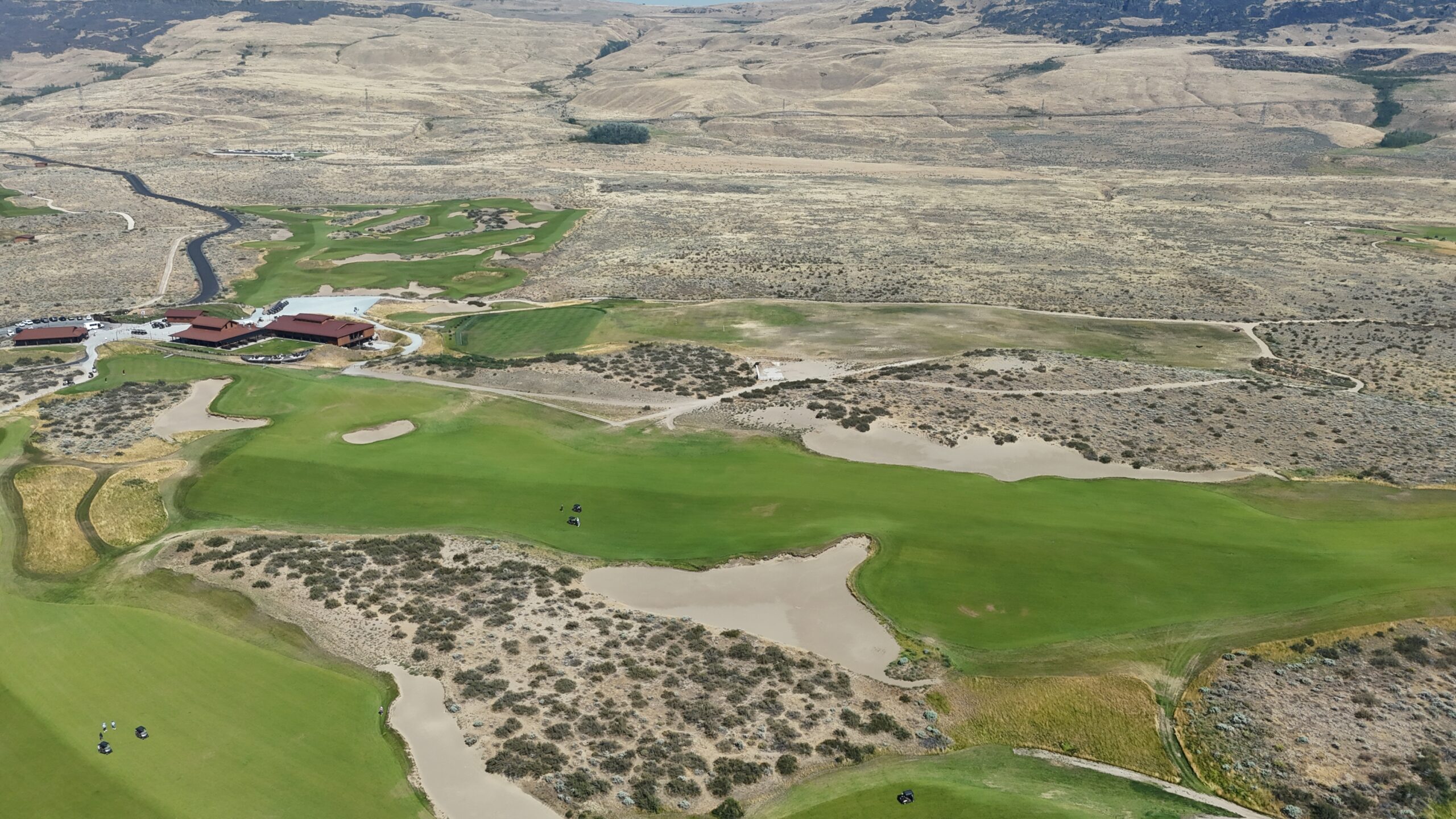
Those long hitters should have a chance to get home in two, and the only complication is an oblong centerline bunker about 50 yards short of the green. The green is angled, somewhat oddly from short-left to long-right, and ends up blending together with the practice green. This orientation and the severity of the angle make this an easy green to miss, as slightly faded balls will finish short of the green, and slight overdraws or pulls will certainly miss in the bunker left. However, all in all, the eighteenth is a reasonable chance at birdie to finish the round.
Final Thoughts
Gamble Sands is an incredibly attractive golf course. The long, tightly-mown ribbon fairways and panoramic vistas of beautifully underrated central Washington create an experience that’s worth the travel. There’s also an audacity about the course; the design is intentionally over the top in some places. As a golf trip, it is certainly worth visiting, particularly with the short course and newly built Scarecrow course that is receiving very positive reviews.
But, I have to be honest about what the golf course is and is not. It is another installment in this modern, audacious golf design language, but I think it fails to rightfully crack the Top 200 golf courses in the U.S. Ballyhack is another audacious, modern design in southwest Virginia, currently ranked outside of the Top 200 by Golf Digest. Gamble Sands fails to eclipse Ballyhack, or its direct public golf trip competitors Streamsong Red and Streamsong Blue.
Gamble Sands is a legitimate destination experience with real architectural weaknesses. While I suspect the amount of blindness at Gamble Sands is intentional, it is not well received, and may have made more sense as a private design. The common refrains are that there is too much forgiveness, too much funneling, and the course is too easy; those refrains are also true. Course raters are clearly leaning into the setting of the course too much, which is artificially elevating Gamble Sands to a bit higher status than the golf architecture would deserve. But, we are all human, and the views from the golf course are incredibly impressive; impressive enough to skew a rating upwards. A golf course’s setting is part of the experience, but when rankings are meant to primarily evaluate architecture, critics need to ask whether the setting is enhancing the design or substituting for it.
That said, Gamble Sands is certainly among the better half of the Top 100 Public courses in the U.S., easily. It is worth the trip to visit and play, to view and to photograph. But perhaps the most notable features at Gamble Sands were designed by Mother Nature and Father Time, rather than Mr. McLay Kidd.
CR&J Final Rating:
Shot Options: 9
Challenge: 6
Layout Variety: 8
Distinctiveness: 8
Aesthetics: 10
Conditioning: 7
Character: 8
Fun: 8
Total: 64/80
Read More: How We Rate Courses
Rating Scale Details:
> 70: Top-50 U.S.
65-70: Top-200 U.S.,
60-65: Best-in-State List
57-60: Best-in-state List Contender
53-57: Very Good
48-53: Good
40-48: Average
< 40: Poor

Author: Kyle Taylor
Kyle is the lead course reviewer at The Course Review & Journal. Kyle has been playing golf for over twenty years, is a plus handicap, and actively competes in USGA and State Golf Association events. By trade, Kyle is an attorney.
Kyle Taylor is a pseudonym used by CR&J’s lead course reviewer to protect personal relationships. The reviews and opinions remain entirely the writer’s own.
Leave a Reply
You must be logged in to post a comment.