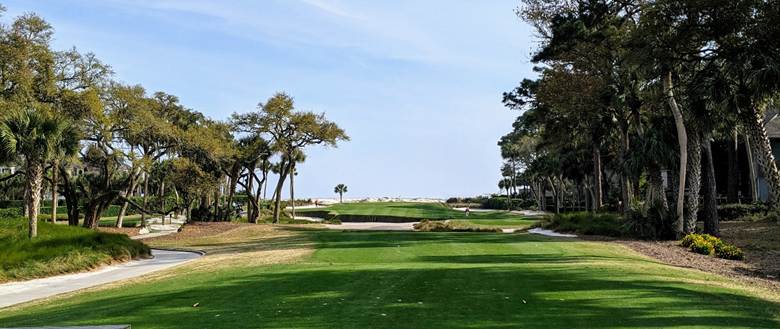
CR&J Final Rating: 60/80 (Best in State List Contender)
Atlantic Dunes is one of two little-sibling courses to Harbour Town Golf Links and was originally designed by George Cobb. Atlantic Dunes was reconstructed by Davis Love III in 2016 (he is now leading the restoration of Harbour Town). Originally dubbed the Ocean Course, Atlantic Dunes is actually the oldest course on Hilton Head Island. Notably, the reconstruction was not a “redesign,” per se. The par-values of each of the holes remained the same, but for the tenth and eleventh holes. Other than those two holes, the green sites, water hazards, and general shapes of each hole are the same as they were before. It appears Davis Love III focused his work on changing bunker placement and redesigning the tenth and eleventh holes.
This course was reviewed as part of a broader Journal entry exploring public golf courses in the Hilton Head area.
Atlantic Dunes now combines a bit of Pinehurst aesthetic with some callbacks to the design language of Pete Dye, and a routing established by George Cobb. Remarkably, it blends quite well into one cohesive course. That is mostly because the routing remains unchanged from the original design, and the improved bunker placement and aesthetic brings the course up to modern standards.
What Works: We found Atlantic Dunes to be well conditioned, moderately challenging (mostly due to the repeated and constant threat of water hazards), and fun. Atlantic Dunes has a design language that is internally consistent. I once referred to Shingle Creek as having different colors of Play-Doh pressed together; Atlantic Dunes is the opposite — a fruit smoothie. The influences are blended into something cohesive rather than clashing or competing. The course is particularly strong in its par-4 holes, having strategic short holes, doglegs that work each way, and lengthy, challenging holes.
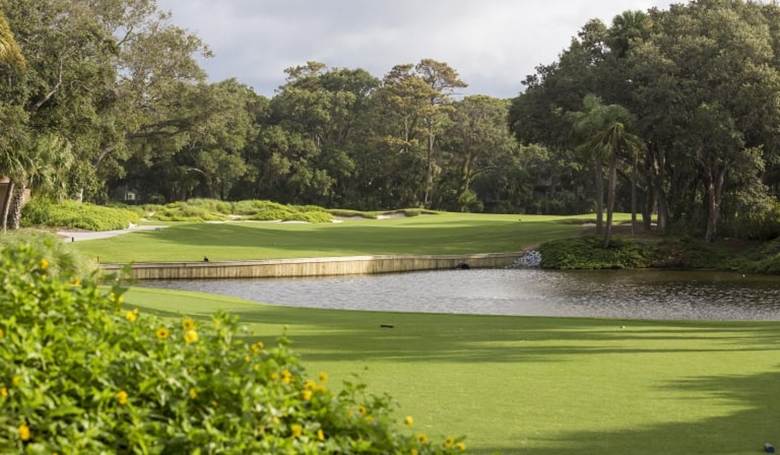
The sixteenth hole at Atlantic Dunes
Best Hole: From an architectural perspective, Atlantic Dunes doesn’t have any “standout” holes, but rather, a nice collection of solid holes that compliment each other. However, my favorite was likely the mid-length par-4 sixteenth.
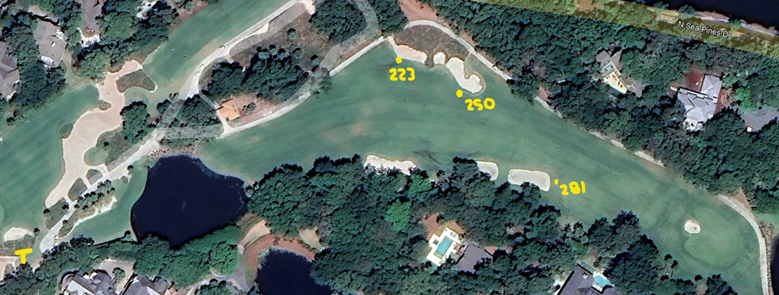
The view of the sixteenth hole at Atlantic Dunes from overhead
The hole aggressively doglegs to the right from an elevated tee. The tee shot works between three bunkers on the inside of the dogleg, and a messy waste-like set of bunkers on the outside of the dogleg. Unless you have a big fade in the bag with driver, the hole essentially forces a tricky layup between the bunkers, and the more aggressive that layup is, the tighter the fairway, more trouble, and more fade is required.
Basically, this hole gives you a nice, safe layup option, and provides the option for a player to try a heroic shot from the tee by precisely controlling a very large fade. Once in the fairway, the green is large in both depth and width but is protected by a lion’s mouth bunker right on the centerline of the green, which can make front pins tricky. I liked this hole best because it was the most atypical of the par-4 holes, but one of the most strategic.
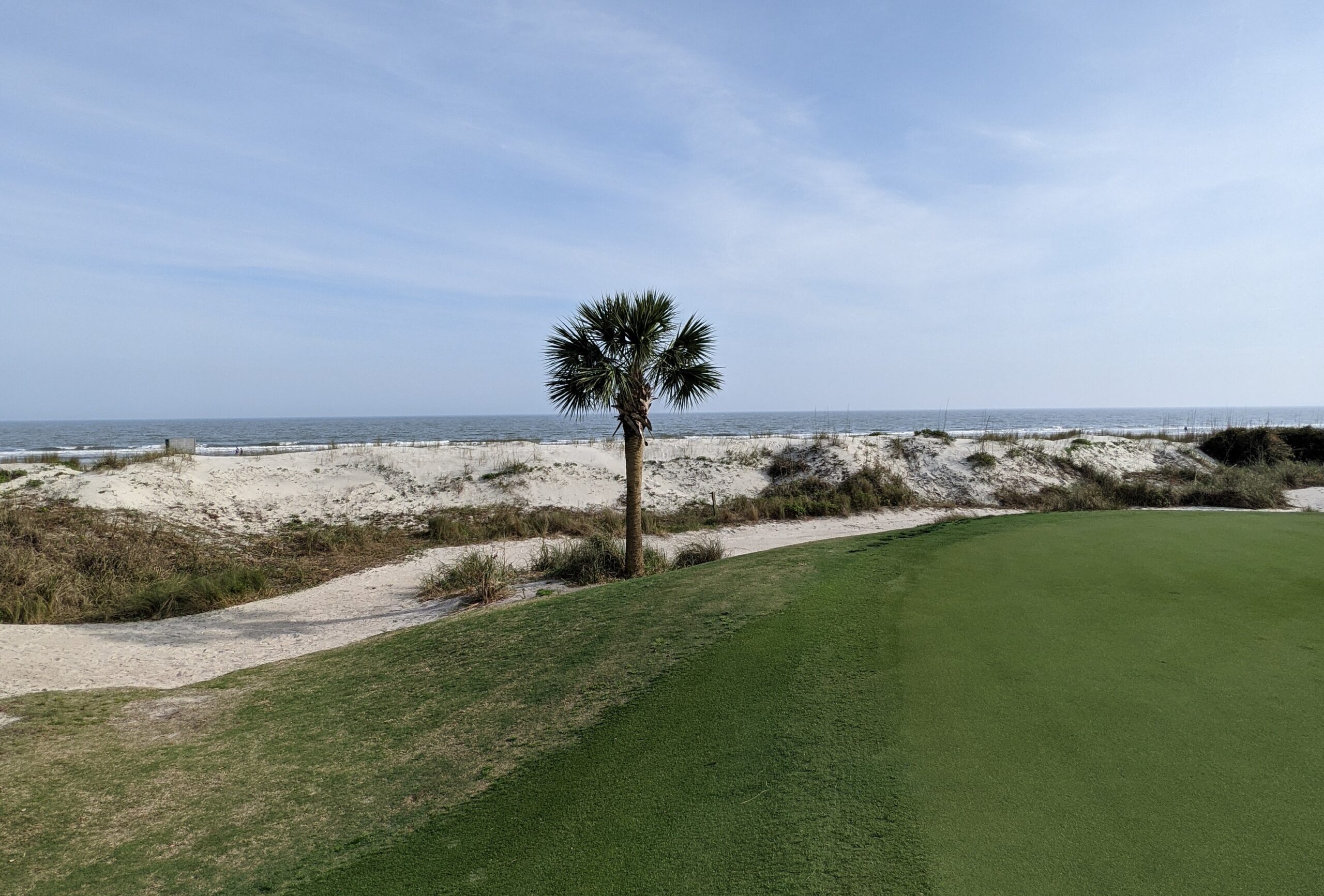
The fifteenth hole at Atlantic Dunes
Interesting Hole: While perhaps not the most architecturally interesting hole at Atlantic Dunes, the mid-length par-3 fifteenth is the most famous, signature hole, due to its view of the Atlantic Ocean. Undoubtedly the most aesthetic hole at the course, with the green framed by the sand dunes and lone tree, stepping on the putting surface reveals one of two holes on the entirety of the island that have ocean frontage. I also love Love III’s usage of the railroad ties surrounding the short waste area, which blend the course with Pete Dye’s Heron Point and Harbour Town Golf Links.
Limitations: While I was complimentary of Love III’s decision to stick with the original routing, as it does make the course feel more intentional and cohesive, that original routing also served to box the reconstruction into some decisions that Love III may not have chosen to build himself. A few of the holes, particularly the sixth, eighth, twelfth, and the finishing seventeenth and eighteenth are probably holes that could have used a more significant redesign. These holes give off the impression that Love III was simply making the best out of the situation he inherited. Atlantic Dunes is surrounded by homes, so there was very little blank canvas here to reimagine. Where they did reimagine, on the tenth and eleventh, I found those holes to be a bit pedestrian, but the eleventh does present some real options off the tee as a short par-4. The original routing was a catch-22, a blessing and a curse, because it is good but not great. The course feels cohesive and like a complete round of golf but packaged and boxed in a layout that is just getting the most out of what it has to offer.
Final Thoughts: Atlantic Dunes is a wonderful resort course, and would make a great members course as well, if one lived in Sea Pines. It is certainly worth playing on any trip to Hilton Head, and while the routing and the individual holes don’t lead to any truly buzzworthy holes, they form a cohesive set of eighteen holes that present a ton of variety and distinctiveness. I’d consider it a must play on a trip to Harbour Town Golf Links.