
Time to Read:
|
This Coeur D’Alene Resort Golf Course review is based on a round played in 2026.
Coeur D’Alene Resort Golf Course is a public course in Coeur D’Alene, ID.
CR&J’s Final Rating: 63/80 (Best-in-State)
Most golf courses have signature holes. Few places have their marketing strategy, their brand identity, and their collective ethos built around a singular shot. Coeur D’Alene is a marketing success from that standpoint. With its famous floating island green, the course’s most recognizable feature has become the resort’s entire public identity. Most of the merchandise in the pro shop depicts the floating green and their website has pictures of the floating green everywhere. Coeur D’Alene is the home of the floating green, and they want you to know that.
From a marketing perspective, this is undoubtedly their strongest asset. The floating green and their marketing strategy around it makes the resort a commercial success, selling rooms, rounds, and trips. Commercial success is far more important than anything I am going to be discussing, and moving their guests across that floating green for a high greens fee is their money-maker.
But, in the golf ratings world, I think this marketing and the perception of the floating green being a “gimmick” may be negatively affecting the perception of the course in golf architecture circles. The aura of the place primes everyone that steps on property that the floating green is the centerpiece of the experience, but it also primes the golfer to expect the other seventeen holes to simply be a supporting cast to the floating green’s uniqueness. I am certain this phenomenon is why the Coeur D’Alene Resort Golf Course is not ranked among the Top 100 Public Courses in the U.S., and is further ranked seventh in Idaho by GolfDigest. Other ranking services agree.
My argument today is simple: Coeur D’Alene Resort is easily a Top 100 public golf course, and we will walk through plenty of holes in this review that do not have island greens that are great holes. Yet, there’s a phenomenon that persists that artificially affects the ranking of courses which possess an extremely strong or unique signature hole or stretch. I am calling this phenomenon “Signature Hole Contamination.”
Coeur D’Alene Resort may be the best example of the first type of signature hole contamination, where a signature hole is so unique or strong that golfers and raters fail to properly evaluate the strength of the rest of the course, instead viewing those holes as supporting cast. This also happens at Harbour Town, which we called the most underrated course in the Top-200 and why many players express disappointment after playing Harbour Town. If you come expecting lighthouse holes, you’ll be disappointed. For sixteen holes, Harbour Town is a battle of angles, positioning, and shot shaping among tall trees, finding a way to navigate a short course with small greens. Then of course, for the last two, you get a different lighthouse style holes, which are the signature stretch of Harbour Town and very cool, but not quite the same vibe as the rest of the golf course.
I think people tend to view those first sixteen at Harbour Town as supporting cast for the last two holes, when it is actually just the opposite. Harbour Town is a great golf course because of the first sixteen, and sells vacation rentals because of the last two. The same thing is going on here at Coeur D’Alene Resort. The fourteenth is so unique and beautiful, that I think golfers get lost in anticipation. Slog through the first thirteen, play the cool hole you came to play, play the last few to get to lunch. But Coeur D’Alene is so much more than that; it is a great golf course even with no floating greens.
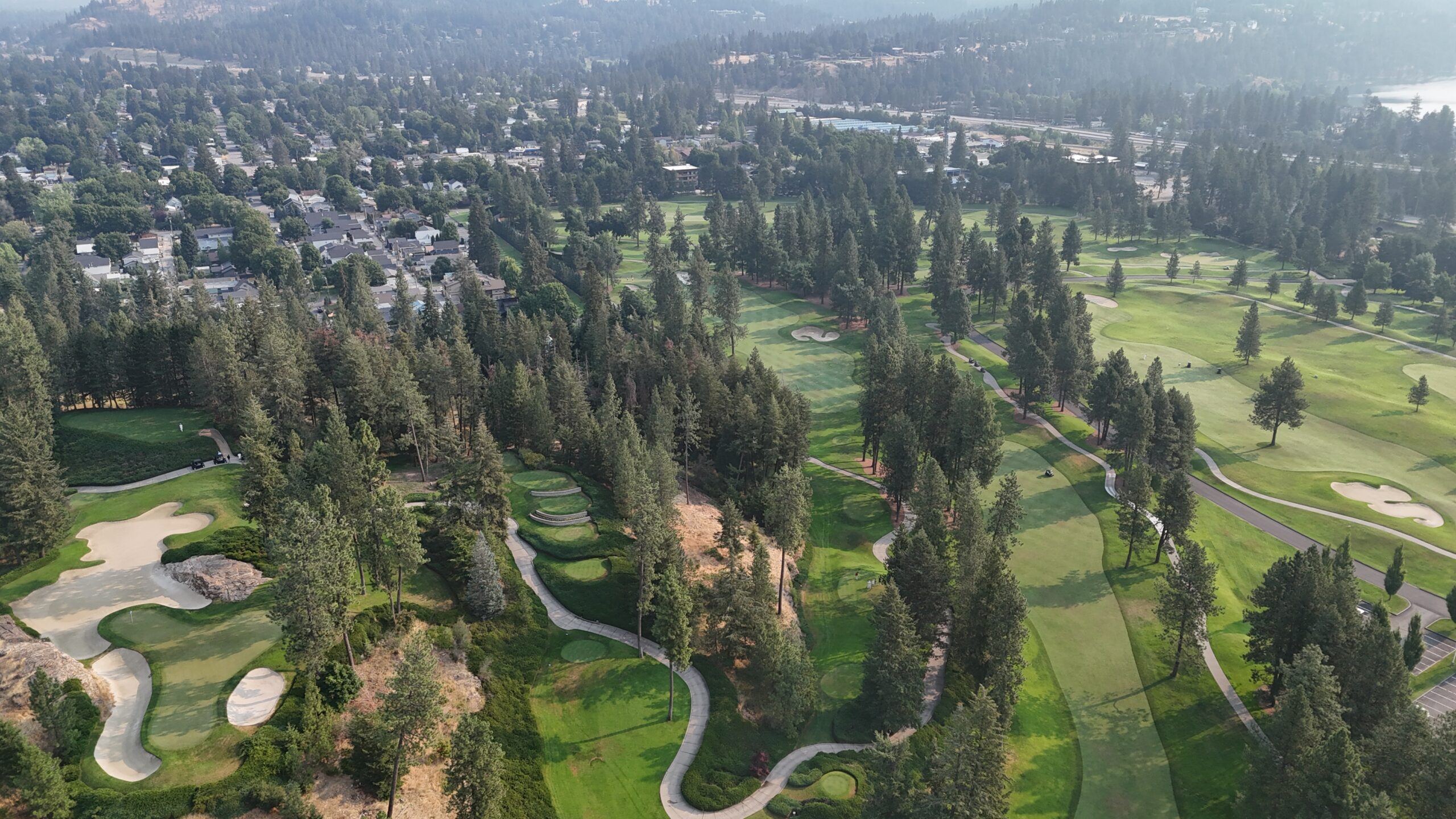
Coeur D’Alene Resort Golf Course was designed by Scott Miller, whose only other course of note is the two We-Ko-Pa courses just outside of Phoenix, AZ. He faced a tough task here to get a golf course and clubhouse into a 130 or so acre area on the lake, with a lot of lake frontage, which I think is managed well. The driving range uses floating balls hit into a lake, the floating green decreases some use of the available acreage, and the hilly part of the property on the west end is used to cram some short, but architecturally interesting holes in a very tight space on unforgiving terrain. Fortunately, most of the property on the east is relatively flat with gentle rolling hills that Miller was able to use to route the majority of the course over. With only 130 or so acres at his disposal, the routing here is superb.
The First Tee
One of the drawbacks to building on a tight acreage, and one of the criticisms of Coeur D’Alene is length, which is most obvious on the par-5 holes. The back tees are just under 6,500 yards, which is quite short by today’s standards. However, this isn’t an impossible hurdle for a course to clear and still be great: Cypress Point is just 6,553 yards and Pasatiempo is 6,473 yards; both top 100 courses in the U.S.
The first here at Coeur D’Alene is a shorter par-5 that bends to the right. The scorecard yardage is deceiving here, because the wind flows predominantly off Coeur D’Alene Lake, blowing inland from the south. This first hole plays directly away from the lake and down the prevailing wind, making this effectively a short par-5. Two of the par-5s here play directly downwind, while the two longer par-5s actually play into the wind.
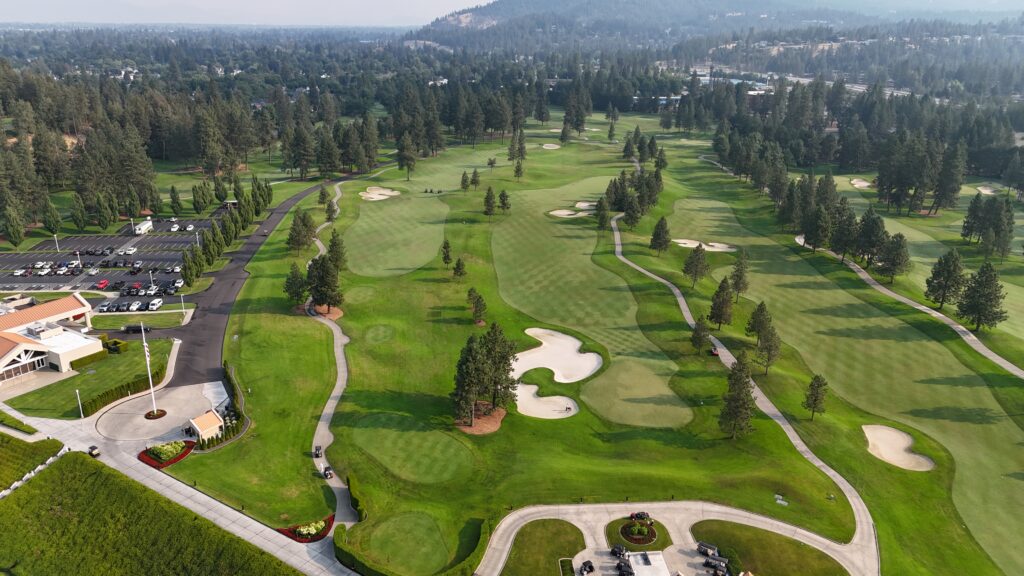
Pinching the landing area for drives is a large bunker on the left, which pinches an otherwise wide fairway down to just 22 yards. Some players may elect to layup short of this bunker and leave just over 200 yards into the hole, downwind. The hole also plays a touch downhill on the second shot to an aggressive putting surface with a significant knob on the right side of the green. Balls ending on the short side of the knob on approach will run down into a collection area short and right of the green.
The second hole begins a fantastic stretch of golf, perhaps the best Coeur D’Alene Resort has to offer, with the second through the seventh. This stretch kicks off with a long, difficult par-4 marching back to Coeur D’Alene Lake.
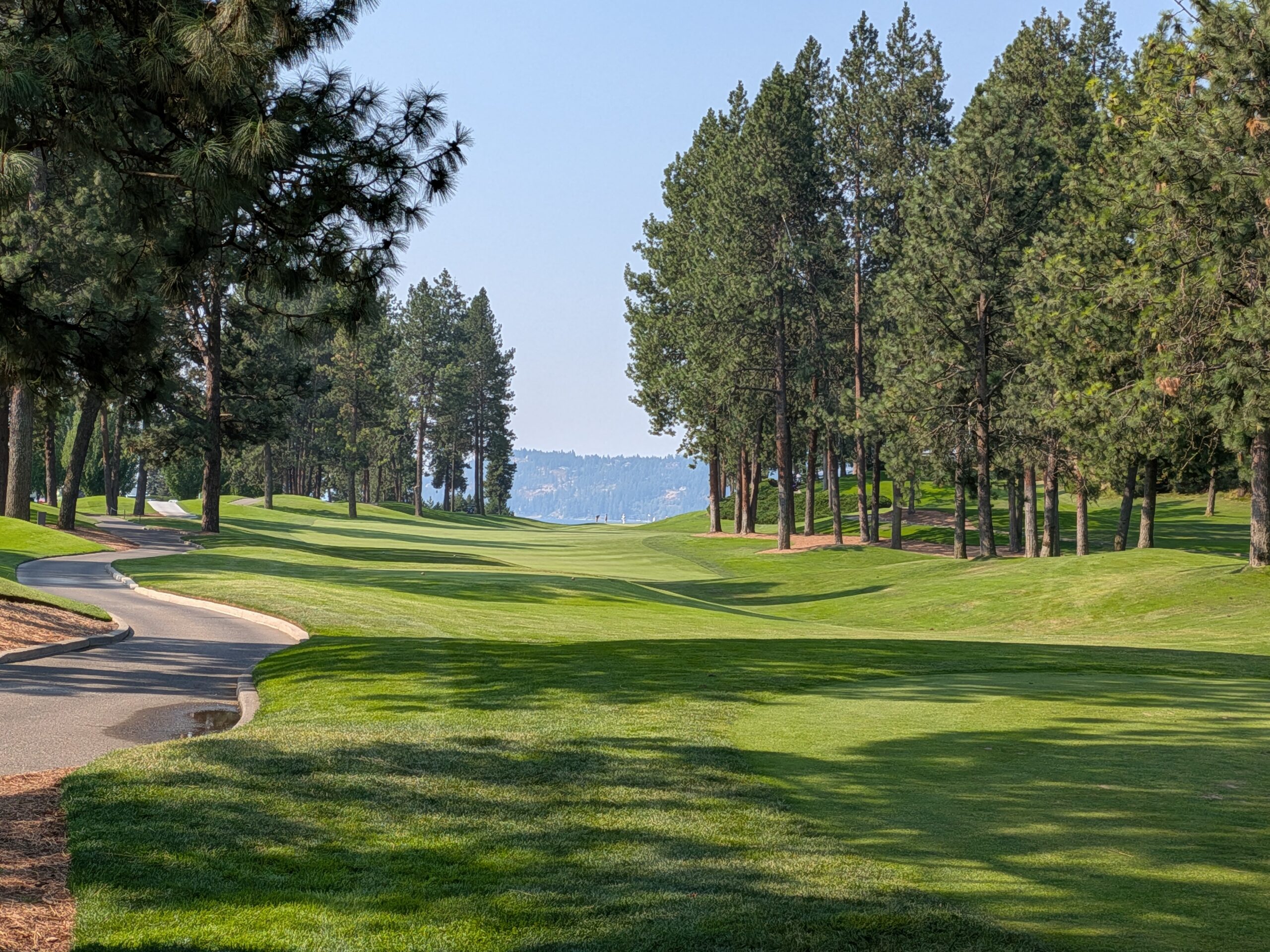
This long, into wind par-4 plays through a narrow chute of tall pines. The fairway here at its widest is 31 yards. The Pacific Northwest has many great courses that feature these types of narrow holes through tall pines, but this is one of the best, as the lake is visible on the horizon through the chute of trees.
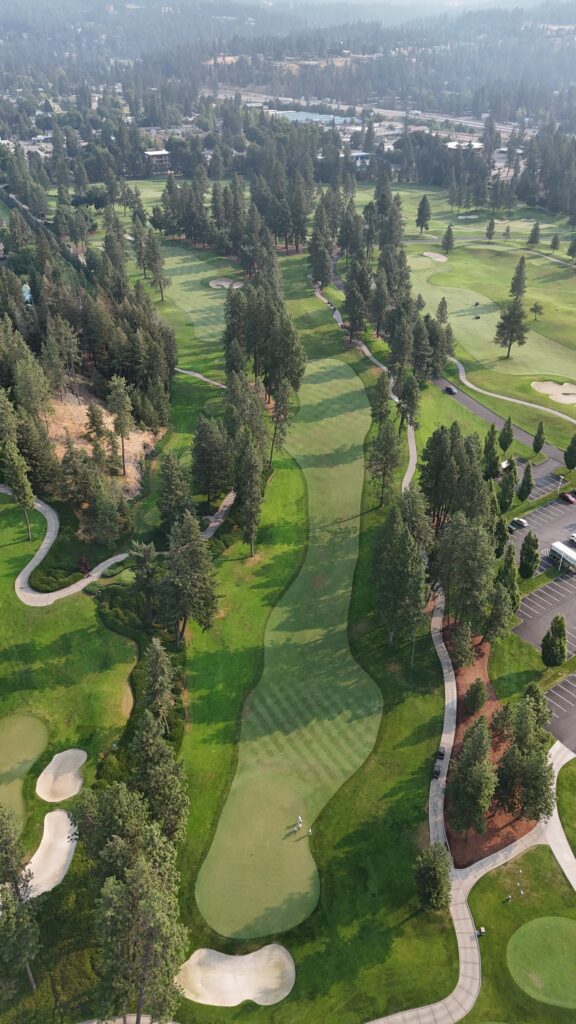
The fairway continues to narrow as it moves towards the putting surface and one bunker stops balls that are bounding over the greens. You’d generally be correct to assume that bentgrass greens in the middle of the summer were soft, as of our date of play, Coeur D’Alene had some of the firmest bentgrass greens I have played to date.
This is actually another feature of the region. Many think of the Pacific Northwest as being rainy, but much of it is actually desert, and this area receives almost zero rainfall in the summer. In the spring and fall, expect the usual. But in the summer, Coeur D’Alene shows its teeth with extremely firm and fast conditions.
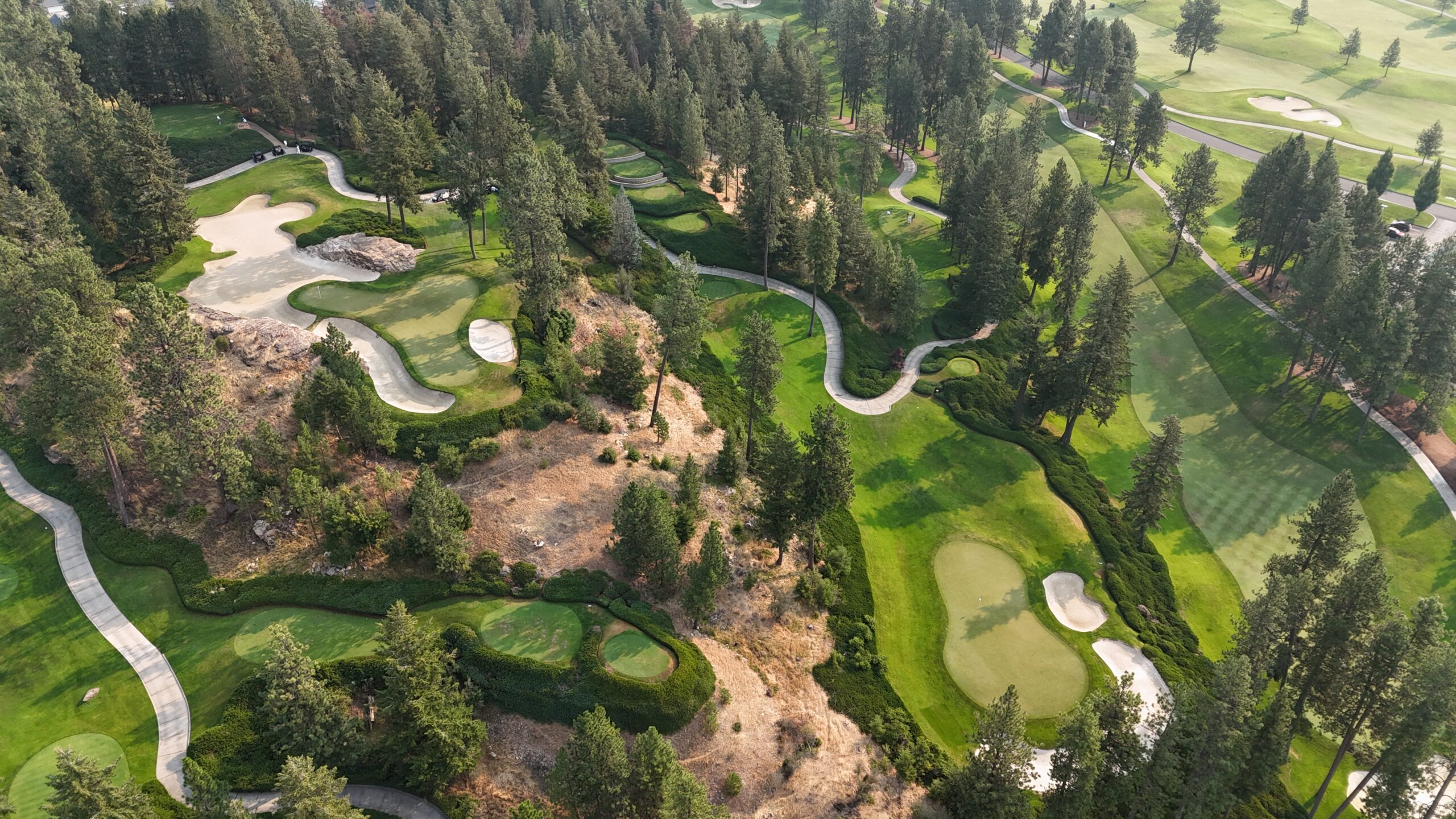
The third is the first of the incredible collection of par-3 holes at Coeur D’Alene Resort, of which there are five. Rather uniquely, three of the next four holes are par-3 holes, which are routed through the hillside on the property, with the other hole being a short par-4. They are also four of the most unique holes at Coeur D’Alene.
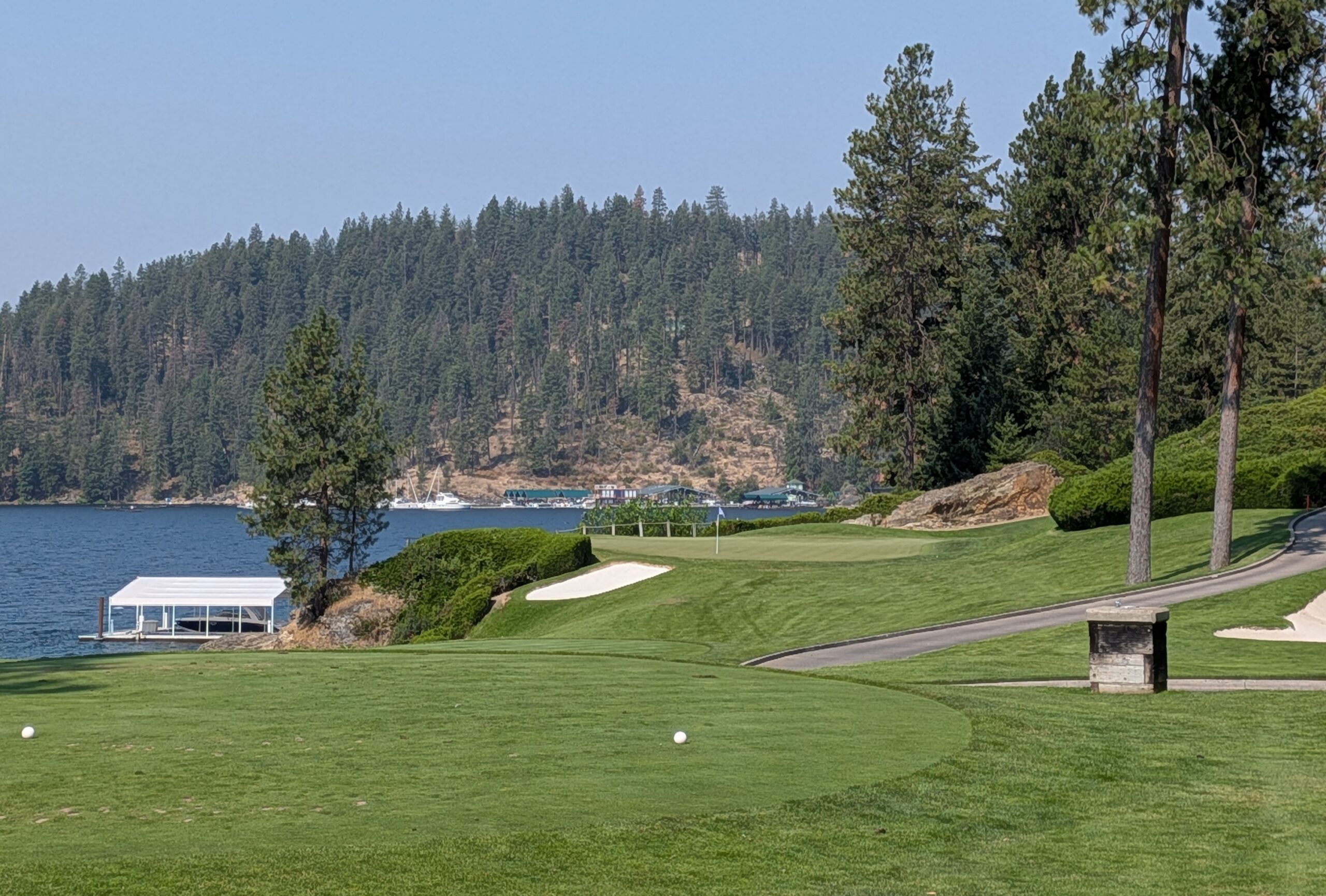
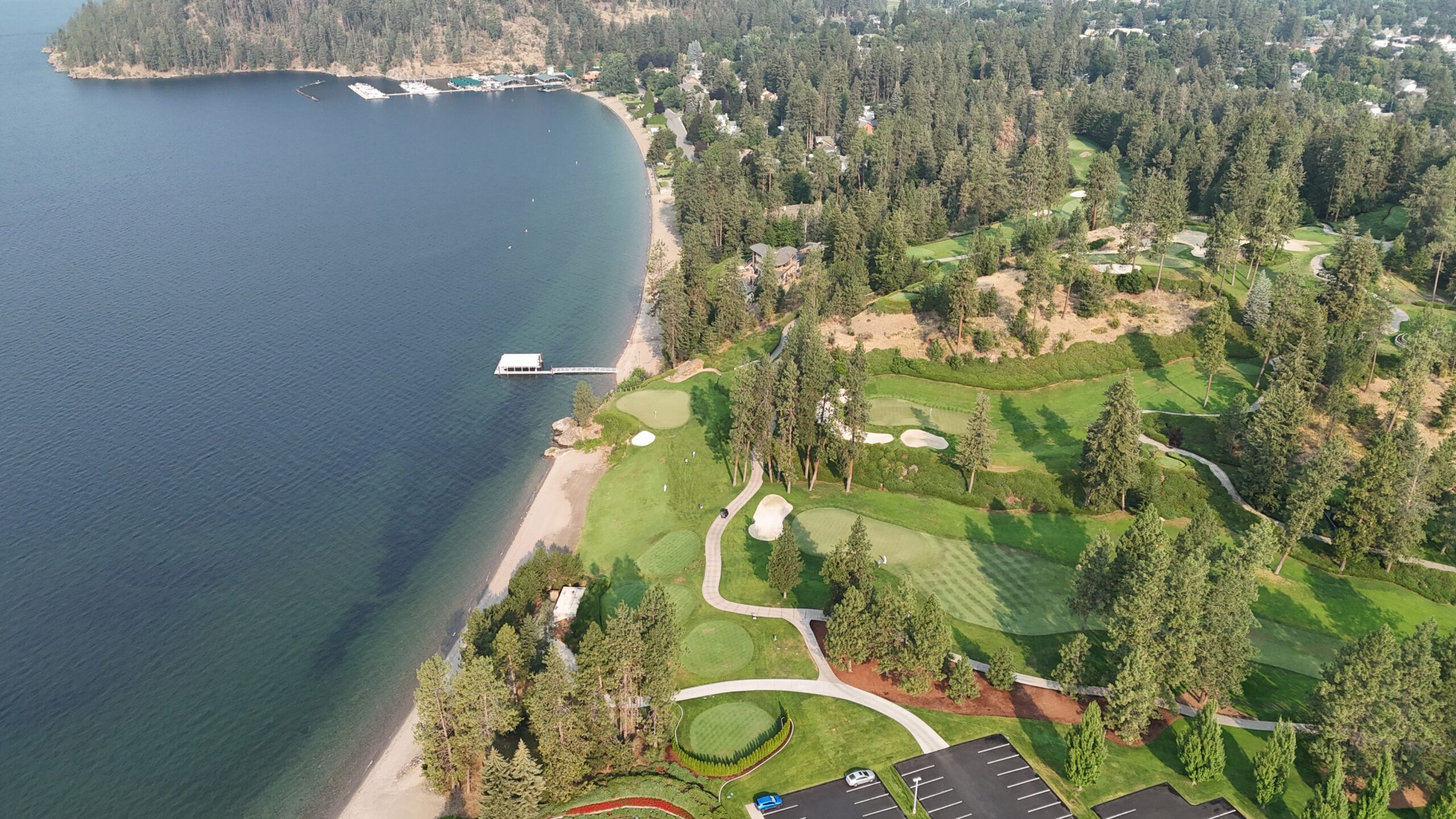
The third is a shorter par-3 that is perched above Coeur D’Alene Lake, with the lake serving as the hazard left, and a hillscape right. The green and singular greenside bunker are built in the flattened area that runs from the hill on the right to the lake on the left.
The fourth is a beautiful but very short par-4 which all but requires a layup off the tee. From the very back tee, the hole is just over 300 yards, but doglegs to the left aggressively as it turns uphill.
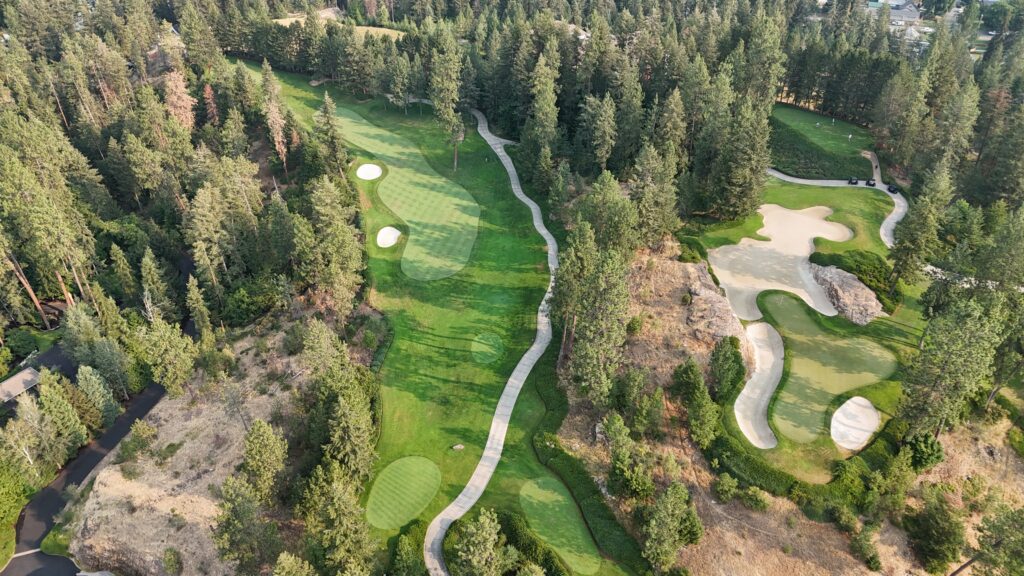
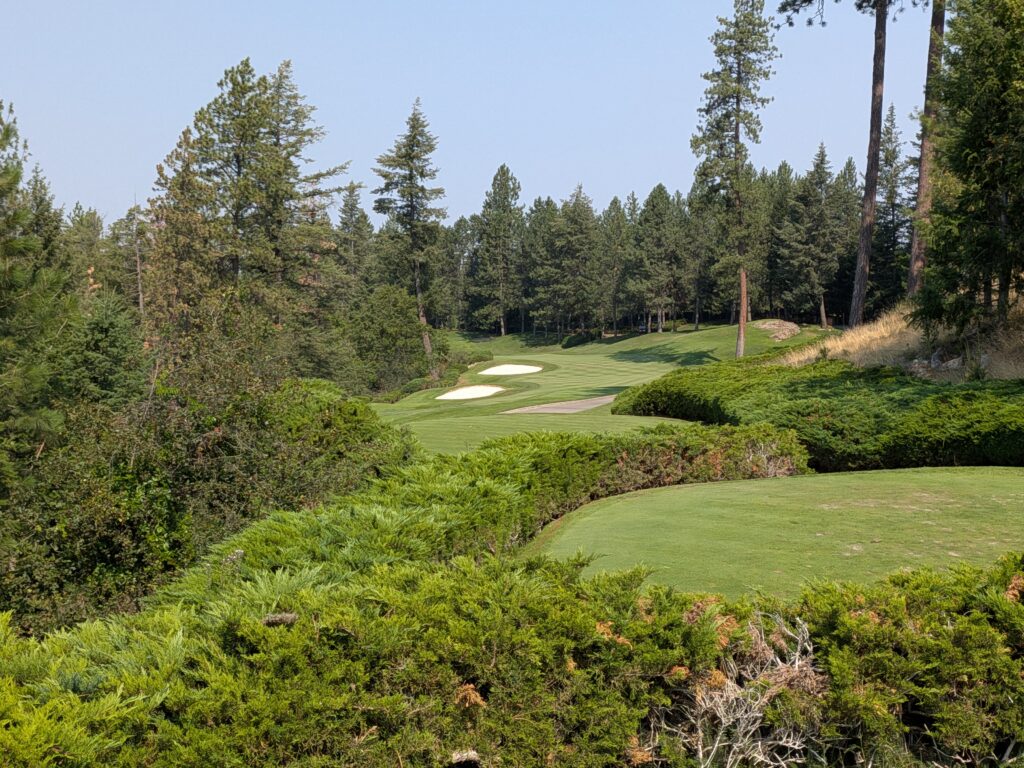
The hole is also quite narrow, with the widest part of the fairway being between the two fairway bunkers. Quite a few different options exist here. First, and probably most intelligently, a tee shot between the bunkers of around 175 yards from the back tee is probably most advisable, which leaves a short, uphill wedge or short iron into the blind green.
For those a bit more daring, a hybrid just to the right of the tallest tree will bound the ball down into the end of the fairway, leaving just half a wedge uphill to the green. In the summer, this option may be less advisable, especially to front pins, due to the lack of spin.
For the most daring, theoretically, driving the green is possible. But it is a narrow, blind target and would require a high tee shot to clear the trees and stay on the green. Complicating things, a large, exposed rock sits in front of the green, which theoretically would drastically repel short shots, whether from the tee or fairway.
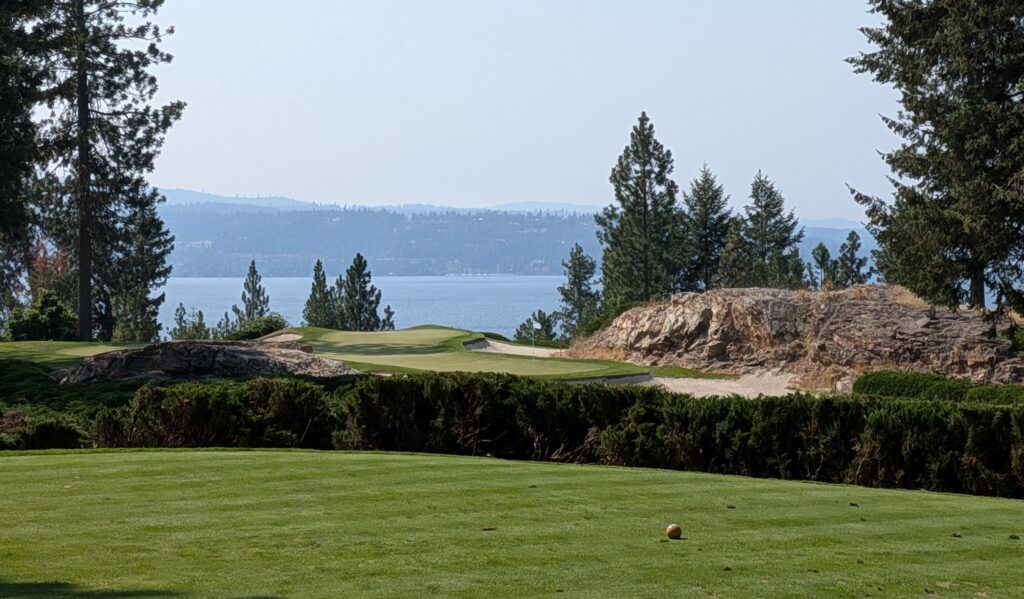
The fifth turns back towards the lake with two consecutive par-3 holes. The first is a classic short hole, just 100 or so yards to the front of the green. The green here is quite large, however, and the hole can play almost 150 yards at the longest.
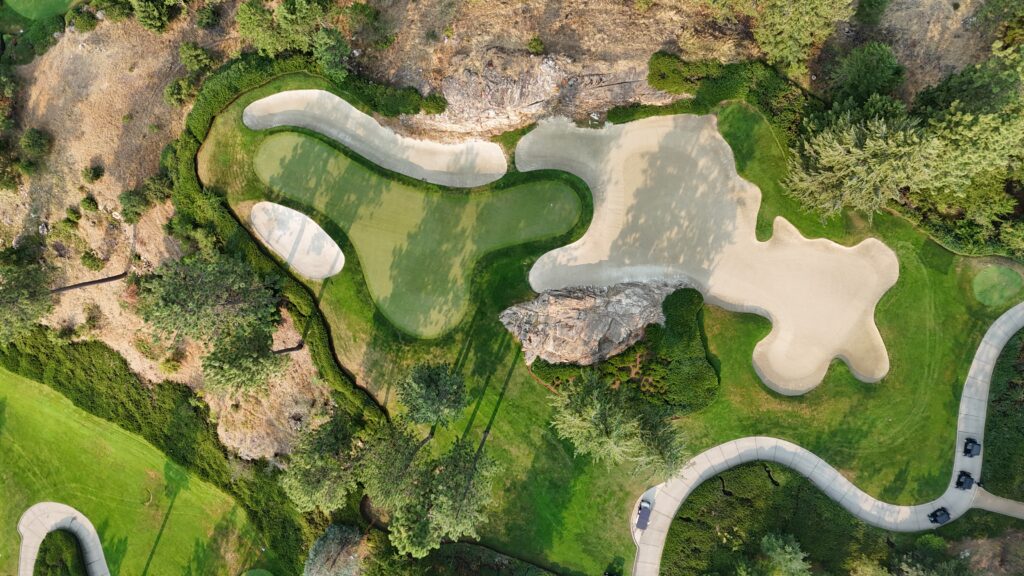
The green at the fifth is incredibly unique. Our Gen-Z caddie described the green as “shaped like a fidget spinner” and I simply cannot put it better myself. Three tongues stick out creating three miniature greens. The design forces the player to hit a dead accurate wedge or face certain demise. Rocks and deep greenside bunkers surround the flanks on each side of the fidget spinner’s spokes.
Let’s pause here before continuing, because this is where I want to draw attention again to the fact that this course is not considered by Golf Digest to be one of the best 100 public courses in the U.S. Yet, I’ve showed you a nice opening par-5, a brutally difficult par-4, a lakeside par-3, an incredible, option based short par-4, and now a fantastic version of a template short hole, requiring a demanding wedge. All of these holes have an incredible aesthetic value, are as distinctive and unique as anything I have played, and none of them have an island green.
At this point in the round, I was no longer wondering whether Coeur D’Alene was more than its famous fourteenth. I was wondering how that question had ever become the dominant way to discuss the course.
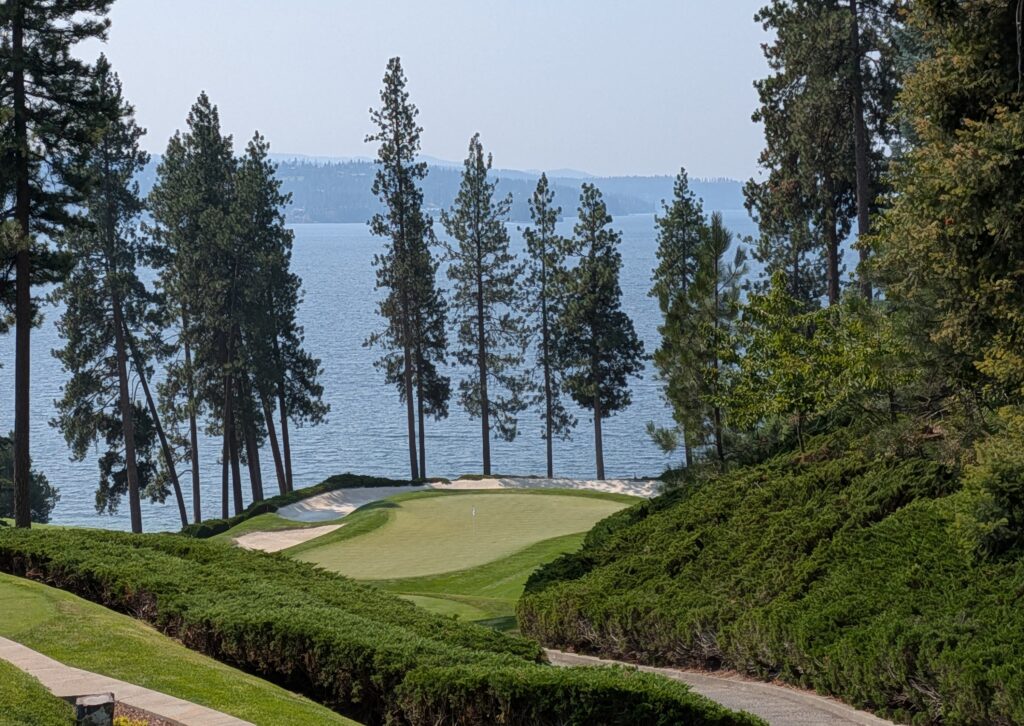
The sixth hole doubles down. The latter of the back-to-back par-3s is a beautiful downhill, mid-length par-3. This is a hole that has been done many times over all over the world, but somehow here, it is executed perfectly.
Often, from the back tees, courses with drop par-3s will get the angles wrong and the green will actually not be visible from the back of the tee box. Miller makes no such mistake here, and the green remains viewable even from the back of the back tee box, due to Miller’s usage of shorter, very vertically staggered tee boxes. The drop par-3 is actually very hard to execute correctly, but Coeur D’Alene Resort gets it right here. Oh, and it helps that the hole is framed by the tall pines and wonderful view of Coeur D’Alene Lake through the gaps in the trees.
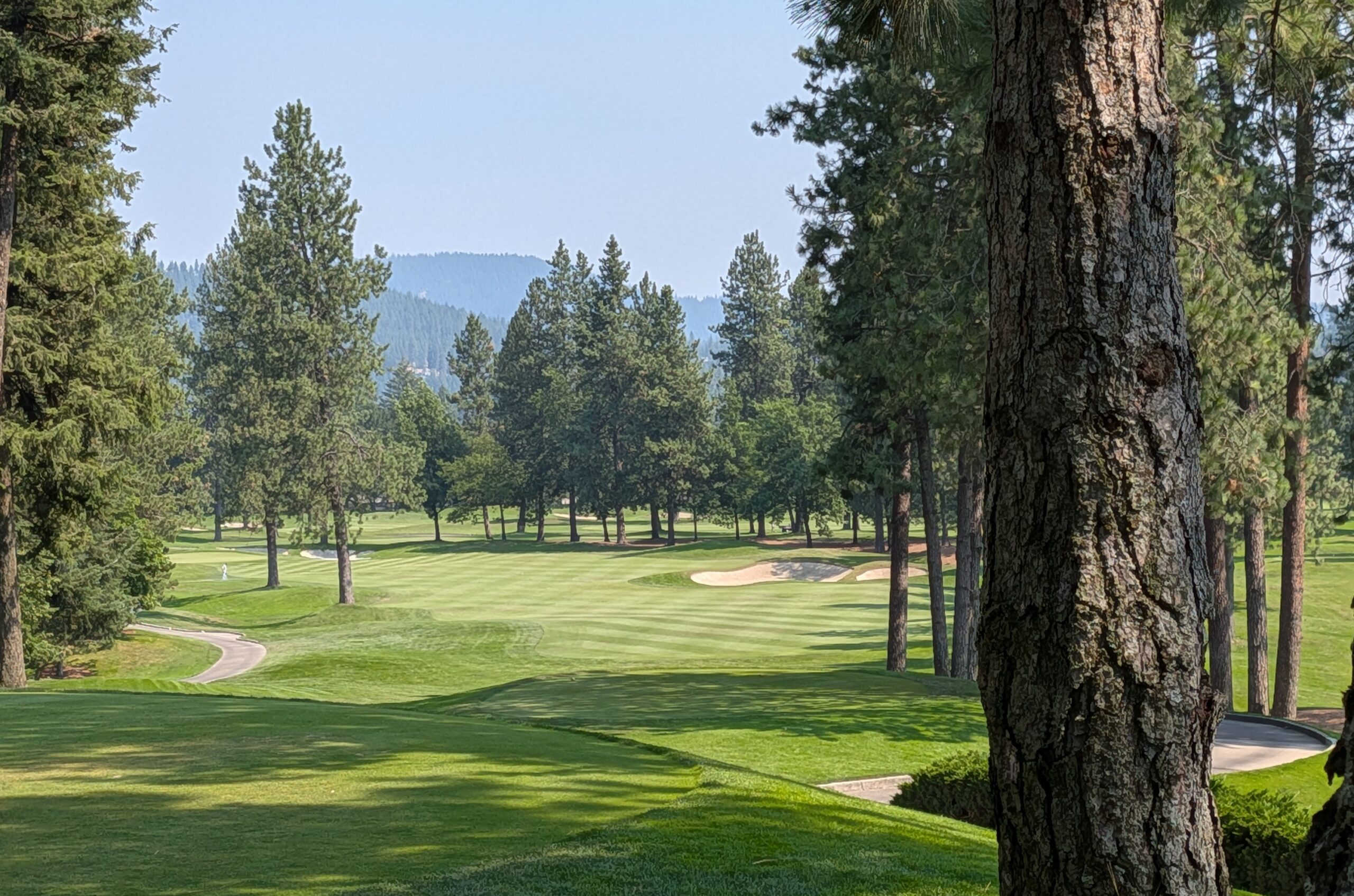
The seventh hole finishes off this hillside stretch of the course and comes off the hill as a dogleg left par-4 of medium length. Simple two-option strategy in this design: a player that can hit a controlled draw can easily hit driver past the bunker to set up a short approach. But, for those of us who struggle with making a golf ball turn left on command, the better play may be to lay up in front of the fairway bunker and face a mid-iron approach into the green. A swale off the back of this green makes recoveries from long borderline impossible, particularly when shortsided.
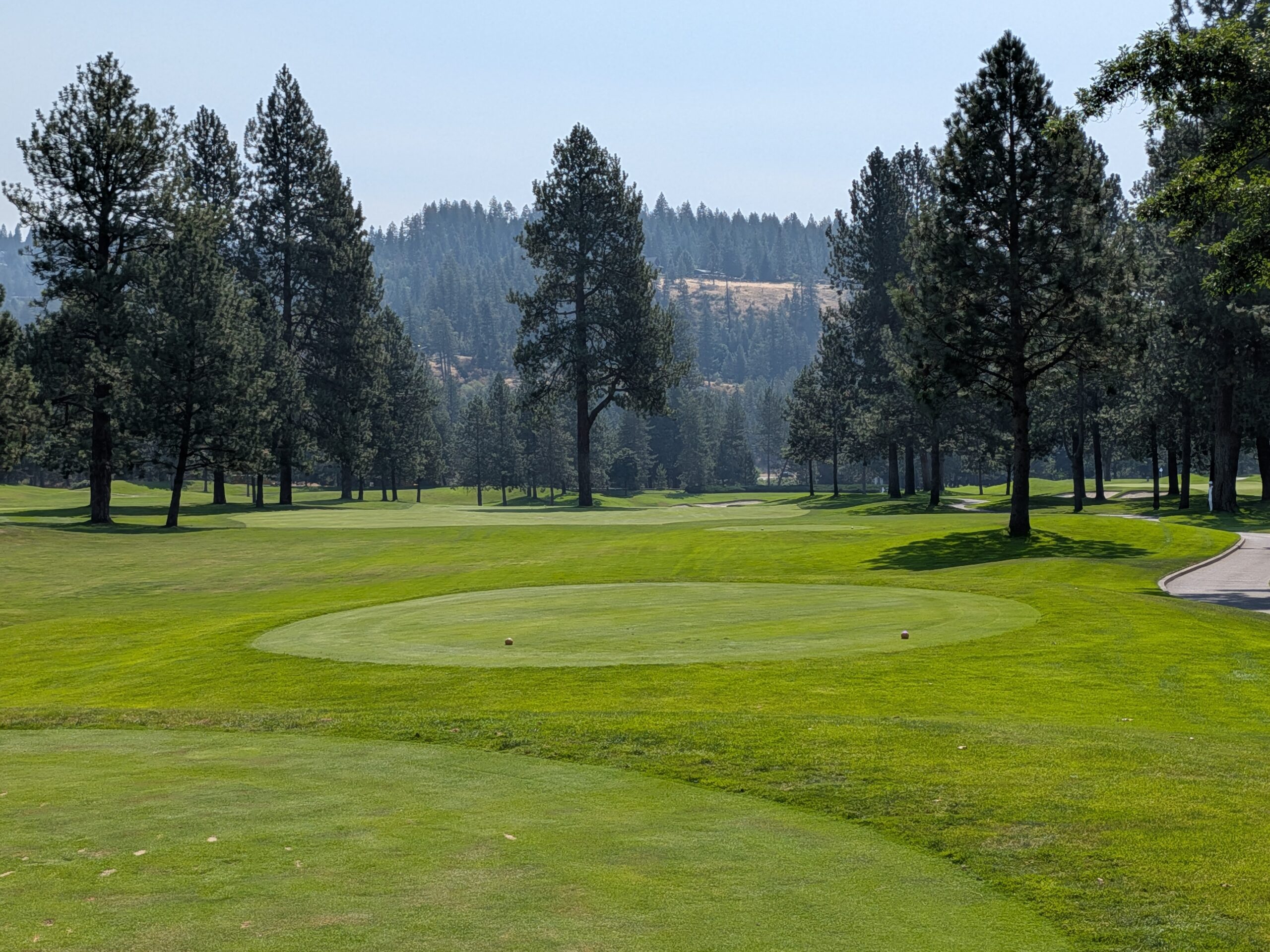
The eighth is a very unique hole and had to take some inspiration from Sahalee (another course played on this trip and for which a review is coming). The fourth hole at Sahalee’s south nine famously features a very narrow fairway, further made narrow by a pine that sits in the right middle of the fairway. Designed some 30-40 years later, Coeur D’Alene does the same thing on the eighth as the course begins to transition to the flatter area of the property.
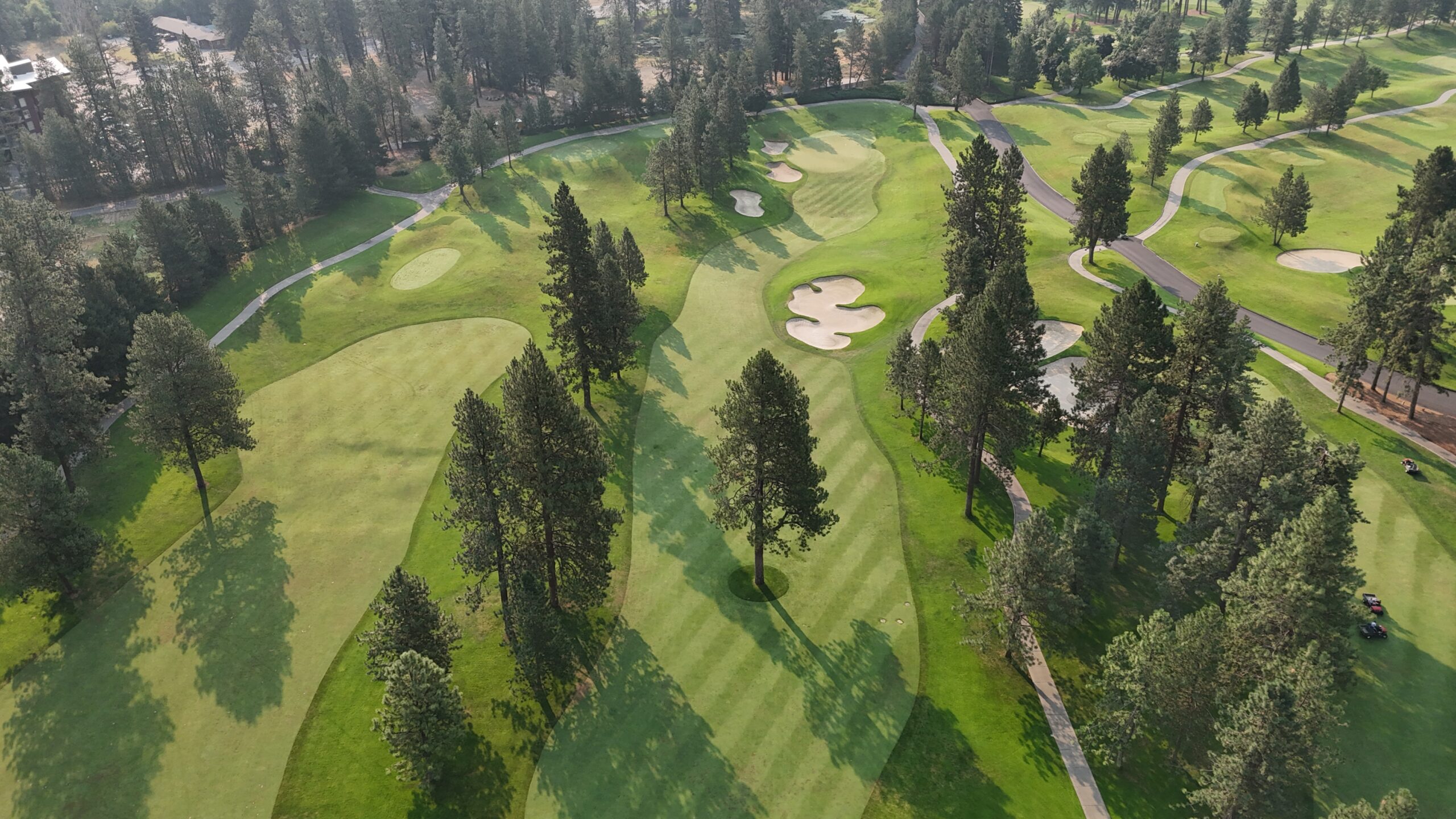
Unlike Sahalee, the lone tree here is almost centered between the tree lines, is very tall, and much more room exists both right and left of the tree. But similarly, both the tree at Sahalee and here at Coeur D’Alene sit approximately 215 yards from the back tee, which appears to be the perfect distance to allow a player room to negotiate around it. The only bad shot here is a shot that strikes the tree, which will leave over 200-yards into the otherwise straight, mid-length par-4. A fairway bunker squeezes the landing area on the right, meaning the optimal route from the tee is likely left of the tree.
The second through eighth is an exceptional stretch of public golf: varied, scenic, compact, and far more architecturally interesting than the course’s reputation suggests.
The ninth is a long, into-the-wind par-5, and the wind means it is the only true three-shot par-5 at Coeur D’Alene. A large fairway bunker on the right squeezes the landing area on the right. The smart play here may be to lay up in front of the fairway bunker that sits around 280 yards from the back tee, since three shots will likely be required anyway. Otherwise this is a simple, straight, long par-5 in which two good shots should leave an opportunity to attack with wedge in hand.
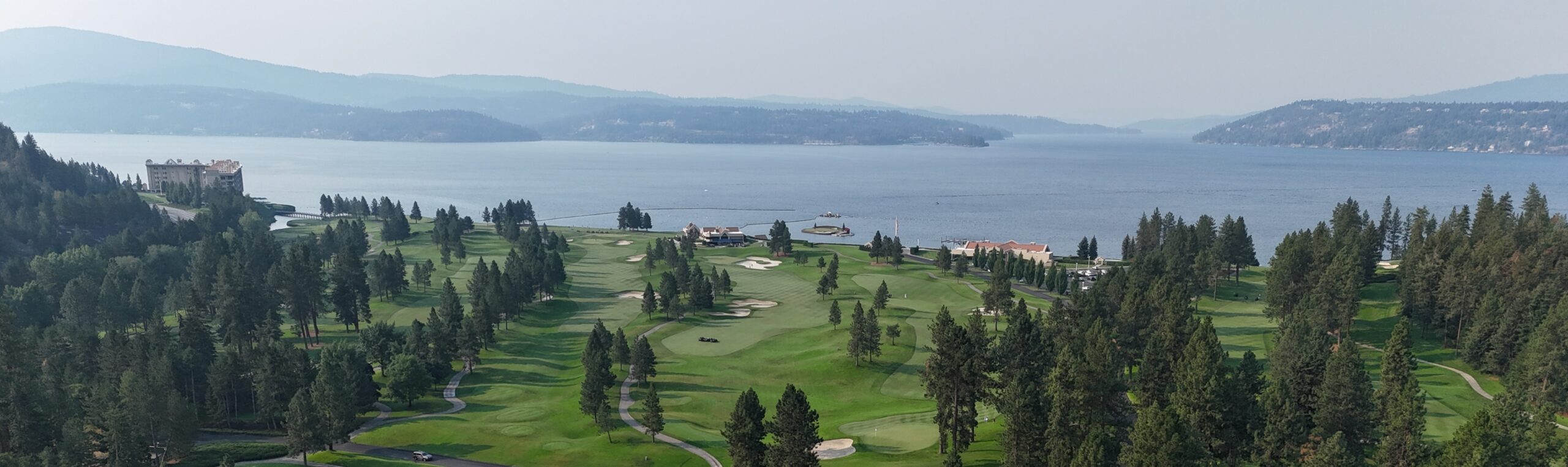
Making the Turn
The tenth and fifteenth holes are essentially twin holes running directly parallel with each other. If there are any criticisms I have of this middle section of the course, it would be length and the down-and-back nature of some of the routing. The tenth is a longer par-4, but runs directly beside the short par-5 fifteenth and they are quite similar holes. Regardless, the tenth features a large bunker on the right of the landing area that again squeezes the landing area down from a wide fairway. Miller somewhat repetitively uses a wide fairway, pinched on one side of the landing area by a large fairway bunker. This pinch, again, happens around 280-yards from the back tee.
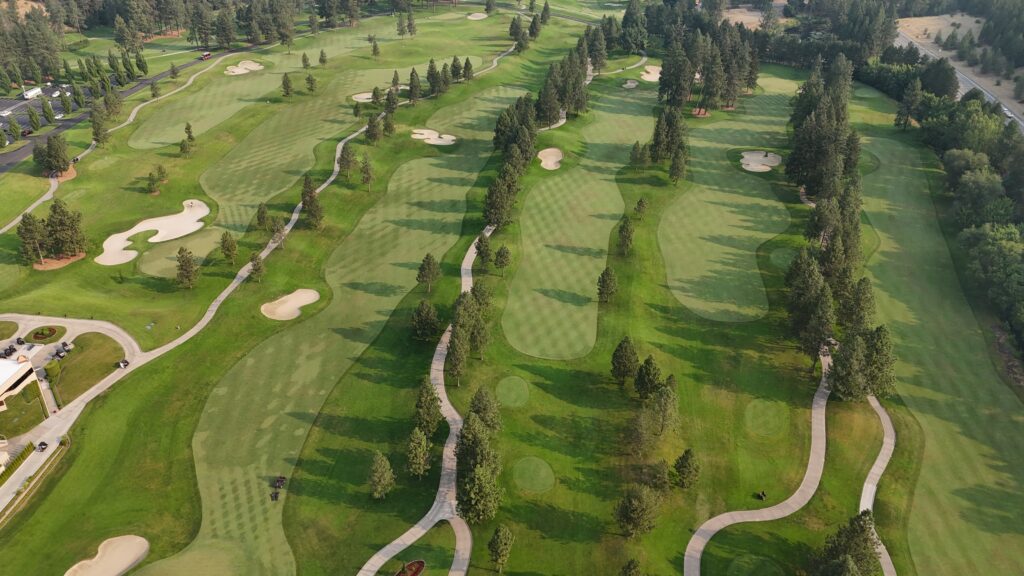
That would be my main criticism of the course: in the flat area of the course, Miller seems to have lacked imagination, and repeatedly uses this concept: the first, ninth, tenth, fourteenth, and eighteenth. Which, coincidentally, are all beside each other. I think this concept is fine once or twice, but more imagination in this flat section of the course may elevate this stretch.
Fortunately, Miller uses these holes mostly as connecting holes to more interesting areas of the course. The first obviously connects to the great run between the second and eighth, the ninth and tenth are connectors to another great run of golf holes between the eleventh and the fourteenth.
The eleventh is a fun par-5 with a narrow tee shot, and features the first hole (but not the last) at Coeur D’Alene that asks the player to navigate some water.
The tee shot is relatively tame, but tight, framed by the canal on the left and dense trees on the right. The fairway slopes gently towards the canal, further complicating the tee shot. Since the hole plays back towards the lake, it does play a bit longer than the scorecard yardage, and will ask a player who has hit a good tee shot to make a decision.
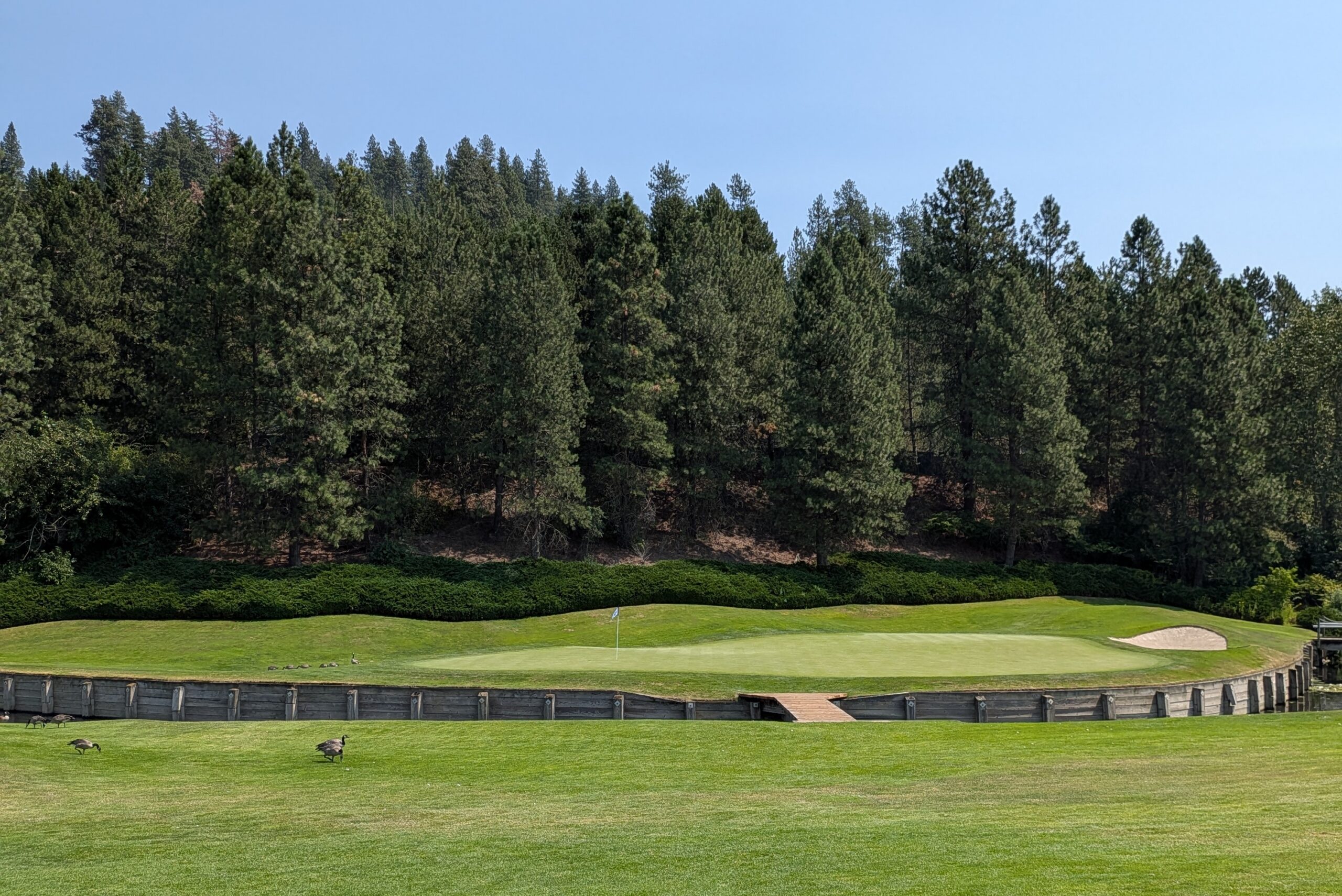
The green sits on the other side of an elbow in the canal, alone on somewhat of an island with a singular bunker behind the green. There is plenty of real estate to go for the green on the second shot, but anything slightly pushed to the right will find the canal. The layup is somewhat uncomplicated, but the fairway cants more towards the canal on the further end, meaning the wedge shot could be played off an uneven lie.
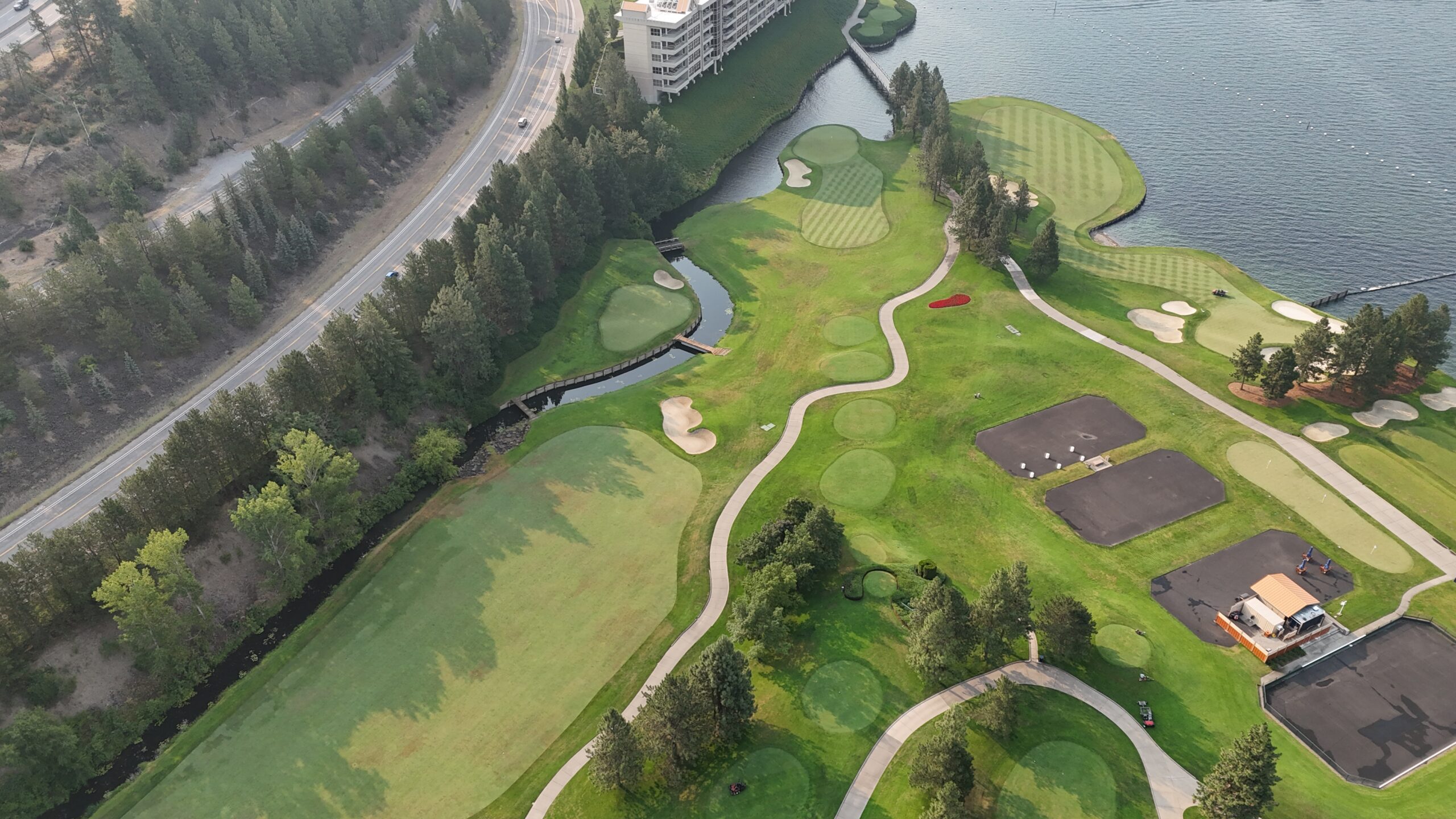
The twelfth hole is the most difficult of the par-3 holes at Coeur D’Alene Resort, and a legitimately tough, long par-3. Playing around 225-yards from the furthest back tee, the large green is shoehorned by the lake, meaning that badly mishit balls might be okay, but well struck balls that are slightly offline are likely to find the water, especially to back pins. From this distance, playing for the front edge and trying to keep the ball short of the water is a reasonable play. But, the green is pitched relatively significantly back-to-front (to catch those long-iron approaches); getting the ball to the hole from short with the water looming behind is a frightening proposition. The twelfth is a genuinely tough par.
The thirteenth is a great risk-reward hole for most golfers, and incredibly aesthetic, as it runs alongside the lake as a short par-4. A small inlet of the lake divides the fairway, but most with above average distance will have the opportunity to carry the inlet if they desire.
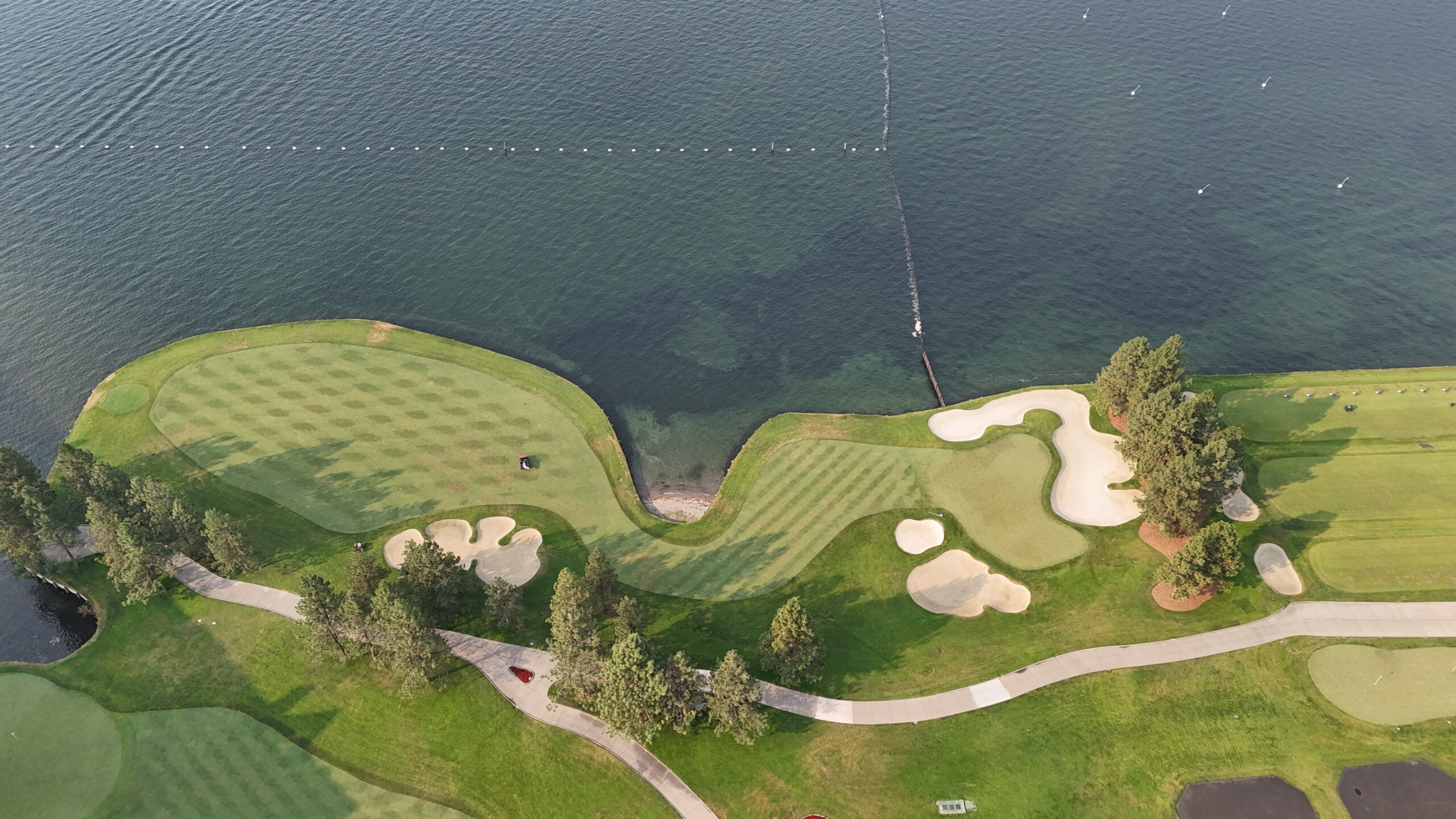
Admittedly, I wish this hole was a bit longer. Right now, for longer players, the risk-reward proposition is mostly about driving the green, but the hole might be a touch better if 10-15 yards longer. Then, the risk-reward curve would be altered. Longer players could carry the inlet for a short pitch, but some would likely elect to layup short of the inlet, leaving a short iron in. Twenty years ago, the inlet was likely perfectly placed, but with the modern advancements in golf, I would assume that most players can easily carry the inlet from their preferred tee box. The green here may be as aggressive as any on the course, which make sense for a short par-4, with a right section largely tilted front-to-back, and a small shelf on the back right. This hole is a perfect buildup to the island fourteenth, and introduces you in a friendly manner to the lake, the wind direction right on the water, and the pressure of shots played along the lake.
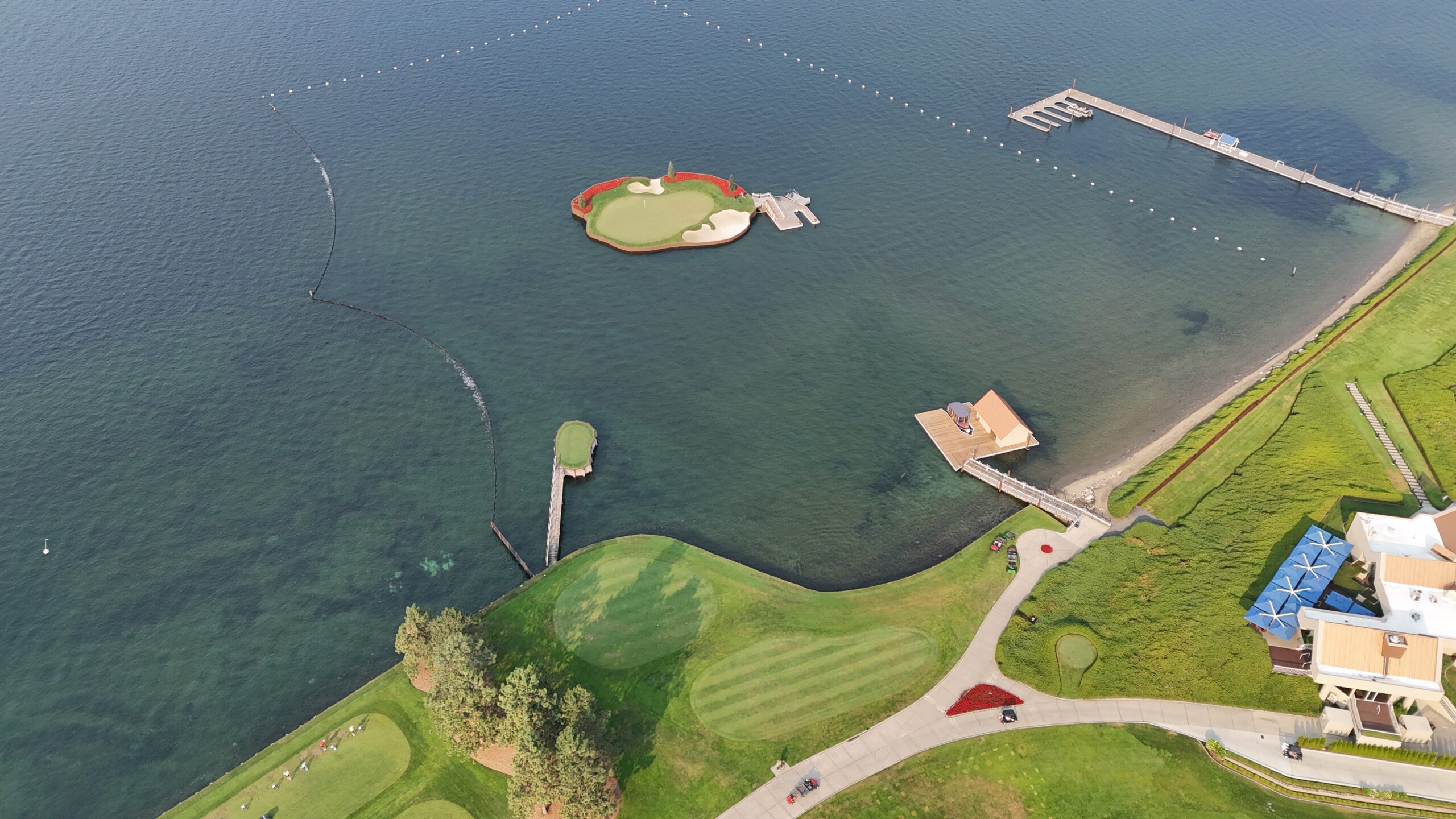
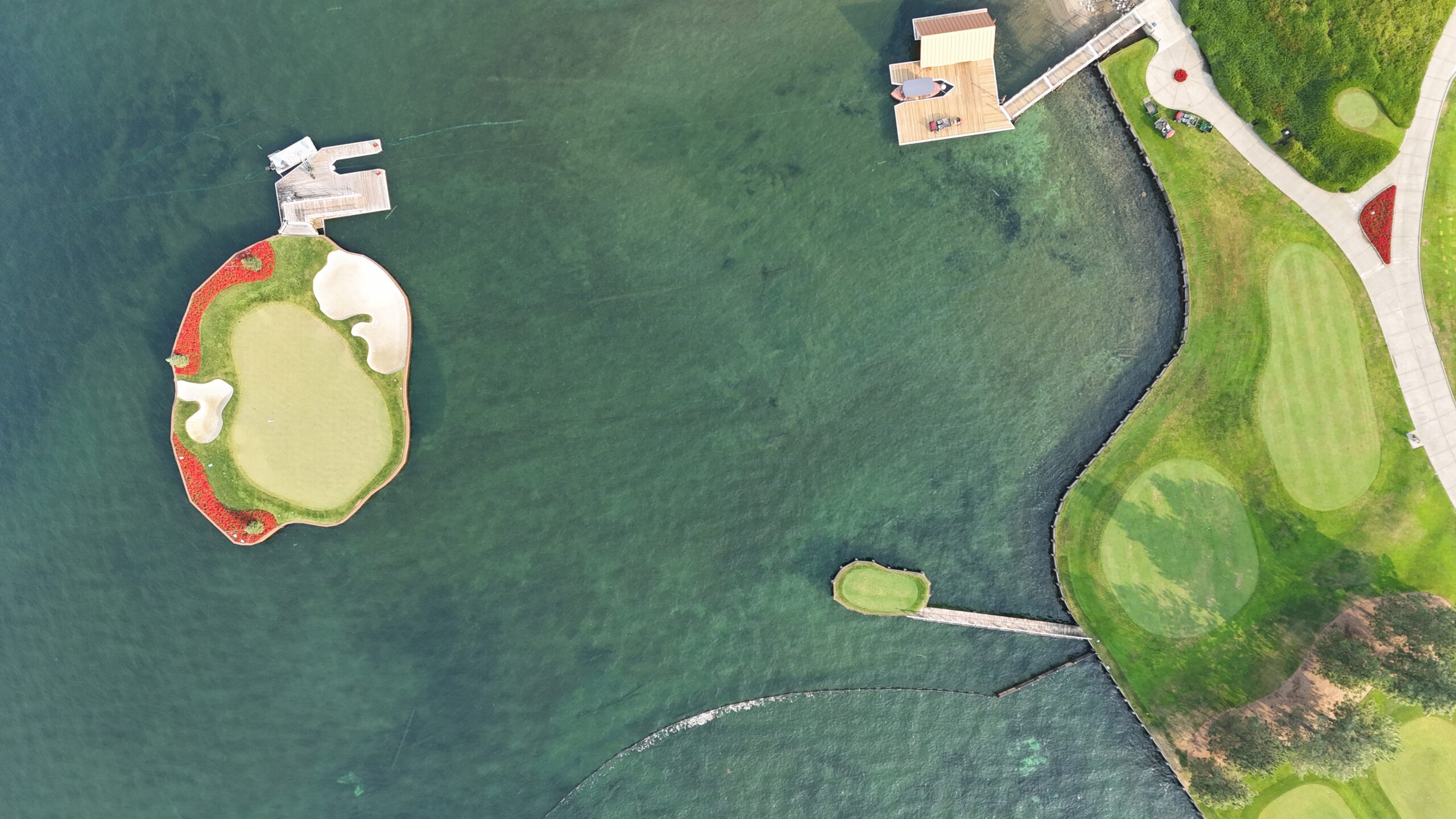
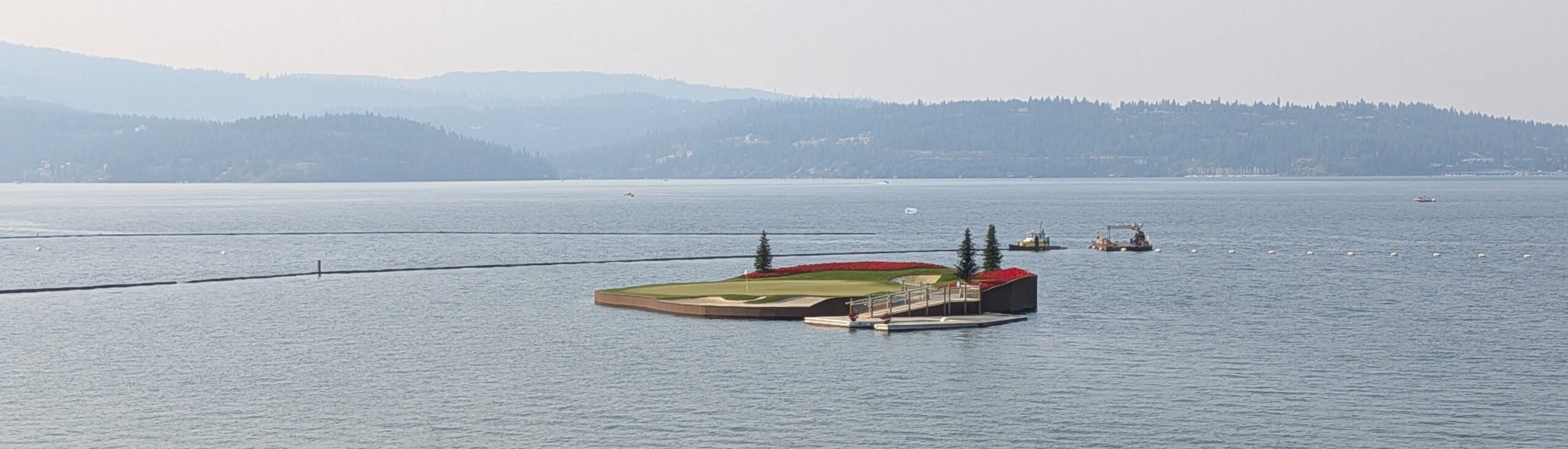
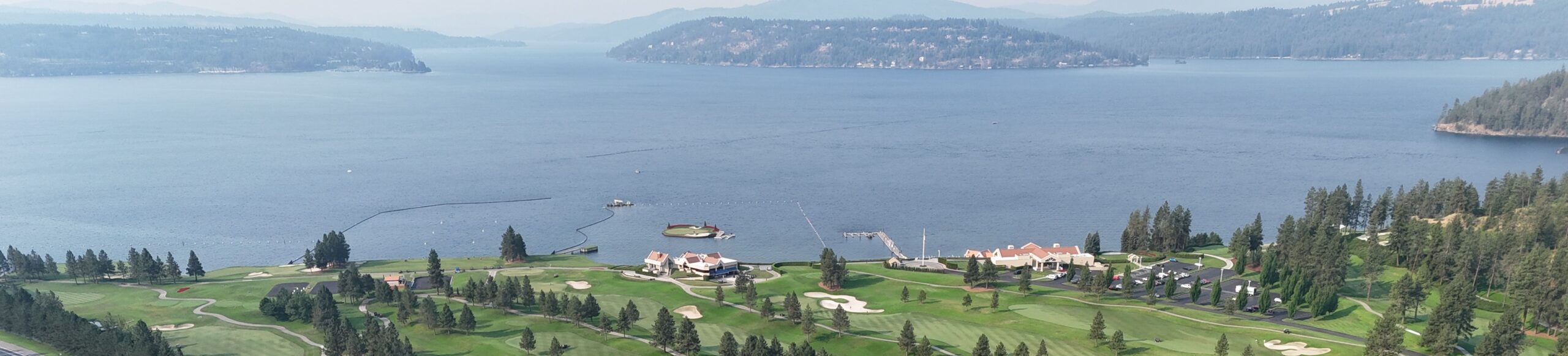
Then comes the fourteenth, the famous floating island par-3 of variable distance. The hole is undeniably beautiful, with red flowers lining the back of the island and bunkers guarding the front-right and rear portions of the green. It is also, objectively, a gimmick. But it is not an offensive one.
Architecturally, the fourteenth is not especially complicated. It is a mostly aerial shot to a large, relatively tame green, with little internal movement and no real ground-game option unless a player is particularly skilled at skipping balls across water. But plenty of good golf holes are purely aerial, and plenty ask a simple question with a spectacular backdrop. The fourteenth does not offend architecturally; it simply does not ask much beyond commitment, distance control, and nerve.
The novelty of the experience is still excellent. It offers one of the more memorable heroic shots in resort golf, one of the only ferry rides in the game, and perhaps the easiest group-photo opportunity in American public golf. It is unique, beautiful, harmless, and unquestionably a mental flashpoint in the round.
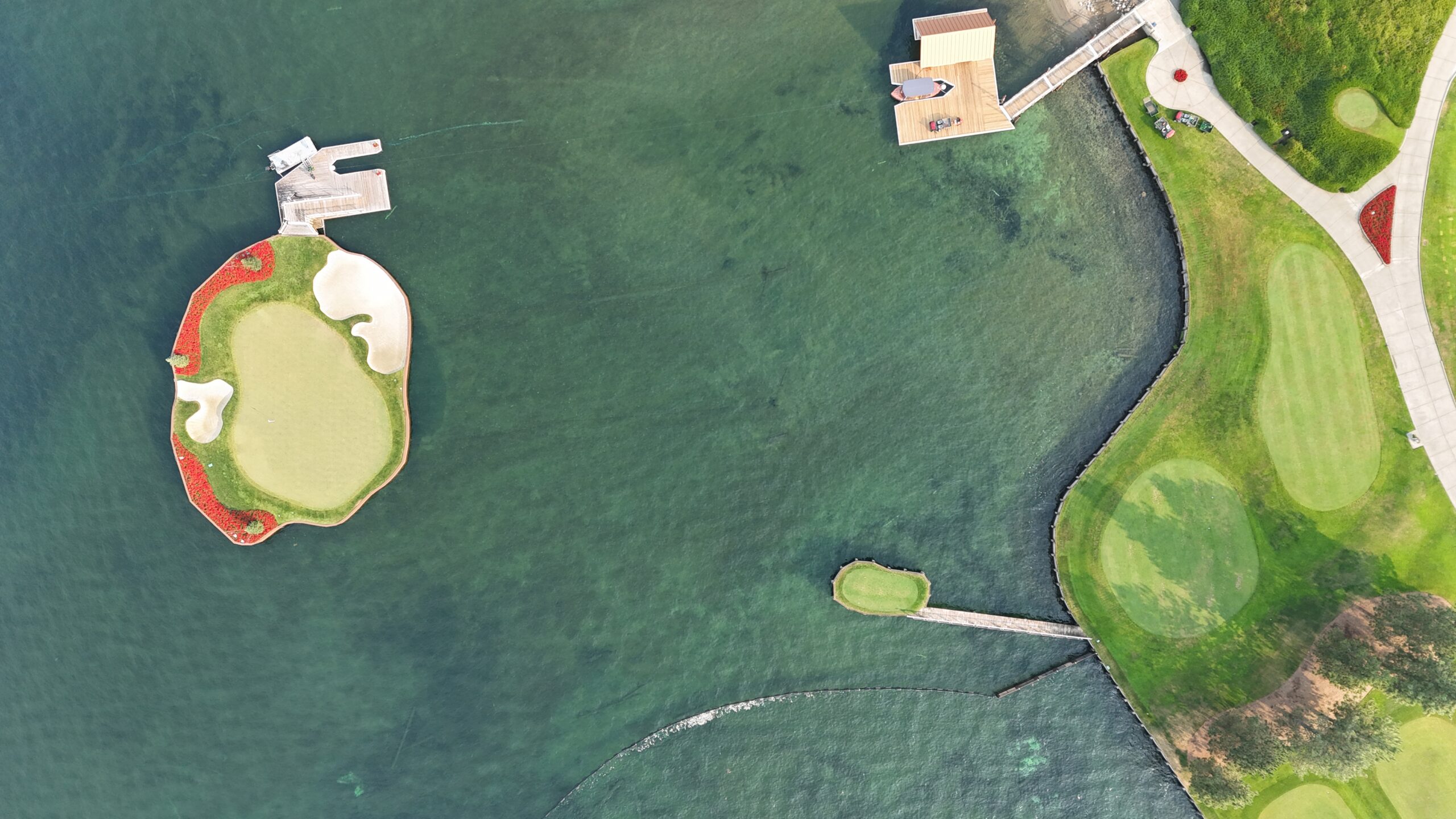
It is also, in my view, only the fourth or fifth best par-3 at Coeur D’Alene Resort, which says far more about the strength of the course’s par-3 set than it does about any weakness of the floating green. The fourteenth is an incredible marketing achievement, but for me it was not the hole I came to play. It was simply a cool part of a much better golf course than its own marketing sometimes allows people to see.
Once the ride on Putter was complete and a certificate for my playing partner’s birdie filled out, we headed across the property to the fifteenth, the aforementioned sister hole to the fourteenth. The fifteenth is the one hole where Coeur D’Alene’s lack of length becomes difficult to ignore. This hole is a 491 yard par-5 from the back tees, just 30 yards longer than the tenth, and the same shape. The only major differences between the tenth and the fifteenth are the par value, the bunker being on the left of the fairway instead of the right, and the green shape. The tenth has an almost perfectly circular green, whereas the fifteenth has a very long, narrow green, which means any miss left or right was short-sided to any pin.
The problem is, the hole plays downwind. On this firm day, my playing partner hit a good drive, and had pitching wedge into the hole. The frustrating part is that the solution appears available, as the fifteenth is one of the few holes at Coeur D’Alene with room to expand.
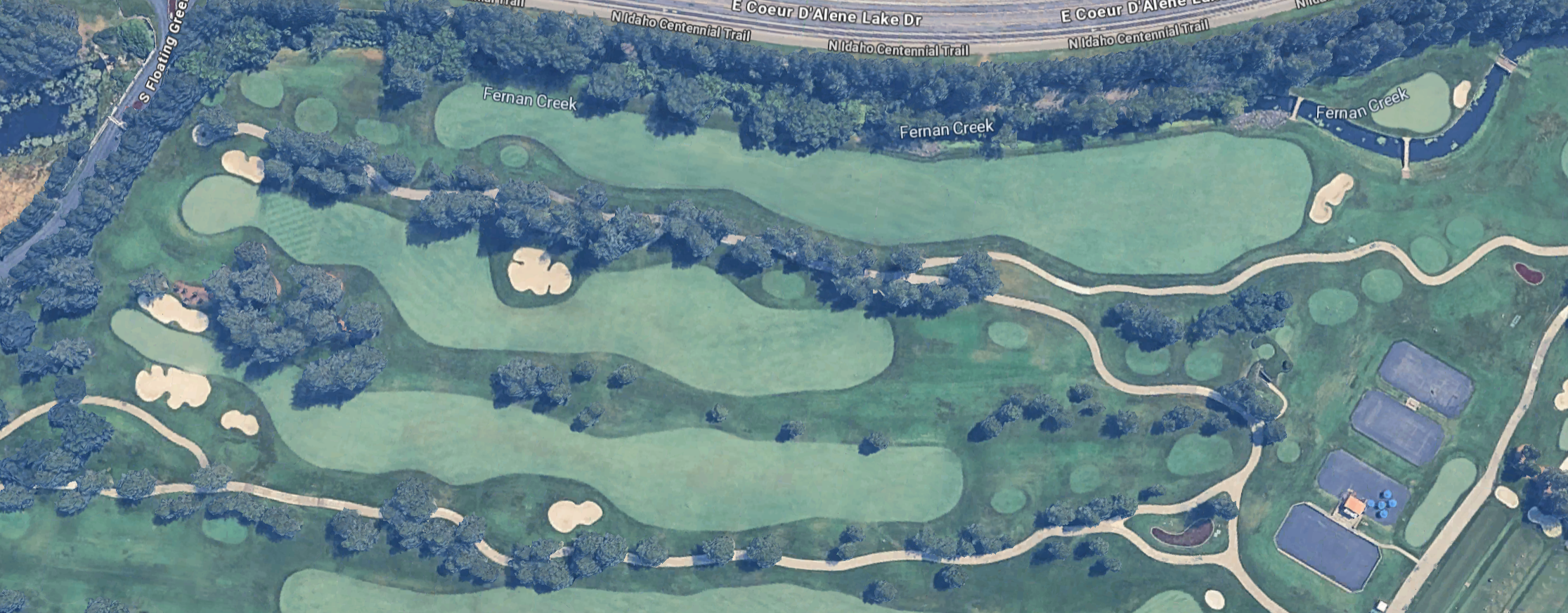
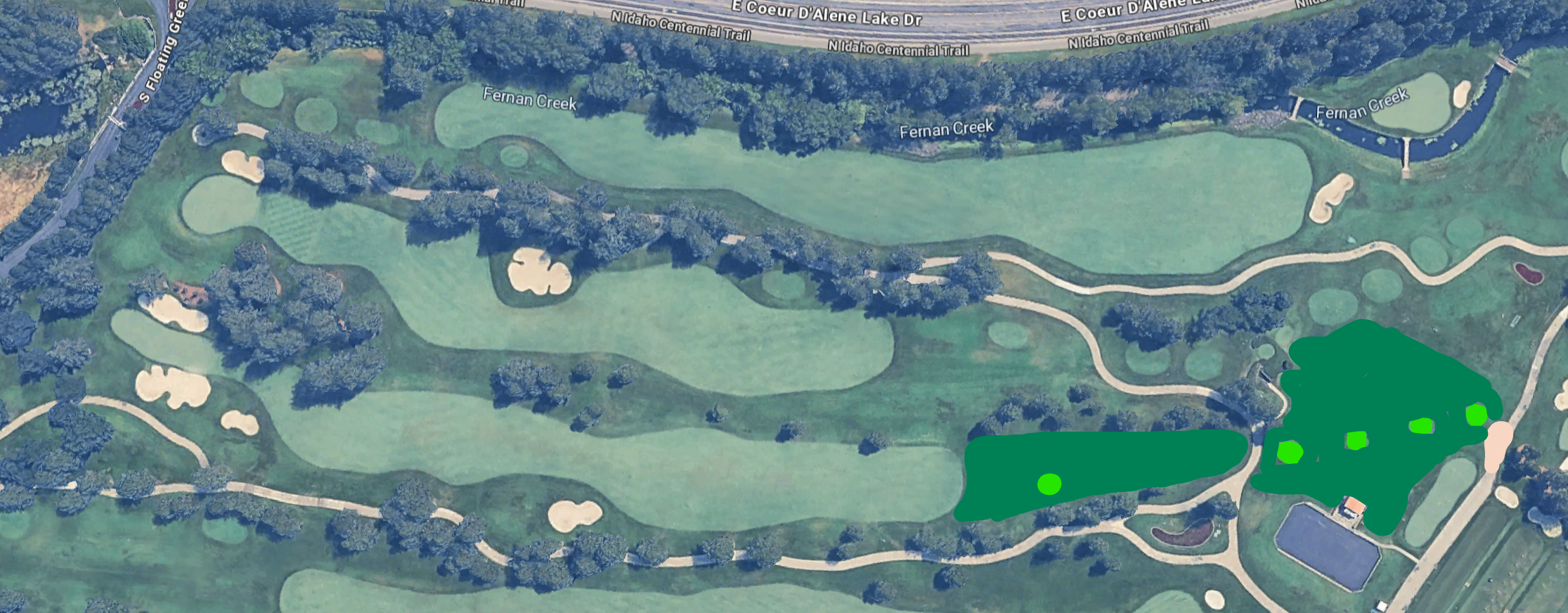
Forgive my crude drawings, but this hole could easily be lengthened to a 580-yard downwind par-5 with the removal of a few tennis courts. Clubs and resorts alike need to face facts on racquet sports, and I could talk all day about this, but club tennis is dead in the U.S. Very few people are joining a club or choosing a resort to visit for tennis. Why? First, tennis courts are one of the most widely built public sports facilities in the U.S., and most are free to use. Most every city has two or more public parks with tennis courts on them. They are easy to find for free. Secondly, among club members and resort guests, pickleball’s popularity has exploded.
Golf, however, has never been more popular. Now is the time to prioritize the golf course and ditch the tennis courts. These courts could be rebuilt somewhere else on property, and optimized for pickleball play, and the resort likely wouldn’t lose a single reservation in the meantime.
The sixteenth is a really fun hole, and if the resort wanted to, property exists behind the sixteenth to lengthen it some. For right now, it is a likely layup off the tee in front of the pinching bunker on the right. The fairway weaves around this bunker and, unlike any other hole at Coeur D’Alene, the fairway ends well short of the green.
Here, the green sits on an island, unprotected by any bunkers; just rough. Four small bunkers dot the end of the fairway, and mostly serve as an optical illusion to new resort guests. I appreciated the uniqueness of this hole, which is also in the flatter area of the property.
Miller followed this design up with another unique hole at the seventeenth.
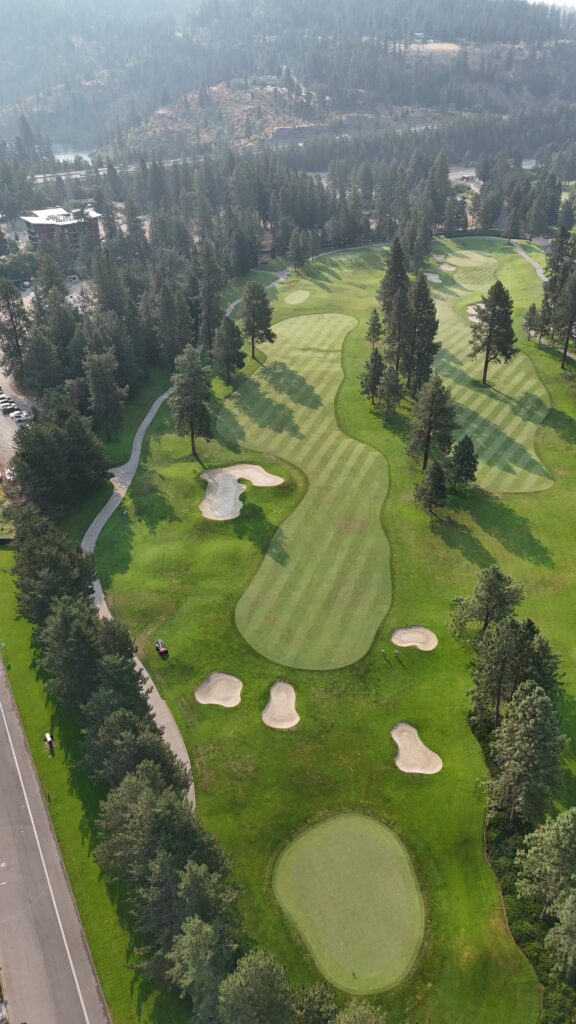
The seventeenth is a really short par-4, but really quite fun. Everyone here, long or short, has an opportunity to drive the green. Some with fairway woods.
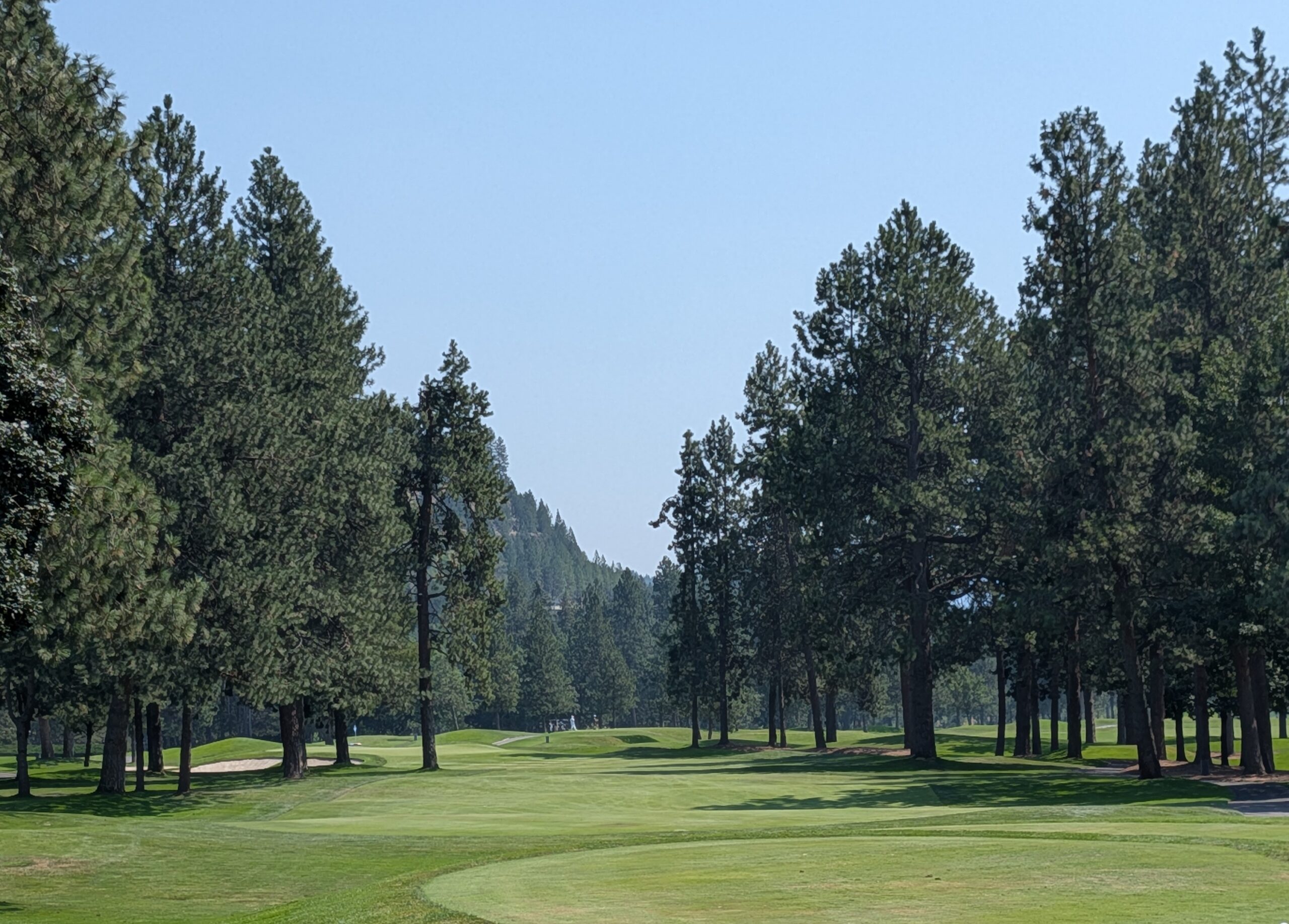
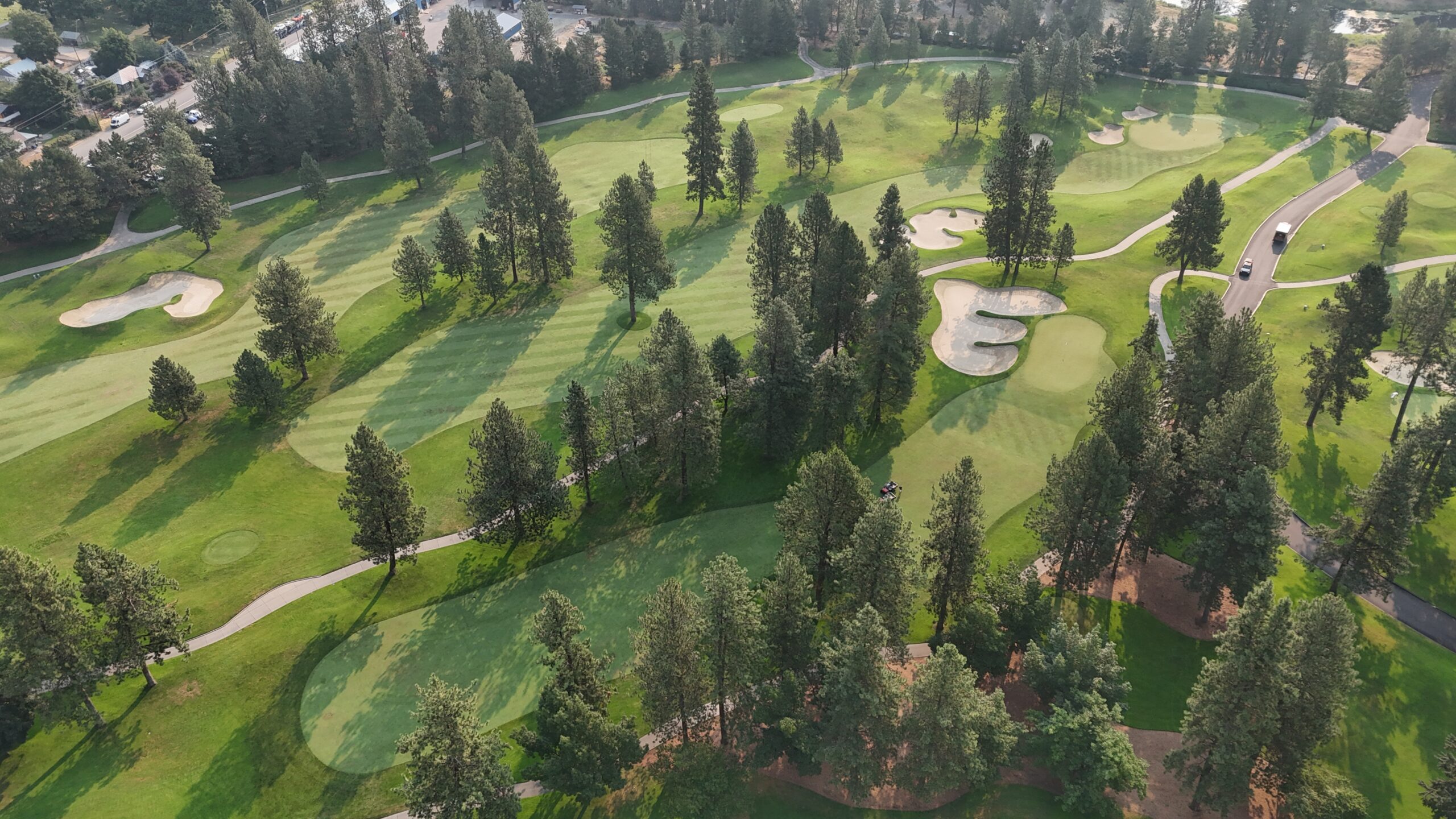
The complication here is that the green sits tucked around the corner of a very tall group of pines, meaning that a draw to reach the green surface is required. That green surface is quite small and is protected by possibly the largest, deepest bunker on property. Those with less guts have nearly as good of a birdie opportunity, as an iron off the tee and a pitch shot should yield a reasonable opportunity. The risk-reward here is not between birdie and bogey, but between eagle and par. On a resort course on the seventeenth hole, with quite possibly the match of a golf trip hanging in the balance, I absolutely love it. This hole comes at the perfect place in the round.
For matches not concluded at the seventeenth, hold on, because the toughest hole on the course awaits at the long, into-the-wind par-4 eighteenth.
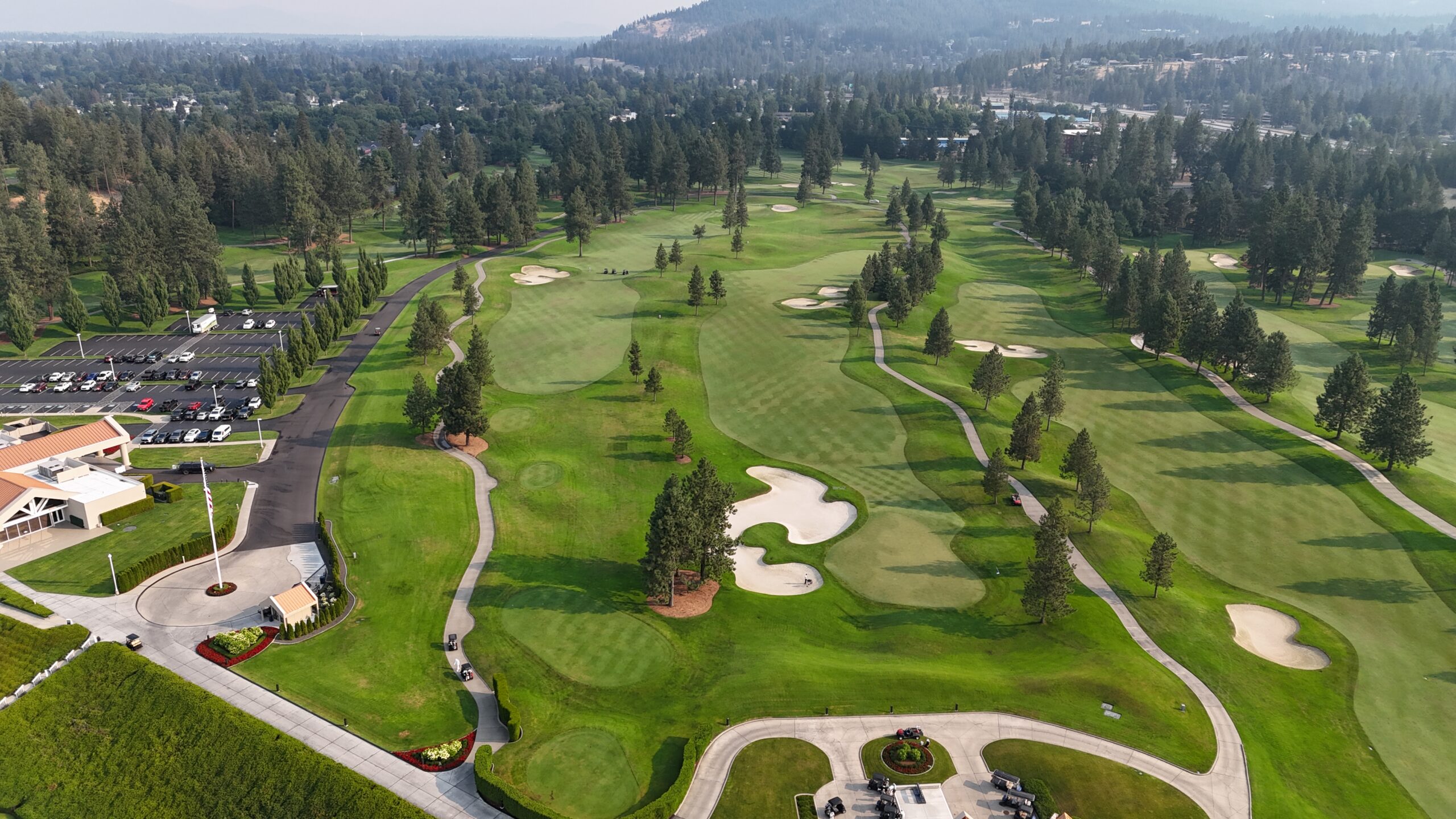
The eighteenth is 460 yards on the card, but into the wind, is effectively around 500 yards from the back tees, with a fairway significantly narrowed by two fairway bunkers. An accurate tee shot and accurate fairway wood or long iron approach is required here. Fortunately, the green is large, but has a bit of internal undulation. A par here is a score that will likely win matches arriving to the eighteenth hole all square.
Final Thoughts
When evaluating whether I think a course should be included in the Top 100 Public ranking, I come back to the critical question that the list really seeks to answer: “is this course one that I would travel across the country and pay a high greens fee to play?” That is as important a question as any architecture question for a Top 100 public list, because consumers use those lists to understand where the best places to plan golf trips might be. The Top 200 U.S. list ranks courses primarily on architectural prestige, and it currently includes only about 35 public courses in the country. The Top 100 Public List should balance architecture with enhanced focus on memorability, playability, conditioning, and aesthetics. The Top-200 U.S. ranking is about prestige; the Top 100 Public ranking is a consumer resource. It includes those 35 public courses that make the Top 200 U.S., plus roughly 65 additional public courses that don’t quite reach that architectural bar but produce the memorable, distinctive, destination-worthy golf experiences that consumers are looking for when they plan a trip.
Coeur D’Alene Resort has both architectural merit and destination worthiness. It has memorable design, particularly in the two architecture-forward stretches from the second through eighth and eleventh through fourteenth. The supporting cast of holes can become a bit repetitive, but every course of this caliber has a few bland holes. Coeur D’Alene has a fantastic aesthetic value, was conditioned extremely well (our visit was during the summer, when minimal rainfall makes conditioning most difficult), so many of the holes are individually memorable. The set of par-3’s here are genuinely elite, with each of the five par-3s asking a different question (short iron success, extreme precision with a short wedge, wind and elevation calculation, long iron execution, and mid-iron nerves under huge penalty pressure).
Our group all left questioning how Coeur D’Alene Resort has been left off the Top 100 Public list, and signature hole contamination is a real phenomenon worth naming. If you arrive at Coeur D’Alene Resort, unload your bags, and catch your first view of the island fourteenth, and spend your next three hours waiting to hit the shot, you’ll miss the true strength of the golf course.
It is not all the course raters’ fault. The discussion of the course, the advertising, the logo, the whole aura of the place lures you into thinking the main attraction here is a novelty shot to an island green. It would be easy to mentally check out, slog through the round, and get to the fourteenth to see what all the fuss is about.
But, don’t do that, because while the fourteenth is a novelty, the rest of the course is unequivocally one of the best 100 public courses in the U.S.
CR&J Final Rating:
Shot Options: 7
Challenge: 7
Layout Variety: 7
Distinctiveness: 9
Aesthetics: 8
Conditioning: 9
Character: 7
Fun: 9
Total: 63/80
Read More: How We Rate Courses
Rating Scale Details:
> 70: Top-50 U.S.
65-70: Top-200 U.S.,
60-65: Best-in-State List
57-60: Best-in-state List Contender
53-57: Very Good
48-53: Good
40-48: Average
< 40: Poor

Author: Kyle Taylor
Kyle is the lead course reviewer at The Course Review & Journal. Kyle has been playing golf for over twenty years, is a plus handicap, and actively competes in USGA and State Golf Association events. By trade, Kyle is an attorney.
Kyle Taylor is a pseudonym used by CR&J’s lead course reviewer to protect personal relationships. The reviews and opinions remain entirely the writer’s own.
Leave a Reply
You must be logged in to post a comment.