

Time to Read:
|
This Riviera Country Club course review is based on a round played in July 2025.
The Riviera Country Club is a private course in Los Angeles, CA.
CR&J’s Final Rating: 74/80 (Top-50)
Learn More: How We Rate Courses
Admittedly, I am a sucker for course rankings. Course rankings from Golf Digest and other major publications form the basis of a lot of what we do here at the Course Review & Journal.
That said, course rankings attract a kind of predictable cynicism. Often, when I am talking course rankings with a random golfer, they offer the same cynical refrains: “There’s no way to rank courses,” or “It’s just a popularity contest,” or worse, “They’re not ranking the golf, they’re ranking the wealth.” I am not inside of these organizations that rank courses. I don’t know how much influence that money, reputation, or access truly exert on rankings decisions.
But the Riviera Country Club offers a near-perfect test case for the cynic’s theory.
Riviera is highly ranked by all of the rankings lists (#19 in the U.S. by Golf Digest). When Golf.com asked PGA Tour players which course on Tour was their favorite in 2019, 20% said Riviera; the highest in the survey. Riviera is a perfect test case for the cynic’s central thesis, because Riviera sits at the intersection of wealth, reputation, media exposure, and institutional power.
Riviera has an annual PGA Tour event and has hosted and will continue to host many important events, including USGA championships and the Olympics. The legacy of George C. Thomas has become a touchstone in golf architecture lore, due to his work at Riviera, Los Angeles Country Club, and Bel-Air Country Club. Coincidentally, these are regarded as the best three courses in Los Angeles and are highly ranked in the State. His name is now synonymous with elite LA golf.
If course rankings are vulnerable to outside influence beyond the playing experience, Riviera would be among the easiest places for that influence to manifest. Particularly Riviera, because it is not a seaside spectacle with infinite views (à la Pebble Beach). Rather, it sits hemmed into an inland Los Angeles neighborhood over land that many would correctly call unremarkable. Yet, it has star-power, a revered designer, a wealthy membership, and is the host to key golf events of the past, present, and future. Away from the actual golf, few clubs in America present a stronger resume and ranking prestige than the Riviera Country Club.
So, I came to Riviera to stress-test the cynics: does Riviera expose the bias of “course rankings” lists or is Riviera truly one of the best twenty golf courses in the United States?
The First Tee
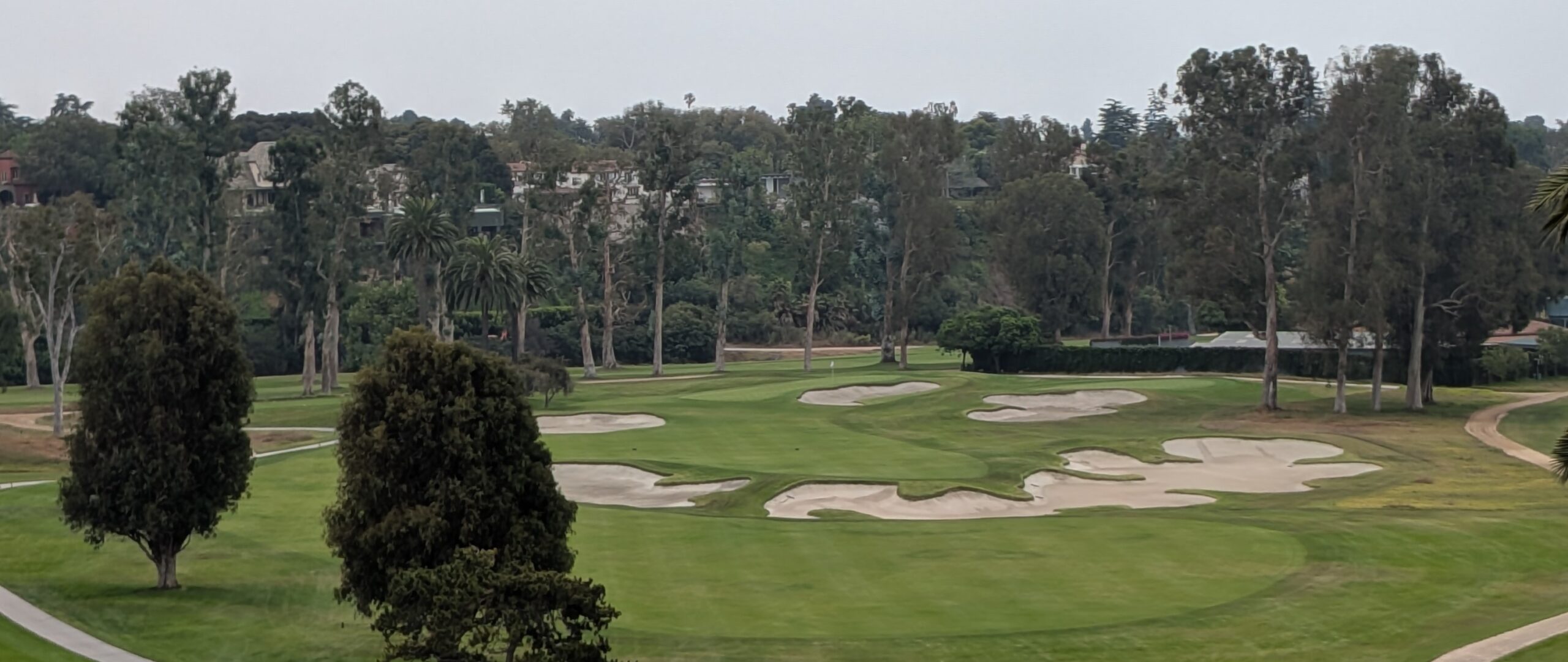
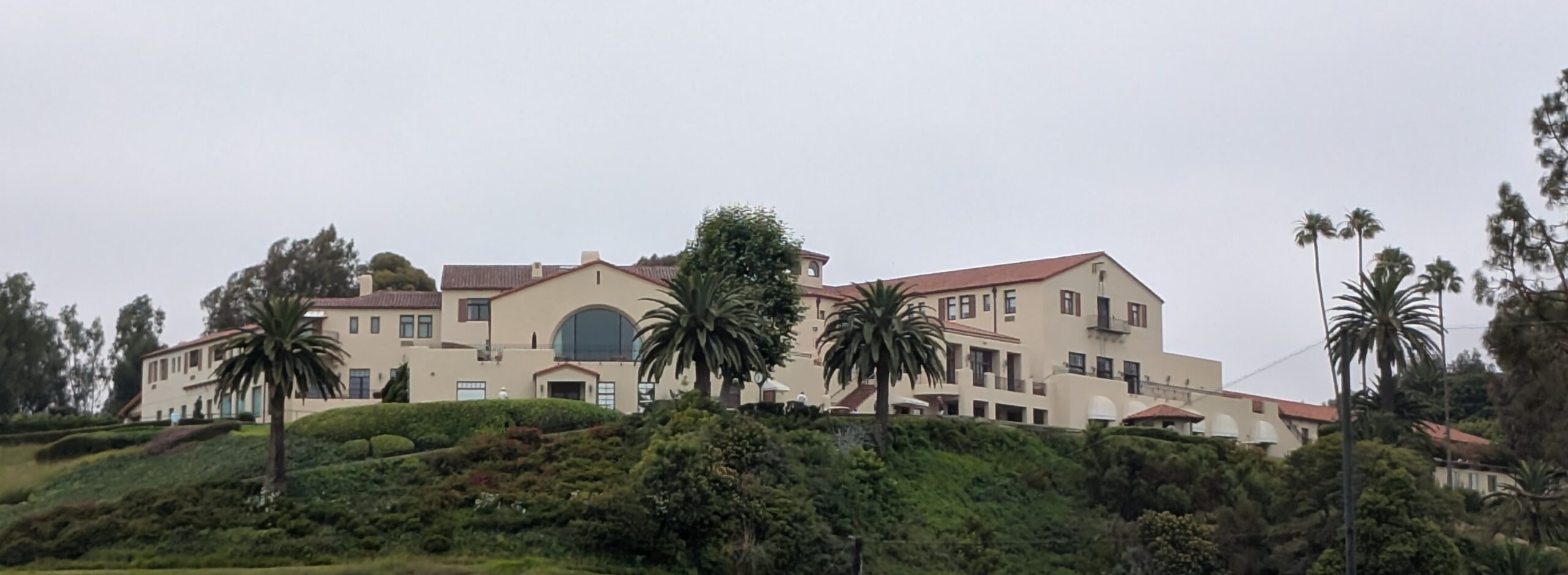
Riviera has an incredible tradition on the first tee using “tournament style” introductions for each player in the group. That wouldn’t exactly work everywhere, but it works at Riviera, and gives a subtle hint to the gravity of the place that you’re about to play. The history of Riviera is well documented, and the weight of that history, and the first tee nerves, really hit when you hear your name announced in front of the sprawling clubhouse on one of the most famous first tee shots in America.
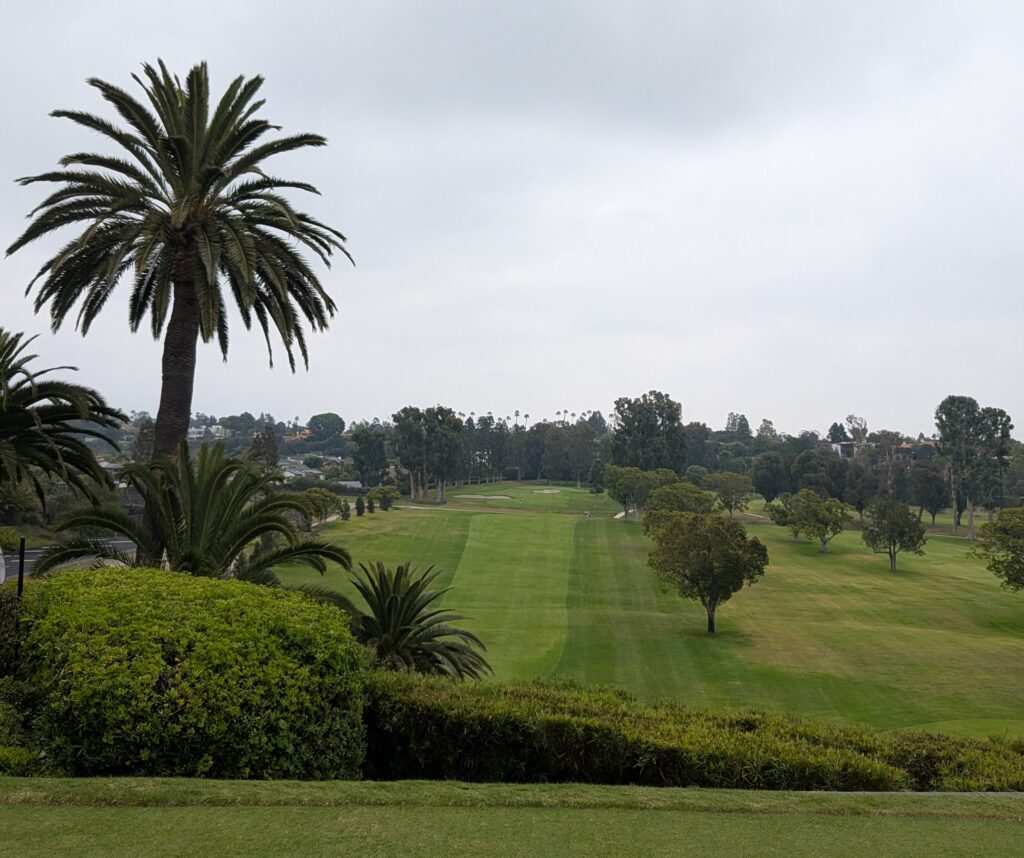
As for the actual golf hole, Riviera starts with two half-par holes, but I expect that the first will actually play as a par-4 for USGA Championships and the Olympics. However, for every day play, the first is a short and straight par-5 with a very elevated tee. Most of Riviera sits in a flat valley significantly below the clubhouse area. The first tee shot is the only shot played from the high point of the property, and but for a few shots (the ninth hole and the tee shot at the eighteenth), the course never really climbs back up that hill. Both the ninth and eighteenth greens sit significantly below the clubhouse level.
Once down in the narrow fairway, which has ample bail out room to either side, the second shot is relatively flat and should be no more than a long-iron into the green, over a large centerline bunker. The first green is also your first introduction to the unique poa annua greens at Riviera. Everywhere but the greens, Riviera has kikuyu grass, which has the reputation for being particularly sticky when mown short. I felt like I adjusted to this part well, but the poa annua greens are somehow fast and bumpy at the same time, which is incredibly disorienting if you aren’t accustomed to it.
For as relatively easy as the first hole is, it is paired with perhaps the hardest hole on the course, as the second is a long, uphill par-4 playing into a narrowing part of the fairway. George Thomas had to envision these holes as a pair, as they run parallel and take up the northern boundary of the property. Oddly enough, even though the hole is very long, the green here is quite small. I actually think that the first is easier, shot for shot, than the second, due to the first’s larger green and downhill nature.
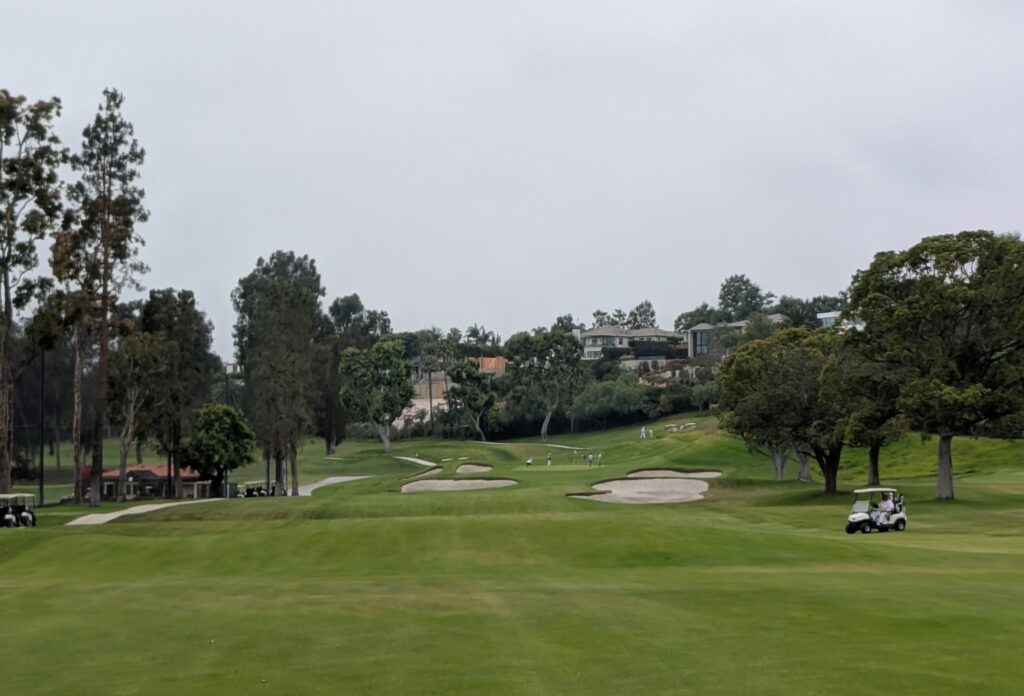
No matter how you divide the par value of the first and second, there’s no doubt they are a fun way to start the round. However, the half-par character of these holes is not characteristic of Riviera. I’d think they are the only “half-par” holes on the property.
I could write a dissertation of every hole at Riviera. Many have written about the third, the dogleg right par-4 in which the fairway is banked from right-to-left, making for a particularly uncomfortable tee shot. Or perhaps the fourth, the controversial long par-3 that often plays as the hardest par-3 on the PGA Tour. Those are so well covered, I’ll leave those discussions for other pieces, but I found both of them to be great holes.


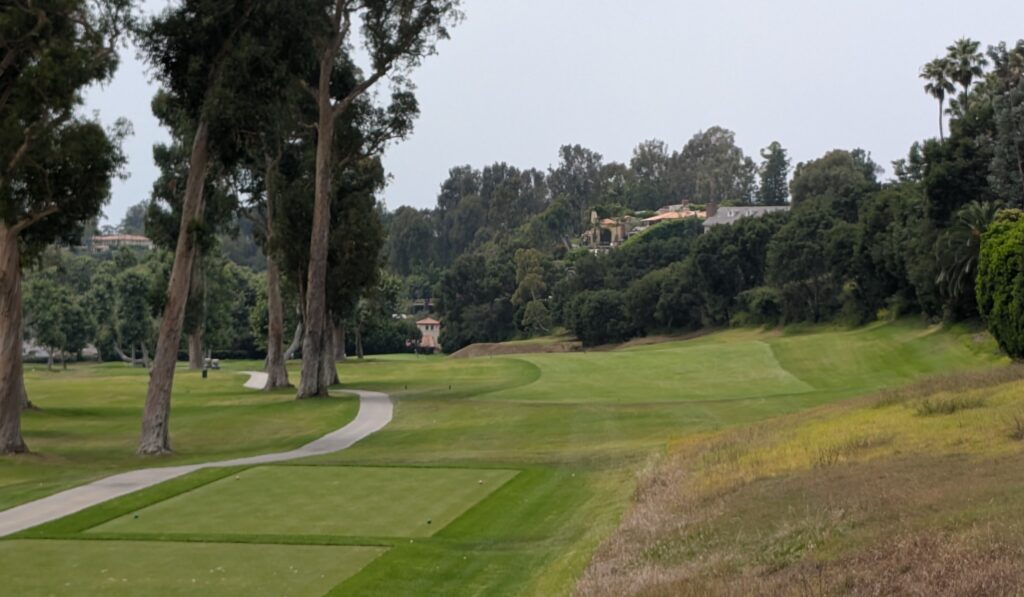
I want to spend my time highlighting what I think is one of the great stretches of holes in golf: the fifth through the eighth. The fifth, a shorter par-4 with a bit of a forced layup, is a shot-makers hole. The tee shot requires either a draw or dead-straight shot off the tee to find the fairway. There is a tee box slightly back and to the right of the tee box we played, but I think that is a worse tee box and makes the hole easier.
From the left tee box, which is the better box, the fairway runs out around 288 yards, meaning that (maybe coincidentally) Thomas has perfectly designed hole this for the modern game. Most players don’t like drawing the ball with driver with today’s equipment; most prefer to go to a fairway wood when playing a draw from the tee.
The fifth provides, if not forces, this option and provides the opportunity to hit just that shot shape. It also minimizes the damage for forcing a shot shape, as it does not feature any fairway bunkers. Rather, the only hazard comes from pulling the tee shot into the trees, missing into the trees on the right, or running out too long into the barranca that crosses the fairway.

The second shot is a gorgeous shot into a relatively unprotected green from a slight elevation. Thirty or forty yards short of the green, a knob bumps out from the right, providing some visual clutter for an otherwise simple shot.
Riviera is an exercise in restraint. This hole is the absolute perfect blend of strategy and challenge, not too hard, not too strategic, not too penal. Just the right amount of everything, with a touch of quirk.
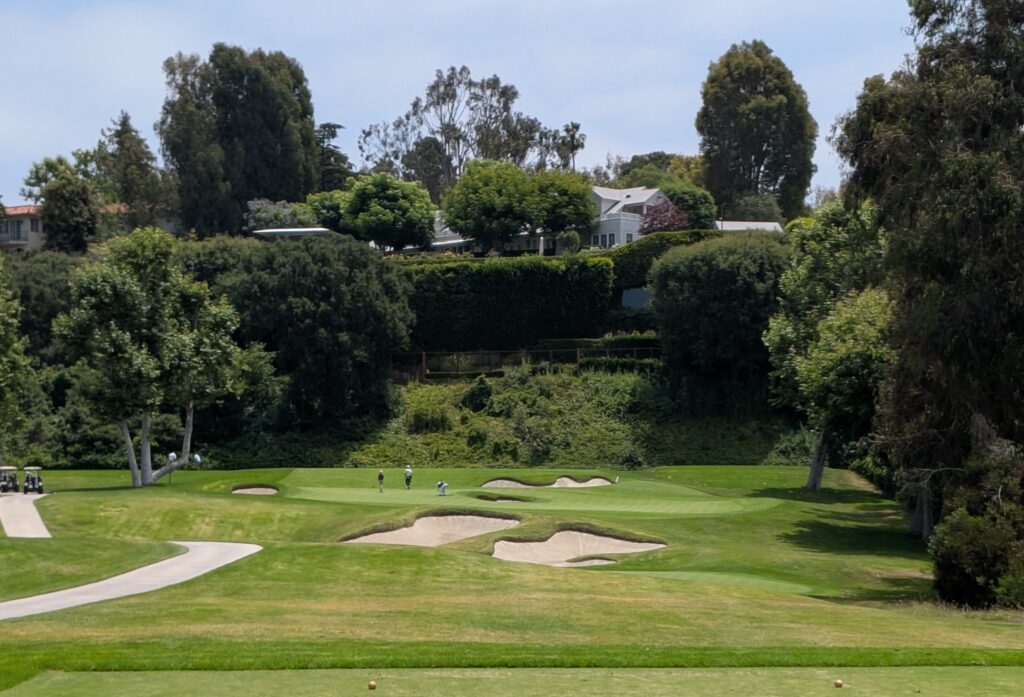
The same thing could be said about the sixth, one of the most famous par-3s in the U.S. The sixth is a mid-length par-3 that is relatively flat. The sixth notoriously has a circular bunker right in the middle of the green. Take out the quirk of the bunker though, and it is still a fantastic hole, with pinnable locations on either side of the bunker, including a devilish back left tongue. But again, this hole reinforces the central theme of Riviera: a precise balance between difficulty and ease, penal and friendly, restraint and quirk.
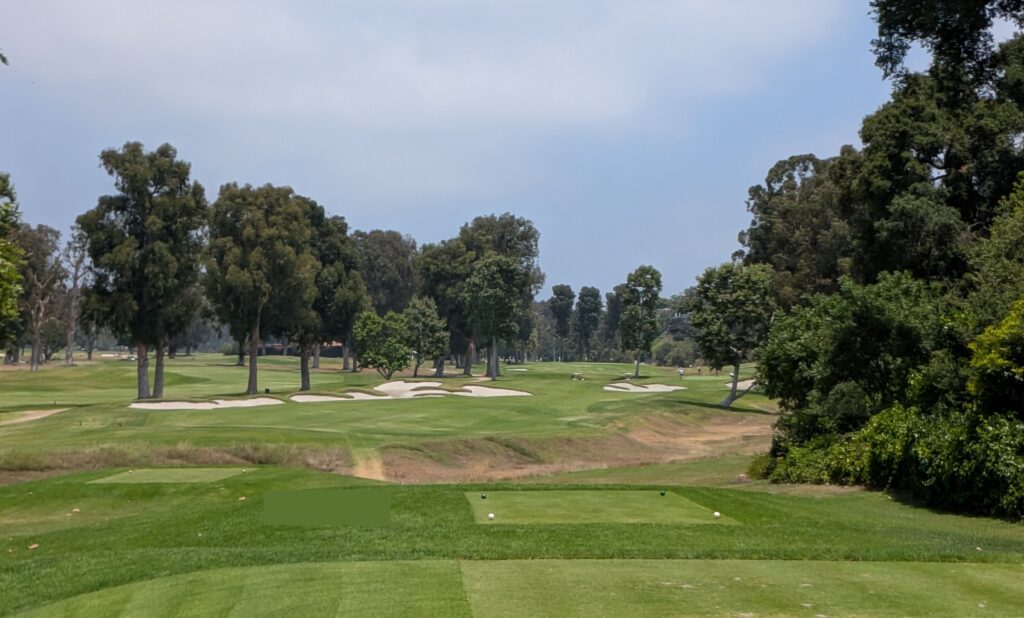
A short walk to the seventh tee reveals a mid-length option based par-4 with two distinct strategies. Most of the PGA Tour players take less than driver at the seventh, but it is a totally valid play to hit driver if that feels more comfortable.
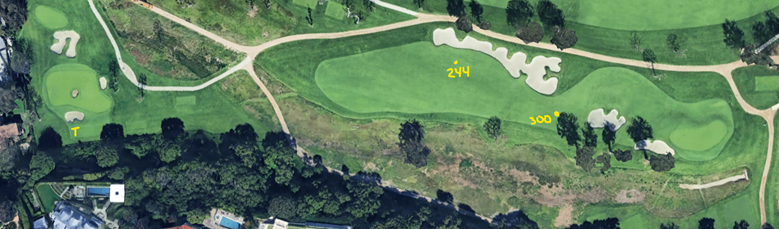
The area where driver would finish is significantly narrowed, but it has two significant advantages. First and most importantly, if successful, the approach would be played from a shorter distance and from a much better angle into the green. The green is canted ever so slightly from front right to back left, meaning that an approach shot is played into the length of the green. However, driver is a risky play as it is less than 30 yards between the bunker and rough, and exceptionally long hitters do have to worry about the cross bunker before the green.
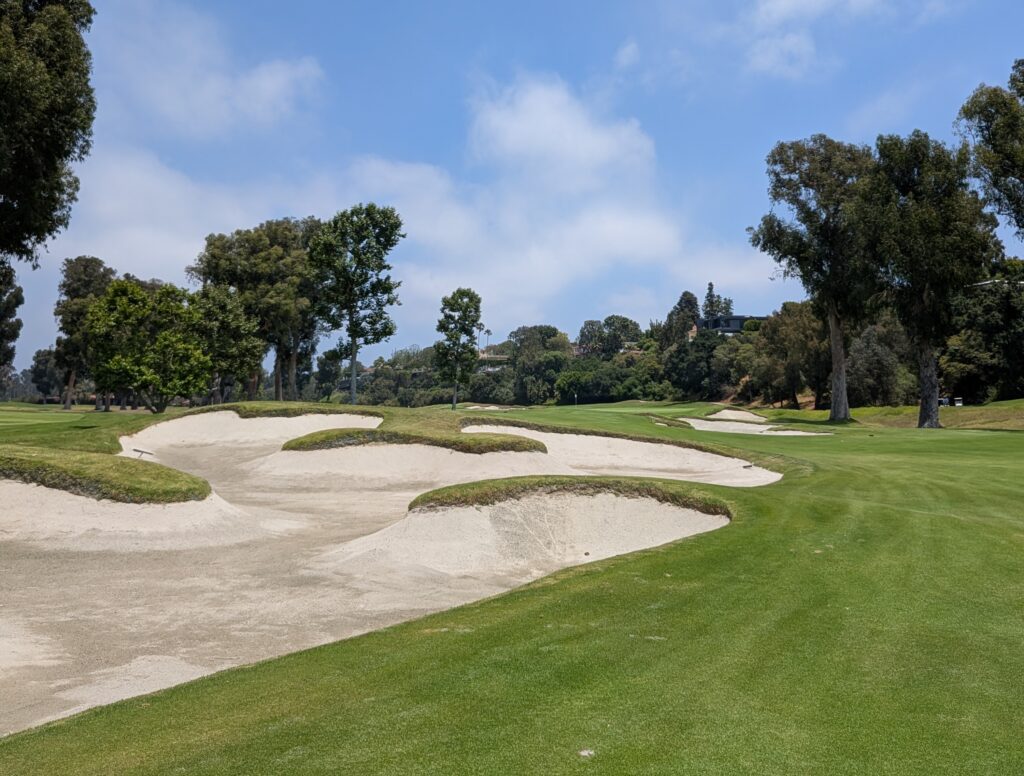
If a player wants to be more conservative, they can be. But they have to negotiate a worse angle on approach, playing into the width of the green rather than the length, and have to deal with the second disadvantage of laying up: the visual clutter of the deep fairway bunker. It is a bit hard to ascertain a good target from in front of the fairway bunker. The putting surface is rather complicated at the seventh as well. Let’s also not forget that both options have the risk of being pulled into the cavernous, but avoidable, fairway bunker that will be a bogey or worse for all but the most skilled players.
Again, the seventh is the perfect amount of everything but doesn’t do anything too much.
Lastly, the best hole at Riviera in my opinion is the par-4 eighth, which is no surprise if you are familiar with my writing, because there are so many ways to play the hole. I love holes that present a number of different reasonable ways to interpret and play the hole. The eighth is a mid-length par-4 features a barranca that bisects the hole into left and right, with a fairway and set of fairway bunkers on either side.
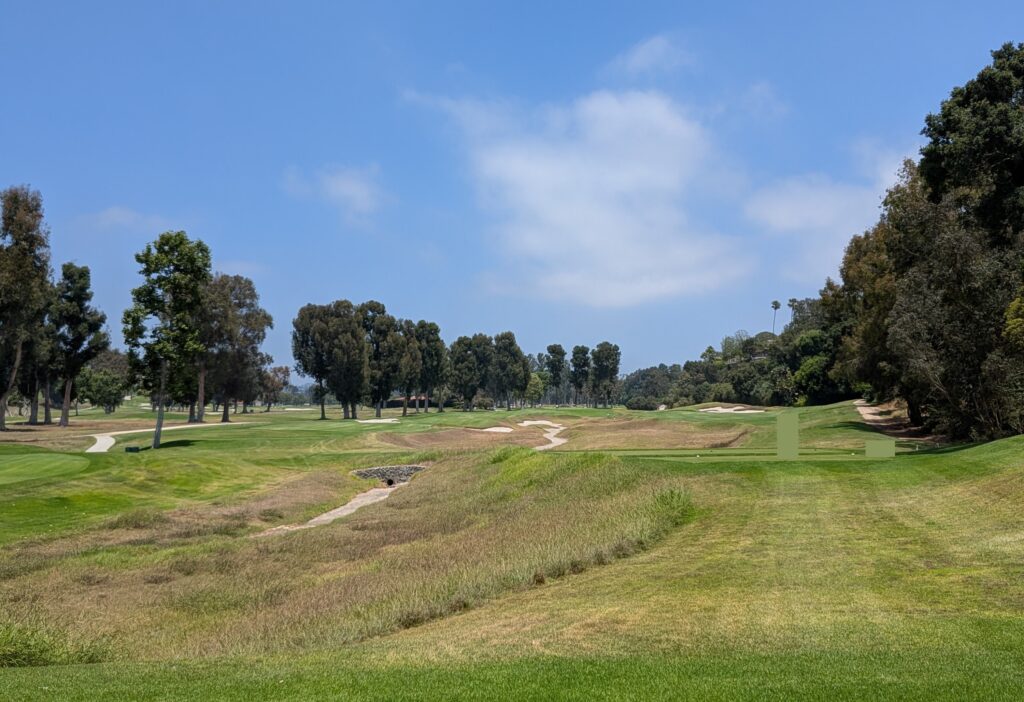
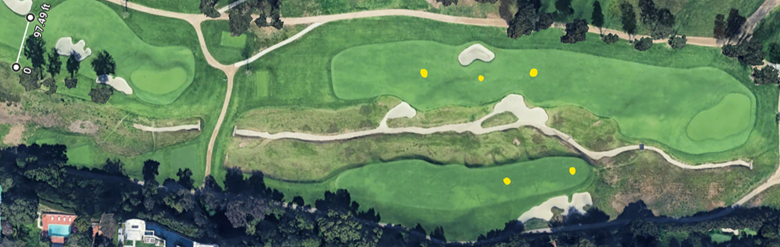
I have put a yellow dot in each place I think you could reasonably place a tee shot. Where you do not want to place your tee shot is IN the barranca, and both sides are actually a bit narrow for driver, which means in the barranca is a legitimate risk. I also love that neither side is significantly shorter, with the left side perhaps a yard or two longer depending on the angle.
The complexity is mostly on the tee shot at the eighth, but the second shot is very deceiving. It would appear there is ample room to miss on approach because there are no greenside bunkers surrounding the green, but the entire right side of the green is a steep drop off into the barranca (or kikuyu on the way down).
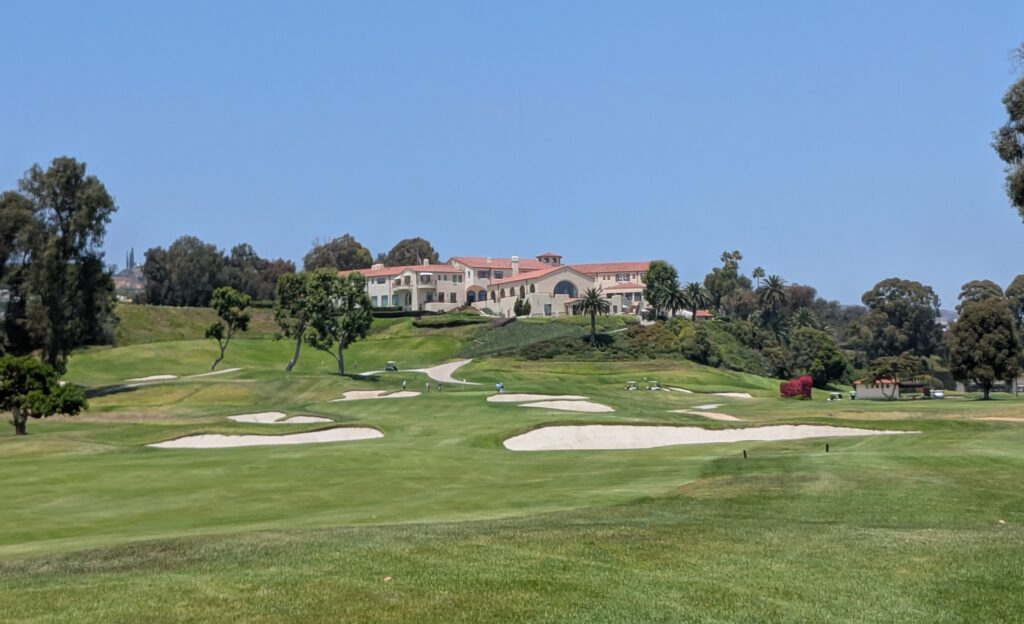
This stretch of golf is representative of what makes Riviera great: a perfect balance of complexity and quirk while still being approachable and fair. These holes are a great test of golf without being unfair, which is probably why Riviera was voted as the favorite by PGA Tour pros.
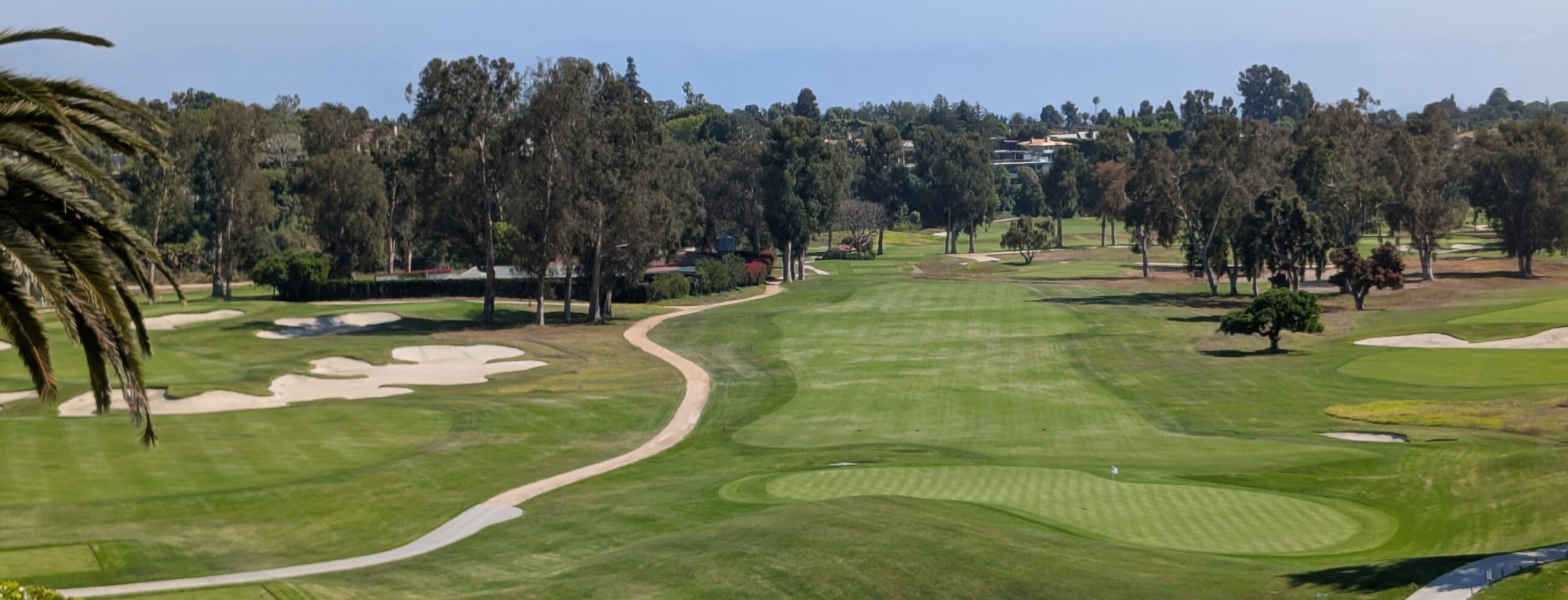
The ninth hole begins an uphill, but beautiful ascent back towards the clubhouse. All in all, on the front nine, you’ve played in six unique directions (E, W, SW, SE, NE, and N) making the routing an absolute masterclass in wind management.
Making the Turn
The tenth hole at Riviera, the short par-4, may be one of the most covered holes in golf. For that reason, I’ll limit the discussion and leave it to the experts, but Golf Digest and The Fried Egg have both put out informative content on how the tenth hole has evolved and how the strategy of the hole will continue to evolve (TLDR: hit driver). I will only comment that it was a beautiful hole, a bit flatter than I had imagined in my mind, and the green is as narrow as advertised.
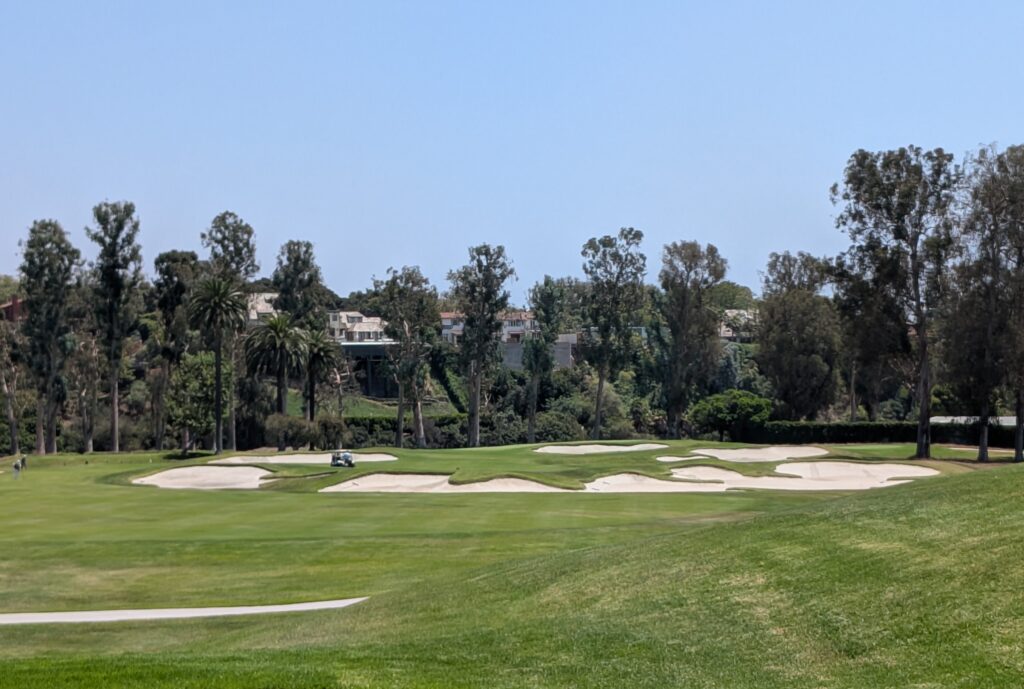
The eleventh is a fun par-5 that is long but somewhat scorable that negotiates the barranca as it turns a 45-degree turn through the fairway of the eleventh. This brings us back to the area of the course I want to cover in detail: the area by the barranca. The twelfth hole returns to the southeastern boundary of the property, which is the same property line that the seventh and eighth reside.
The twelfth is a mid-length par-4 (it can play excessively long from the very back tee box) with an ever-so-slight turn to the right. The tee shot is played into a fairway with no fairway bunkers, and the approach crosses the barranca in what is one of the most aesthetic approaches on the course. Here, Thomas uses restraint not to overcomplicate the hole and provides a postcard worthy approach to the green. A single lone tree (Bogey’s Tree) sits right beside the green, just to the left of the putting surface, for just a touch of quirk. Its overhanging branches can clip approaches coming in from the left rough.
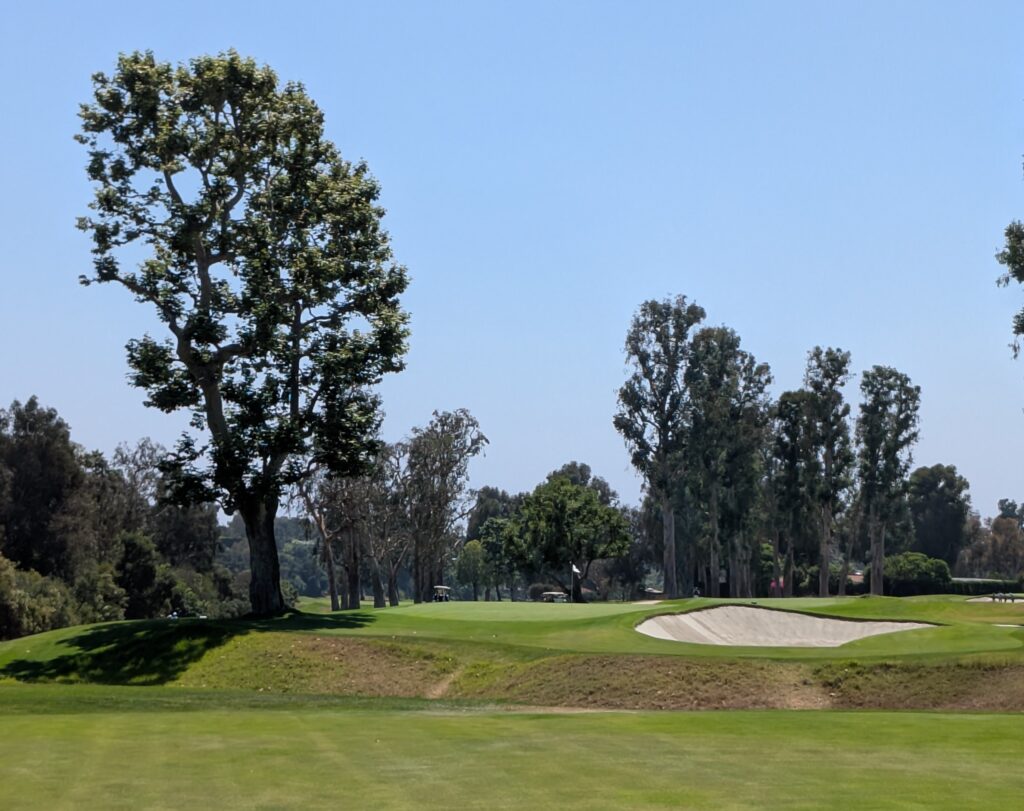
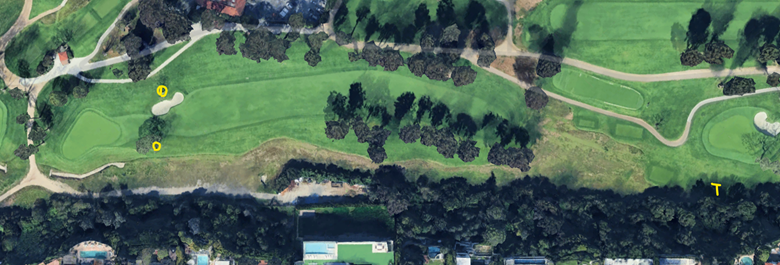
The thirteenth is the last hole bordering the barranca, and perhaps the only hole at Riviera where I have real criticism to offer. The thirteenth is a long par-4 that forces a draw from the tee due to the presence of trees closely lining the fairway both left and right. The thirteenth feels out of place, but not because it’s difficult, but because its difficulty is achieved in two ways Riviera otherwise avoids.
First, the hole doesn’t fit the character of Riviera. These trees, particularly on the left that block the barranca, sit too close to the fairway. No other hole at Riviera relies on an artificially narrow, tree-lined chute on both sides of the tee shot. Perhaps the eleventh does so to a degree, and a few holes tighten one side of the fairway (the fifth and fifteenth, mainly), but the thirteenth demands you play through a corridor that feels more like Sahalee than Riviera.
Second, the hole requires a draw, which (again) the modern player hates to do with a driver. But, if a player backs down to a fairway metal, this leaves a very long approach between the two trees short of the green.
I think I would design the thirteenth more like this:
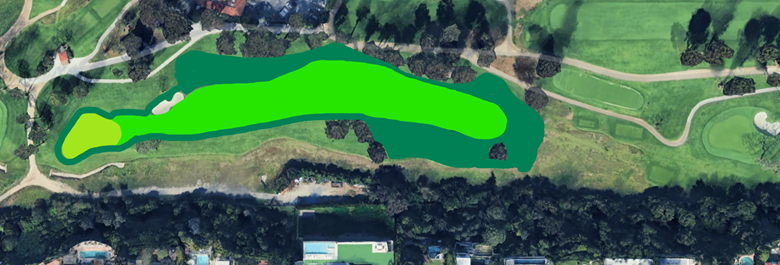
What I have done is thinned the trees on the left, leaving a single tree or two to accomplish the same objective but provide some options. Also on the right side of the fairway, I have widened the fairway, to allow more area in which to play a straight tee shot from the tee. I think these small changes would make the hole match the character of the rest of Riviera.
Alternatively, as a radical redesign, I also like the idea of removing all of the trees, and having the fairway play along the line of the barranca, like the seventh and eighth.
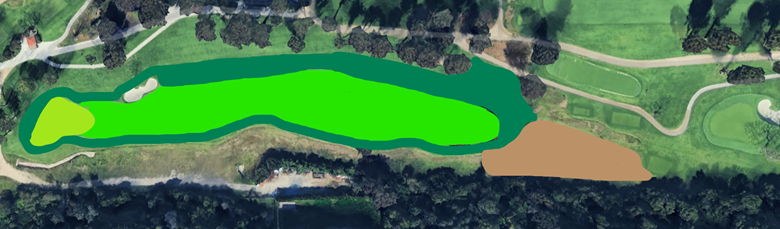
This exactly matches the character of the seventh and eighth holes and would be a better hole, but also, a much easier hole, due to the significant widening of the playing corridor.

The rest of the course is a joy to play, including the long par-4 fourteenth and very difficult and often discussed long par-4 fifteenth. The fifteenth is often remembered for Viktor Hovland intentionally playing down the seventeenth fairway for an easier drive. That strategy has been stunted by the club’s installation of a new tree.
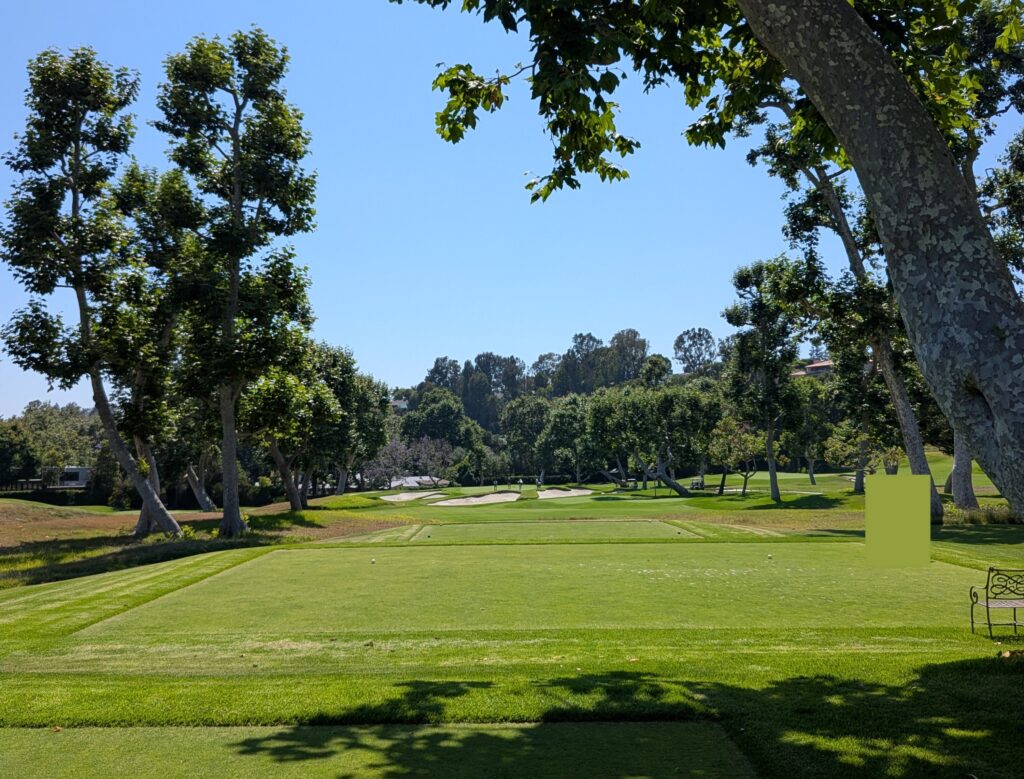
I loved the par-3 sixteenth hole, which is a mid-length hole that has a very small green and deep, cavernous bunkers. Albeit one of the harder holes on the course, I still found the hole to be fair and made par out of the greenside bunkers. But the excessively small green adds a bit of quirk without being so difficult as to seriously derail a decent round.
The seventeenth turns and begins the march back to the clubhouse as a long par-5, and then the eighteenth is obviously a very famous hole as well that has been well documented as a fantastic finishing hole.
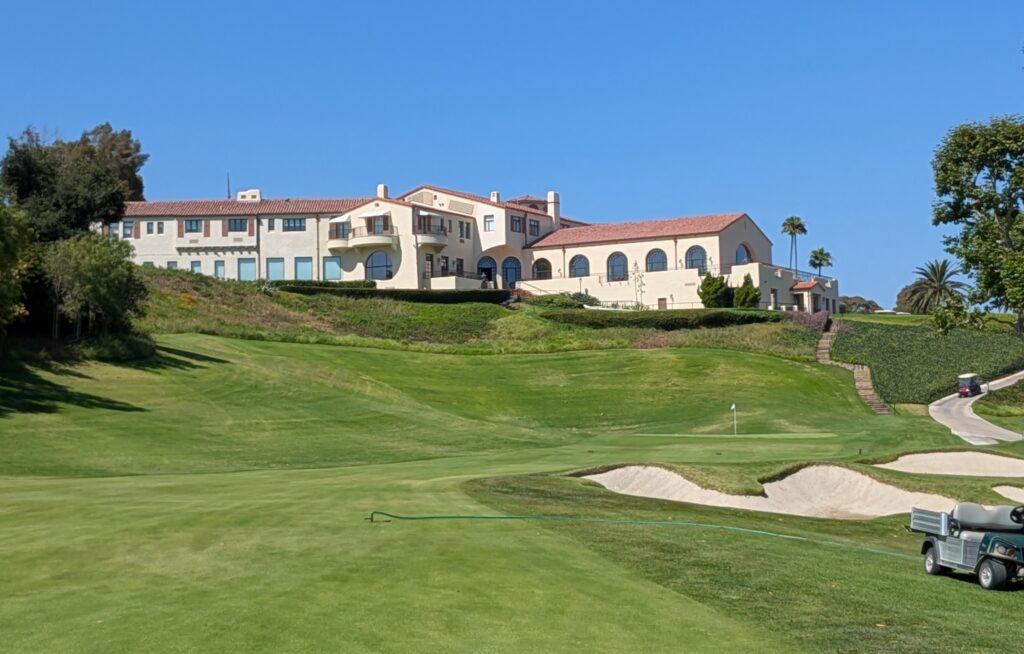
I must admit, I’m not sure that I agree that the actual golf at the eighteenth is particularly great, but the view is fantastic from the eighteenth fairway, but I will let others debate the merits of the eighteenth hole.
Final Thoughts
Riviera forces you to think about what you value in a golf course; what makes a golf course great, anyways? Is it breathtaking views? Is it tight margins for error and difficulty? Does the course need to call for exacting shot shaping and hitting it in all nine proverbial windows?
The answer is actually, no and yes. It needs all of that. And it needs all of it in moderation. It needs the right amount of difficulty, and the right amount of quirk, the right amount of views. A course dominated by quirks may feel gimmicky and forced. A course dominated by difficulty may leave a golfer feeling beat down on most rounds. A course that sacrifices the quality of the golf holes for the best views may test your camera phone more than your golf game.
Riviera is one of the few courses in the world that, in my opinion, gets the blend of those important elements right. It is far from perfect. But it has the perfect blend of character, distinctiveness, challenge, quirk, options, shotmaking, and opportunity that makes it stand out in my mind as conclusively one of the best golf courses in the U.S.
This time, the course-ranking-list-cynics are wrong.
CR&J Final Rating:
Shot Options: 8
Challenge: 8
Layout Variety: 10
Distinctiveness: 10
Aesthetics: 8
Conditioning: 9
Character: 10
Fun: 11
Total: 74/80
Read More: How We Rate Courses
Rating Scale Details:
> 70: Top-50 U.S.
65-70: Top-200 U.S.,
60-65: Best-in-State List
57-60: Best-in-state List Contender
53-57: Very Good
48-53: Good
40-48: Average
< 40: Poor

Author: Jaxon MacGeorge
Jaxon is the founder and lead course reviewer at The Course Review & Journal. Jaxon has been playing golf for over twenty years, is a scratch handicap, and actively competes in USGA and Tennessee Golf Association amateur events. By trade, Jaxon is an attorney and lives in Gallatin, TN, a suburb of Nashville.

Leave a Reply to VintageGolf Cancel reply