

The Journal is where CR&J captures the breadth of our golf experience; courses played, places traveled, and ideas that don’t always warrant a full architectural review. Not every course demands 4,000 words, but many still deserve to be seen, rated, and contextualized. The Journal allows us to build a meaningful ratings record, explore regional golf, and document how courses fit into the larger landscape of the game. In each Journal entry, we will try to provide short-form ratings for three to five courses in the same general geographic area.
Read: How We Rate Courses
Courses Reviewed in this Journal:
(Clink Link to Jump to Review)
Course Review: The Olde Farm
CR&J’s Final Rating: 68/80 (Top 200 U.S.)
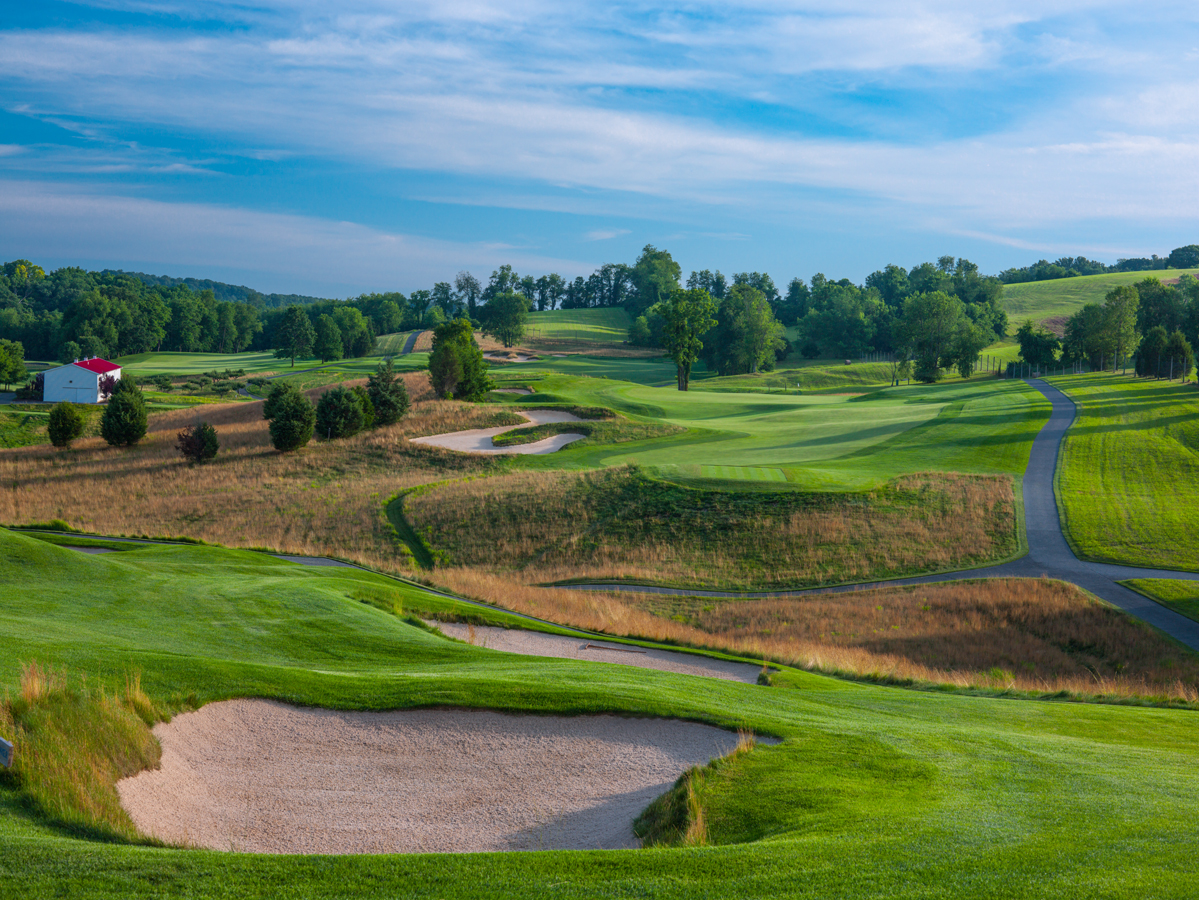
The Olde Farm probably deserves a full-length feature, but unfortunately, it has been several years since I last visited the Olde Farm. The Olde Farm is very private and membership is limited, making accessing the course very difficult outside of specific social circles. If you are lucky enough to come across an invite to play, The Olde Farm is undeniably a special place. Currently, The Olde Farm is ranked by Golf Digest as the #103 course in the U.S., and #2 in Virginia, with the other ranking services generally agreeing. The property is ordained by a number of special “barn” venues that serve as comfort stations and dining venues, in the coolest possible way.
The course’s owner and founder Jim McGlothlin (former CEO of United Coal), who owned the only home with a connection to the golf course, recently passed away. It remains to be seen what, if any, effect that has on the future of The Olde Farm. Should I ever regain access or get another invite again in the future, expect a full long-form feature.
What Works: The Olde Farm is characterized by three main positives: (1) elite conditioning, (2) wide fairways, (3) tricky putting surfaces. First, as of my last visit years ago, The Olde Farm set the standard in course conditioning. I remember talking to someone who had visited The Olde Farm shortly after attending the Masters. I asked them “how did the course conditioning compare” to which they responded “the same.” As for the actual golf, The Olde Farm is not a difficult golf course, but it certainly has some challenging holes. However, most of the fairways are very wide with limited tree trouble. Most of the way-off-line-hazards are tall grass rather than trees. The main defense of the course is typically a set of very fast, very undulating putting surfaces with deep grass faced bunkers surrounding the greens. Bobby Weed did some of his best work at The Olde Farm and designed some truly unique holes that present a TON of character and distinctiveness. Some of the property has natural character (particularly the northern boundary of the property), but most of the character and genius of The Olde Farm was crafted by Weed on a otherwise uninspiring piece of farmland. The Olde Farm also has a delightful short course and one of the best practice facilities in Virginia.
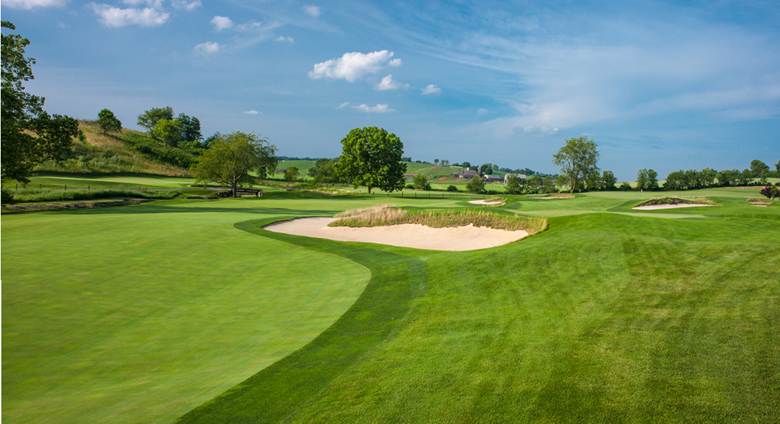
Best Hole: There is a ton of contenders for this title, and it is hard to pick just one, but my favorite holes often fall in the shorter to mid length, option/strategy variety of hole, and that’s the theme here as well. The par-4 eighth hole is a short drivable par-4 with a ton of different ways to play it.
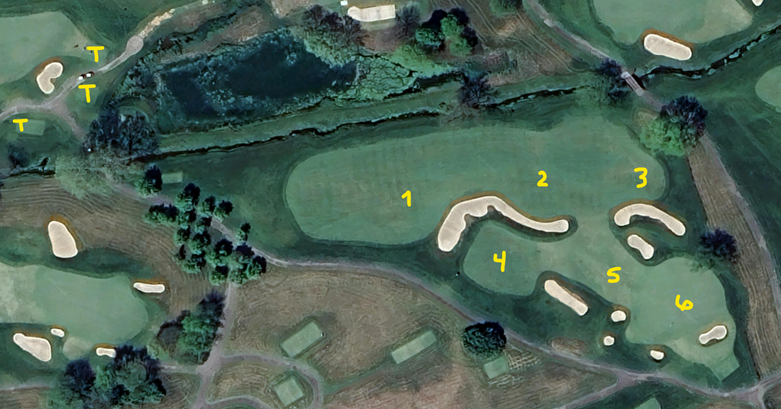
I’ve always seen six distinct ways to play this par-4, depending on where the tee box is located on a particular day. Laying up in front of the bunker at #1 leaves only 125-130 to the hole and each successive option brings more risk, but perhaps a better angle, depending on the pin position. Options 1, 2, and 3 in the fairway are actually significantly below the surface of the green, whereas 4 and 5 are more on the same level of the green. There is, perhaps, 10-15 feet of elevation between the lower fairway and the green surface, making the lower fairway just tricky enough to be discouraging. If you try to drive the green, it is less than 300-yards from the back tee so it is certainly possible, but a miss will likely leave you in one of those deep pot bunkers surrounding the green, which is slightly perched on top of the small hill.
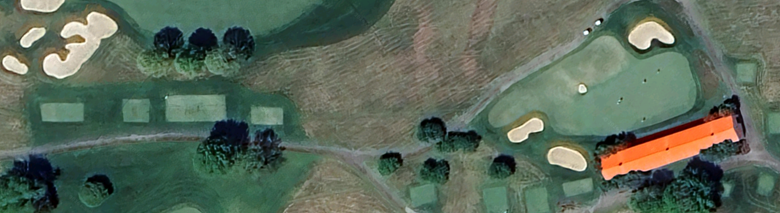
Interesting Hole: Probably the most photographed hole due to the uniqueness is the mid-length par-3 sixth hole, which is right beside the “long barn,” which is an amazing comfort station with tons of great drinks, snacks, and alcoholic beverages.
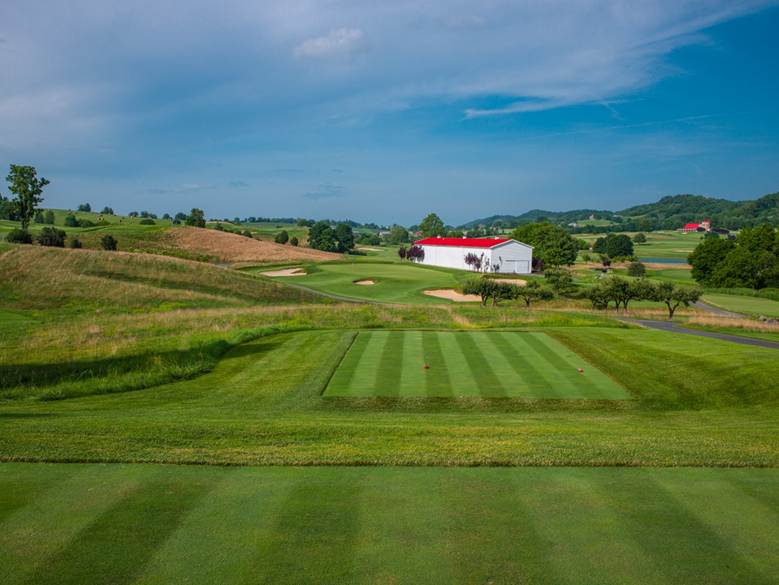
I’ve seen many slightly pushed fades be banked off the long barn and onto the green. That result is much preferable than the left miss, which will either leave you in a tightly mown area below the green, or in a deep, lion’s mouth bunker on the centerline. It might be the only hole in the Top 200 that allows you to bank a shot off of a metal barn to hit the green.
Limitations: It would be almost sacrilegious for me to say that The Olde Farm has many limitations, but it does. When comparing it to the elite company of the courses it is ranked near, it perhaps lacks a bit of aesthetic value, due do its setting in the Southwest Virginia farmland, without an abundance of natural features nearby, but for some small mountains in the distance. Additionally, the course is not a difficult course, and while it does present a stern test, particularly on the third and fourth holes (very difficult), the course is definitely a second-shot course, because the fairways here are probably a time and a half wider than normal, and three times wider than a “tight” course like Olympic Club or Sahalee. I reason because this course was built for Mr. McGlothlin, wider fairways were something he desired. Now, I say that as a reviewer and not personally – because personally, I love it. Fairways should be wide; it really fits my game! But to a professional golfer, the width of this golf course would allow a highly skilled golfer to hit a ton of drivers, hit a ton of wedges off the perfectly manicured grass, and make a ton of birdies.
Final Thoughts: The Olde Farm is a special place. Everyone I talk that has been there comments on just how special The Olde Farm is, and they always use that word: special. It is special, because there isn’t that much in the world of golf like it, making it a unique experience, particularly in this part of the US. I think it should rank into the bottom of the Top 100, and would rank it above similarly positioned courses like the Highland Course at Primland, Valhalla GC, Canyata, and Victoria National.
CR&J’s Final Rating: Shot Options: 9; Challenge: 6; Layout Variety: 9; Distinctiveness: 9; Aesthetics: 7; Conditioning: 10; Character: 9; Fun: 9. Total: 68/80 (Top 200 U.S.)
Course Review: Glenrochie Country Club
CR&J’s Final Rating: 50/80 (Good)
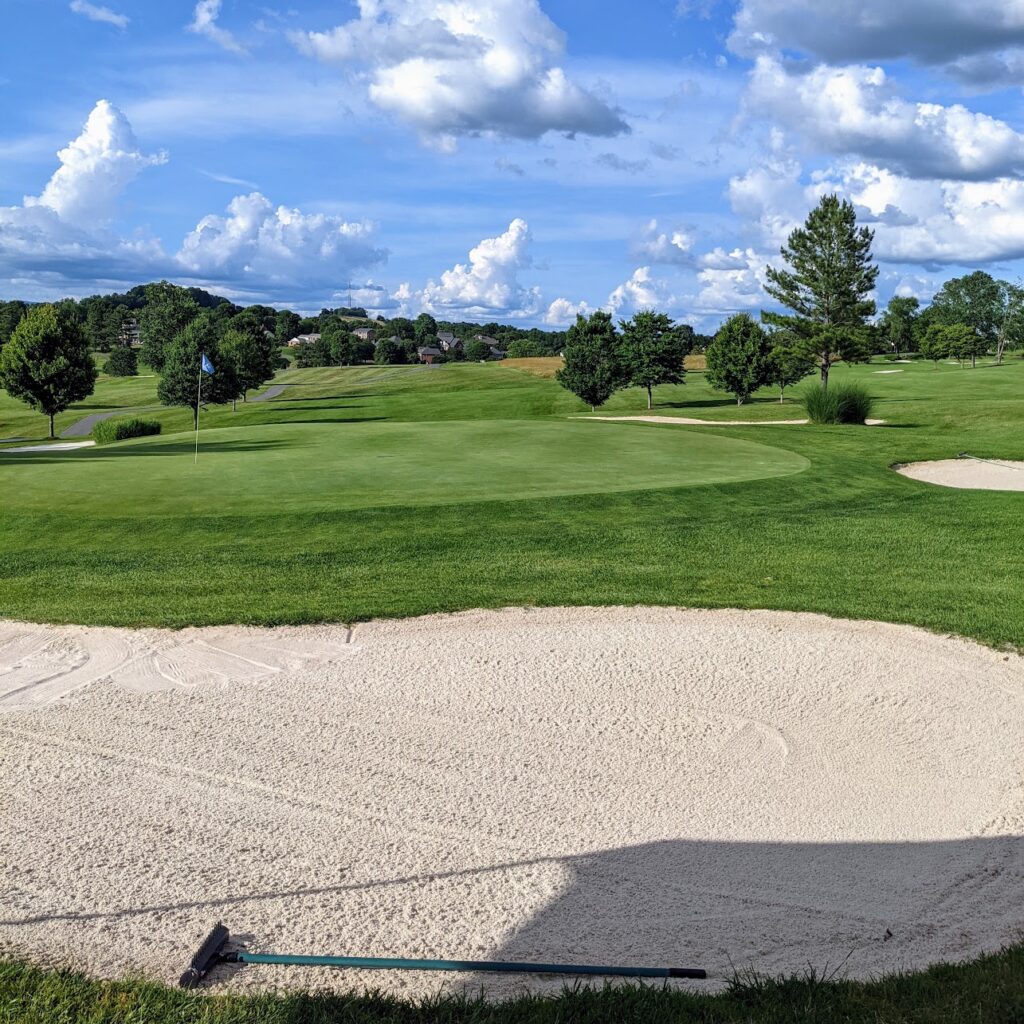
Glenrochie Country Club is set just about 15 minutes from The Olde Farm in Abingdon, VA. Glenrochie is Abingdon’s only private golf course, where the neighboring town of Bristol, VA has three. Glenrochie is a residential country club with a bit of a blue-collar vibe. My understanding is that the membership fees are not expensive, and as I understand it, Glenrochie may be the best deal in southwest Virginia. The course is actually two pretty distinct 9-hole courses. Glenrochie was originally build as a 9-hole course, and that original 9 is now the first hole and then the eleventh through eighteenth. The second through the tenth were added later as the club expanded. Accordingly, they actually have two distinct characters, with the older feeling more like an upscale municipal course, with tighter packed holes and homes only on the perimeter. The newer holes are undoubtedly more “residential country club” with some of the similar refrains and design elements you would expect from that type of course.
What Works: Glenrochie works because it gives you what you expect, and at the price point, perhaps more than you expect. Course conditions are consistently good to playable with nice greens that can sometimes run on the faster side. Glenrochie has a particularly severe set of greens, particularly on the older side, but it is clear that Dan Maples tried to be aggressive in his putting surface design on the newer side to try to match the character of the older side. When quick, this results in a challenging test of one’s short game. Off the tee, Glenrochie plays through wide corridors and the houses rarely, if ever, come into play. Glenrochie is not a long course, but and like The Olde Farm, gets most of its challenge through that really tough set of putting surfaces (slower than The Olde Farm on average, but smaller with much more internal undulation). Glenrochie has a bit more natural scenery than most, being set at the base of a mountain.
Best Hole: One of my favorite holes in southwest Virginia is the thirteenth at Glenrochie, again a shorter par-4 that gently moves to the right the whole way, with a few options on how to play. I really love this hole because of its simplicity, which stands in contrast to the eighth at The Olde Farm. It shows that you don’t have to have six options and an elevation change to have a great hole.
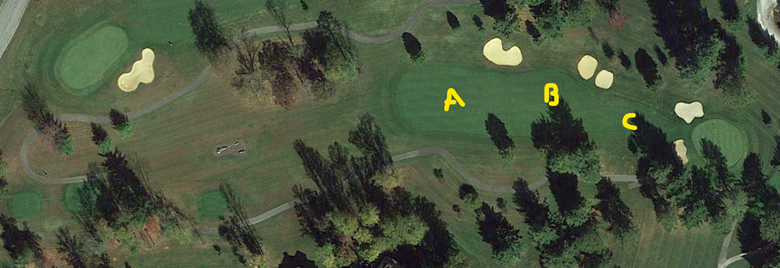
There are three distinct ways to play this hole, with a long iron off the tee into the front of the fairway, taking all the bunkers out of play and leaving 130-140 yards into the hole. Alternatively, a fairway metal in front of the pair of bunkers feels like the right play and often is, which leaves just a wedge into the hole. For aggressive players, particularly ones that move the tee ball to the right, a third option exists to try to run it up close to the green, but you have to feel pretty confident about moving the ball to the right around the trees. Anything right of the fairway for any of the three options is very dead and completely blocked out, so missing in the bunkers is preferable to a slight right miss.
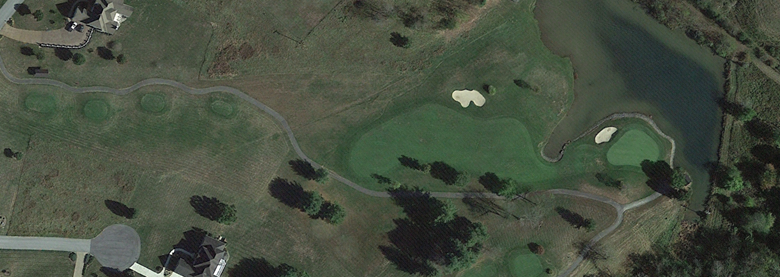
Interesting Hole: Another hole I really like is the mid-length par-4 sixth hole, which requires a layup off the tee generally, as the pond cuts in on the approach to the green, right about where a driver would stop from the back tees. However, just a wedge or short iron approach remains from the fairway. The trick to this hole is the severity of the green. A high point ridge bisects this green dividing it into front and back. If the pin is in the front, spin control is at a premium to avoid ripping it off the green. If the pin is in the back or middle, watch out, because if the greens are quick and your approach lands on the down slope, a very good approach shot can finish in the water. Landing a ball on the back of the green here is always very risky, and after you know this, back pins often lead to long, very fast lag putts. This is a hole on paper that should be scoreable, but generally, a par here is a good score.
Limitations: The limitations here seem to mostly be related to money. I think the underlying bones of this course are really quite something. I’ve always dreamed of buying this course and renovating/restoring it, because it could be a really good golf course with the right renovation. Conditioning is normally good but nowhere near top quality (in an area that is relatively temperate and easy to grow grass) probably due to a lack of funds and membership willing to pay higher fees for even better course conditions. Lastly, any future renovation needs to focus on making the character of two nines match even better, specifically making the back match the front a bit better. The weakest holes are fifteen and sixteen and badly need re-imagining.
Final Thoughts: Glenrochie delivers on its promises; modest but well-executed. Regardless, it makes for an enjoyable golf round and the club is certainly worth joining for golfers, considering the lack of other good golf options in the immediate area.
CR&J’s Final Rating: Shot Options: 6; Challenge: 6; Layout Variety: 7; Distinctiveness: 6; Aesthetics: 7; Conditioning: 6; Character: 5; Fun: 7. Total: 50/80 (Good)
Course Review: Draper Valley Golf Club
CR&J’s Final Rating: 46/80 (Average)
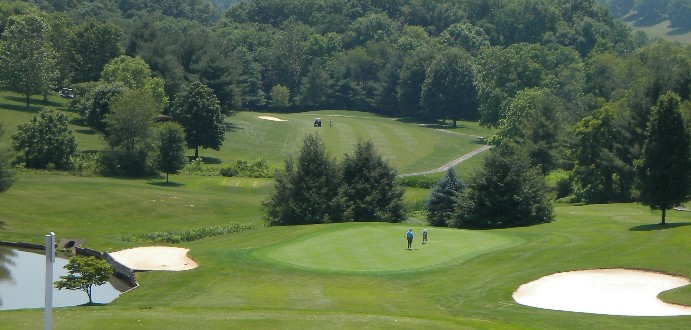
Rolling up I-81 about an hour from Abingdon, and just on the other side of Wytheville, VA, is Draper Valley Golf Club. Draper Valley is in a golf desert. The I-81 corridor between Abingdon and Radford, VA near Virginia Tech (about a 75-mile stretch) has, by my count, three 18-hole golf courses: Holston Hills, Wytheville Golf Club, and Draper Valley golf Club. Accordingly, you would be correct to have low expectations for Draper Valley. But somehow conversely, it is a bit of a hidden gem. I’ve written how I think that term is overused and actually just means a decent golf course in the middle of nowhere, and applied to Draper Valley, that’s exactly what it means. I found Draper to have good conditioning, interesting holes, and a fun routing, and it definitely felt like I was in the middle of nowhere in Draper, VA.
What Works: Set at the base of a mountain ridge in the Blue Ridge mountains, it also had a nice, natural scenery. I wouldn’t expect Draper to blow the Top-200 golfer away, but it is clear from the first few holes that Draper Valley is more than you’d expect from a golf course in this area. Conditioning was similar, if maybe slightly below Glenrochie, but still perfectly playable without any concerns. For those that care, Draper Valley has no homes on the interior of the course, just a few dotting the edges of certain holes, which does help create a cohesion and favorable Parkland style routing, rather than a “nature walk” or neighborhood alley.
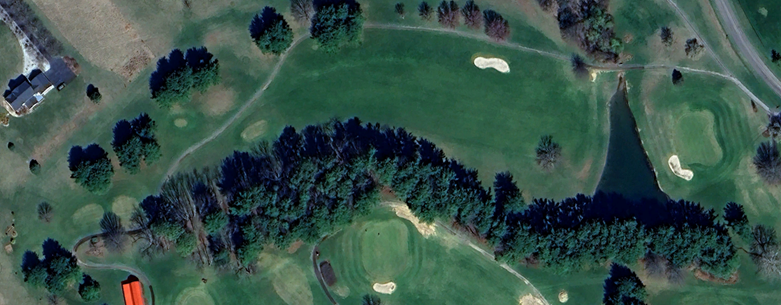
Best Hole: My favorite hole was probably the mid-length dogleg right par-4 that played to a green set on the other side of a small, intruding lake. What you see is what you get here, but the view from the fairway is nice, and the only real hazard to avoid other than the lake is the fairway bunker.
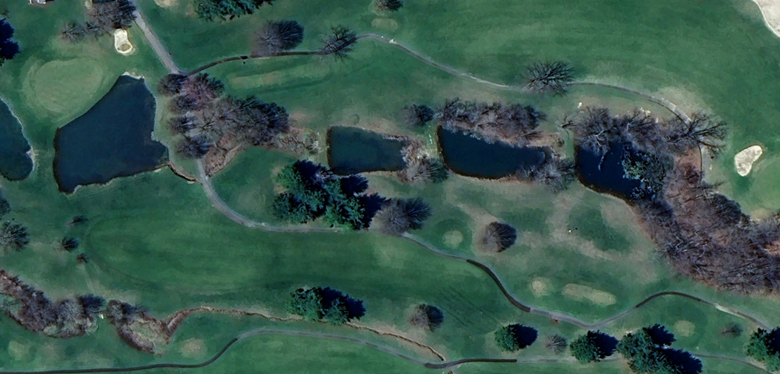
Interesting Hole: The eighteenth hole is an interesting 90-degree dogleg right that plays into a straight fairway, where pretty much any length of tee shot will work, and then plays directly over a small lake that protects the entire front of the eighteenth green. This hole is both scenic, with a small house behind the green, but also means that matches that come down the eighteenth have plenty of suspense, with the final shot being a tricky wedge or short iron over the water hazard.
Limitations: Draper Valley is a solid golf course, but its limitations are the same as many around it. It wouldn’t make a ton of business sense for them to increase the quality of the course and charge $125/round for public play. It does not exist in an area where that business strategy would work. However, it is a really solid local golf course built primarily for local play, and from a raters perspective, that is its limitation to becoming a better or more highly ranked golf course. However, Draper Valley fits its objective quite well, balancing affordability and course quality.
Final Thoughts: If you find yourself driving down I-81 in Southwest Virginia, Draper Valley is an great spot for some golf, and should have limited regional intrigue to come play the course if you live within an hour or two. This course exceeded my expectations in a major way, but admittedly, my expectations for high quality golf in Draper, VA were very low.
CR&J’s Final Rating: Shot Options: 6; Challenge: 6; Layout Variety: 6; Distinctiveness: 4; Aesthetics: 6; Conditioning: 6; Character: 5; Fun: 7. Total: 46/80 (Average)

Author: Jaxon MacGeorge
Jaxon is the founder and lead course reviewer at The Course Review & Journal. Jaxon has been playing golf for over twenty years, is a scratch handicap, and actively competes in USGA and Tennessee Golf Association amateur events. By trade, Jaxon is an attorney and lives in Gallatin, TN, a suburb of Nashville.

Leave a Reply to RidgeRunner Cancel reply